



 Chat with AI
Exam 6: The Skeletal System

Exam 1: An Introduction to Anatomy and Physiology90 Questions
Exam 2: The Chemical Level of Organization105 Questions
Exam 3: Cell Structure and Function126 Questions
Exam 4: The Tissue Level of Organization88 Questions
Exam 5: The Integumentary System103 Questions
Exam 6: The Skeletal System218 Questions
Exam 7: The Muscular System115 Questions
Exam 8: The Nervous System149 Questions
Exam 9: The General and Special Senses118 Questions
Exam 10: The Endocrine System100 Questions
Exam 11: The Cardiovascular System: Blood84 Questions
Exam 12: The Cardiovascular System: the Heart115 Questions
Exam 13: The Cardiovascular System: Blood Vessels and Circulation121 Questions
Exam 14: The Lymphatic System and Immunity105 Questions
Exam 15: The Respiratory System101 Questions
Exam 16: The Digestive System129 Questions
Exam 17: Metabolism and Energetics77 Questions
Exam 18: The Urinary System114 Questions
Exam 19: The Reproductive System118 Questions
Exam 20: Development and Inheritance97 Questions
Select questions type


The smooth, rounded, or oval articular process of a bone is termed a
(Multiple Choice)
5.0/5  (76)
(76) Which facial bone articulates with the frontal bone and the maxilla to complete the lateral wall of the orbit?
(Multiple Choice)
4.8/5 (70)
(70) 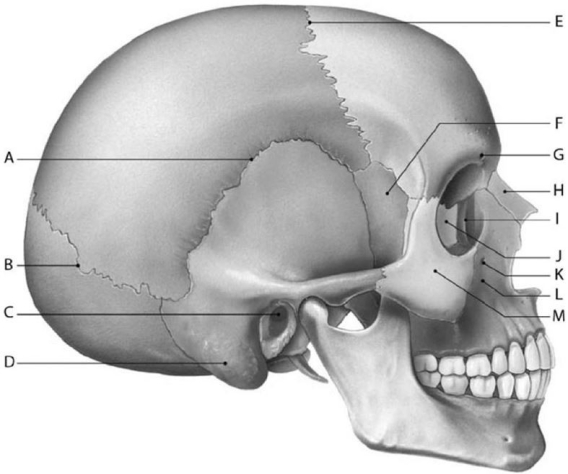 Figure 6-2 Adult Skull (Lateral View)
Use Figure 6-2 to identify the labeled part.
-Structure B is the joint between the ________ and ________ bones.
Figure 6-2 Adult Skull (Lateral View)
Use Figure 6-2 to identify the labeled part.
-Structure B is the joint between the ________ and ________ bones. (Multiple Choice)
5.0/5 (74)
(74) 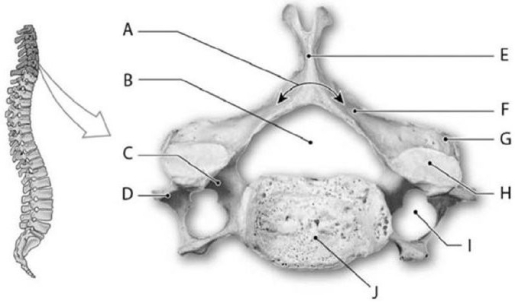 Photo Credit: Ralph T. Hutchings
Figure 6-3 A Cervical Vertebra (Superior View)
Use Figure 6-3 to identify the labeled part.
-Structure F is the
Photo Credit: Ralph T. Hutchings
Figure 6-3 A Cervical Vertebra (Superior View)
Use Figure 6-3 to identify the labeled part.
-Structure F is the (Multiple Choice)
4.9/5 (87)
(87) Which of the following primary functions of the skeletal system applies to the role of red bone marrow?
(Multiple Choice)
4.8/5 (94)
(94) What is the function of the tibial and fibular collateral ligaments?
(Multiple Choice)
4.8/5 (74)
(74) The paired ________ form(s) the lateral walls of the nasal cavity, and function(s) in slowing airflow and deflecting inhaled air toward the olfactory receptors.
(Multiple Choice)
4.9/5 (68)
(68) Figure 6-2 Adult Skull (Lateral View)
Use Figure 6-2 to identify the labeled part.
-Structure D is the
Figure 6-2 Adult Skull (Lateral View)
Use Figure 6-2 to identify the labeled part.
-Structure D is the (Multiple Choice)
4.9/5 (91)
(91) You and your twin sister, both 18 years of age, were in a car accident. She had a clean break across the humerus and the upper arm bone-no bleeding, no break in the skin. However, you have a very messy break of the distal tibia in the lower leg, requiring pins to be inserted. Which statement is true regarding the differences in your break and your sister's break?
(Multiple Choice)
4.7/5 (75)
(75) Photo Credit: Ralph T. Hutchings
Figure 6-3 A Cervical Vertebra (Superior View)
Use Figure 6-3 to identify the labeled part.
-Structure E is the
Photo Credit: Ralph T. Hutchings
Figure 6-3 A Cervical Vertebra (Superior View)
Use Figure 6-3 to identify the labeled part.
-Structure E is the (Multiple Choice)
4.8/5 (80)
(80) Which of the following accounts for almost two-thirds of the mass of bone tissue?
(Multiple Choice)
4.9/5 (80)
(80) A joint that permits no movement and is described as an interposition of cartilage plates is called a
(Multiple Choice)
4.8/5 (88)
(88) Near the external auditory meatus, the long, sharp process called the ________ process is an attachment site for ligaments that support the hyoid bone.
(Multiple Choice)
4.7/5 (76)
(76) Which type of synovial joint is described as an oval articular face nestling within a depression on the opposing surface?
(Multiple Choice)
4.8/5 (88)
(88) The structure that surrounds a diarthrotic joint is called a(n)
(Multiple Choice)
4.8/5 (71)
(71) 
Filters
- Essay(0)
- Multiple Choice(0)
- Short Answer(0)
- True False(0)
- Matching(0)