



 Chat with AI
Exam 1: The Human Body: an Orientation

Exam 1: The Human Body: an Orientation110 Questions
Exam 2: Cells: the Living Units108 Questions
Exam 3: Basic Embryology112 Questions
Exam 4: Tissues110 Questions
Exam 5: The Integumentary System109 Questions
Exam 6: Bones and Skeletal Tissues108 Questions
Exam 7: Bones, Part 1: the Axial Skeleton110 Questions
Exam 8: Bones, Part 2: the Appendicular Skeleton113 Questions
Exam 9: Joints110 Questions
Exam 10: Skeletal Muscle Tissue110 Questions
Exam 11: Muscles of the Body160 Questions
Exam 12: Fundamentals of the Nervous System and Nervous Tissue112 Questions
Exam 13: The Central Nervous System109 Questions
Exam 14: The Peripheral Nervous System114 Questions
Exam 15: The Autonomic Nervous System and Visceral Sensory Neurons110 Questions
Exam 16: The Special Senses114 Questions
Exam 17: The Endocrine System115 Questions
Exam 18: Blood110 Questions
Exam 19: The Heart114 Questions
Exam 20: Blood Vessels113 Questions
Exam 21: The Lymphatic and Immune Systems115 Questions
Exam 22: The Respiratory System110 Questions
Exam 23: The Digestive System113 Questions
Exam 24: The Urinary System112 Questions
Exam 25: The Reproductive System116 Questions
Select questions type


In anatomical position, the palms of the hands face medially toward the thighs.
(True/False)
4.9/5  (82)
(82) Which organ system keeps blood constantly supplied with oxygen, removes carbon dioxide, and contains many air tubes?
(Multiple Choice)
4.9/5 (90)
(90) Although transmission electron microscopy is usually used for high-magnification viewing, it is certainly possible to use it at low magnification as well. That is, one can produce similar micrographs of tissues taken by light microscopy and electron microscopy at the same magnification. Even at the same magnification, however, you can easily tell the two kinds of micrographs apart. How?
(Multiple Choice)
4.8/5 (88)
(88) A CT scan produces an image of a transverse section of the body.
(True/False)
4.9/5 (75)
(75) 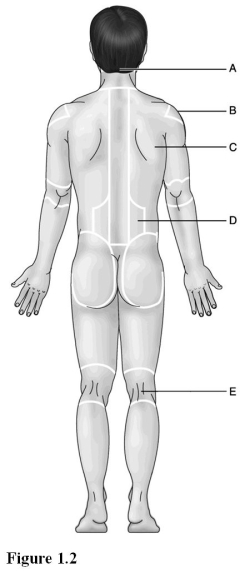 Use the diagram above to answer the following questions.
-Which letter indicates the scapular region?
Use the diagram above to answer the following questions.
-Which letter indicates the scapular region? (Multiple Choice)
4.9/5 (85)
(85) Use the diagram above to answer the following questions.
-Which letter indicates the popliteal region?
Use the diagram above to answer the following questions.
-Which letter indicates the popliteal region? (Multiple Choice)
4.8/5 (69)
(69) The dimensions of cells and organelles would best be described using which units of measurement?
(Multiple Choice)
4.8/5 (101)
(101) Pathological anatomy deals with structural changes caused by disease.
(True/False)
4.9/5 (83)
(83) Use the diagram above to answer the following questions.
-Which letter indicates the occipital region?
Use the diagram above to answer the following questions.
-Which letter indicates the occipital region? (Multiple Choice)
4.9/5 (89)
(89) Hormones are regulatory proteins that are secreted by the ________ system.
(Multiple Choice)
4.8/5 (84)
(84) 
Filters
- Essay(0)
- Multiple Choice(0)
- Short Answer(0)
- True False(0)
- Matching(0)