



 Chat with AI
Exam 6: Bones and Skeletal Tissues

Exam 1: The Human Body: an Orientation110 Questions
Exam 2: Cells: the Living Units108 Questions
Exam 3: Basic Embryology112 Questions
Exam 4: Tissues110 Questions
Exam 5: The Integumentary System109 Questions
Exam 6: Bones and Skeletal Tissues108 Questions
Exam 7: Bones, Part 1: the Axial Skeleton110 Questions
Exam 8: Bones, Part 2: the Appendicular Skeleton113 Questions
Exam 9: Joints110 Questions
Exam 10: Skeletal Muscle Tissue110 Questions
Exam 11: Muscles of the Body160 Questions
Exam 12: Fundamentals of the Nervous System and Nervous Tissue112 Questions
Exam 13: The Central Nervous System109 Questions
Exam 14: The Peripheral Nervous System114 Questions
Exam 15: The Autonomic Nervous System and Visceral Sensory Neurons110 Questions
Exam 16: The Special Senses114 Questions
Exam 17: The Endocrine System115 Questions
Exam 18: Blood110 Questions
Exam 19: The Heart114 Questions
Exam 20: Blood Vessels113 Questions
Exam 21: The Lymphatic and Immune Systems115 Questions
Exam 22: The Respiratory System110 Questions
Exam 23: The Digestive System113 Questions
Exam 24: The Urinary System112 Questions
Exam 25: The Reproductive System116 Questions
Select questions type


The perichondrium surrounding cartilage is composed of ________ connective tissue.
(Short Answer)
4.8/5  (80)
(80) 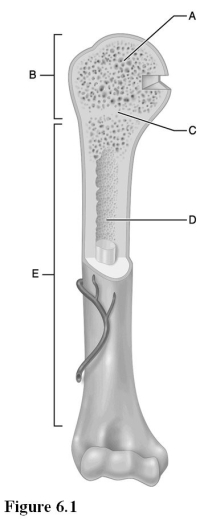 Use the diagram above to answer the following questions.
-Which letter indicates the remnant of what was once, in a growing juvenile, the epiphyseal plate?
Use the diagram above to answer the following questions.
-Which letter indicates the remnant of what was once, in a growing juvenile, the epiphyseal plate? (Multiple Choice)
4.8/5 (95)
(95) Osteocytes, residing within lacunae, are connected via canaliculi.
(True/False)
4.8/5 (83)
(83) If a long bone is fractured midshaft, which region of the bone has been damaged?
(Multiple Choice)
4.9/5 (71)
(71) Epiphyseal plates typically close at the time an infant learns to walk.
(True/False)
4.9/5 (92)
(92) The only bone inferior to the skull that develops via intramembranous ossification is the
(Multiple Choice)
4.9/5 (80)
(80) A tubercle is a very large, blunt process for muscle and ligament attachment.
(True/False)
4.9/5 (80)
(80) The bones of your hand and fingers would all be categorized as long bones.
(True/False)
4.9/5 (85)
(85) Use the diagram above to answer the following questions.
-Which letter indicates the diaphysis of a long bone?
Use the diagram above to answer the following questions.
-Which letter indicates the diaphysis of a long bone? (Multiple Choice)
4.8/5 (80)
(80) The type of cartilage that can withstand the strongest compression and tension forces is
(Multiple Choice)
4.8/5 (82)
(82) 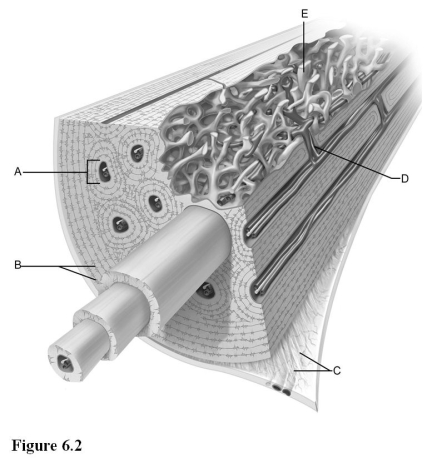 Use the diagram above to answer the following questions.
-Which letter indicates the space where microscopic blood vessels and nerves pass through the center of the osteon?
Use the diagram above to answer the following questions.
-Which letter indicates the space where microscopic blood vessels and nerves pass through the center of the osteon? (Multiple Choice)
4.7/5 (71)
(71) Which of the following is true regarding endochondral ossification?
(Multiple Choice)
4.9/5 (75)
(75) Which of the following cells is secreting cartilage matrix?
(Multiple Choice)
4.7/5 (74)
(74) Which of the following is not a function of the bony skeleton?
(Multiple Choice)
4.9/5 (86)
(86) Which of these is not a step in intramembranous ossification?
(Multiple Choice)
4.8/5 (72)
(72) All of the following are true regarding the functions of bones except
(Multiple Choice)
4.7/5 (91)
(91) In ________ growth, cartilage-forming cells from the perichondrium produce new cartilage tissue by actively secreting matrix.
(Short Answer)
4.8/5 (89)
(89) ________ canals lie perpendicular to the central, or Haversian, canals.
(Short Answer)
4.9/5 (92)
(92) 
Filters
- Essay(0)
- Multiple Choice(0)
- Short Answer(0)
- True False(0)
- Matching(0)