



 Chat with AI
Exam 10: Skeletal Muscle Tissue

Exam 1: The Human Body: an Orientation110 Questions
Exam 2: Cells: the Living Units108 Questions
Exam 3: Basic Embryology112 Questions
Exam 4: Tissues110 Questions
Exam 5: The Integumentary System109 Questions
Exam 6: Bones and Skeletal Tissues108 Questions
Exam 7: Bones, Part 1: the Axial Skeleton110 Questions
Exam 8: Bones, Part 2: the Appendicular Skeleton113 Questions
Exam 9: Joints110 Questions
Exam 10: Skeletal Muscle Tissue110 Questions
Exam 11: Muscles of the Body160 Questions
Exam 12: Fundamentals of the Nervous System and Nervous Tissue112 Questions
Exam 13: The Central Nervous System109 Questions
Exam 14: The Peripheral Nervous System114 Questions
Exam 15: The Autonomic Nervous System and Visceral Sensory Neurons110 Questions
Exam 16: The Special Senses114 Questions
Exam 17: The Endocrine System115 Questions
Exam 18: Blood110 Questions
Exam 19: The Heart114 Questions
Exam 20: Blood Vessels113 Questions
Exam 21: The Lymphatic and Immune Systems115 Questions
Exam 22: The Respiratory System110 Questions
Exam 23: The Digestive System113 Questions
Exam 24: The Urinary System112 Questions
Exam 25: The Reproductive System116 Questions
Select questions type


In muscular dystrophy, the protein dystrophin, which strengthens the sarcolemma by connecting the cytoskeleton with the extracellular matrix, is missing. What would be a consequence of these fibers lacking this important sarcolemma strengthening protein?
(Multiple Choice)
4.9/5  (83)
(83) Which of the following correctly defines a triad of the sarcomere?
(Multiple Choice)
4.9/5 (80)
(80) Muscle cells that produce ATP anaerobically via glycolysis are called ________.
(Short Answer)
4.9/5 (81)
(81) 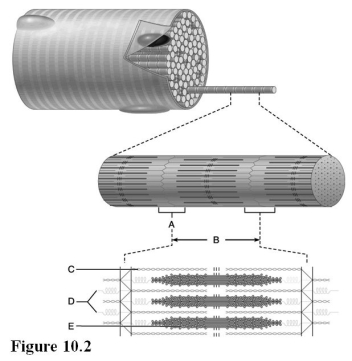 Use the diagram above to answer the following questions.
-Identify the letter that indicates the thick (myosin) filament.
Use the diagram above to answer the following questions.
-Identify the letter that indicates the thick (myosin) filament. (Multiple Choice)
5.0/5 (87)
(87) 
Filters
- Essay(0)
- Multiple Choice(0)
- Short Answer(0)
- True False(0)
- Matching(0)