



 Chat with AI
Exam 11: Muscles of the Body

Exam 1: The Human Body: an Orientation110 Questions
Exam 2: Cells: the Living Units108 Questions
Exam 3: Basic Embryology112 Questions
Exam 4: Tissues110 Questions
Exam 5: The Integumentary System109 Questions
Exam 6: Bones and Skeletal Tissues108 Questions
Exam 7: Bones, Part 1: the Axial Skeleton110 Questions
Exam 8: Bones, Part 2: the Appendicular Skeleton113 Questions
Exam 9: Joints110 Questions
Exam 10: Skeletal Muscle Tissue110 Questions
Exam 11: Muscles of the Body160 Questions
Exam 12: Fundamentals of the Nervous System and Nervous Tissue112 Questions
Exam 13: The Central Nervous System109 Questions
Exam 14: The Peripheral Nervous System114 Questions
Exam 15: The Autonomic Nervous System and Visceral Sensory Neurons110 Questions
Exam 16: The Special Senses114 Questions
Exam 17: The Endocrine System115 Questions
Exam 18: Blood110 Questions
Exam 19: The Heart114 Questions
Exam 20: Blood Vessels113 Questions
Exam 21: The Lymphatic and Immune Systems115 Questions
Exam 22: The Respiratory System110 Questions
Exam 23: The Digestive System113 Questions
Exam 24: The Urinary System112 Questions
Exam 25: The Reproductive System116 Questions
Select questions type


A horizontal line on the back used for locating the fourth lumbar vertebra.
(Multiple Choice)
4.8/5  (89)
(89) The muscle which raises the corners of the mouth into a smile is the ________.
(Short Answer)
4.9/5 (89)
(89) What muscles are important in mastication (excluding the muscles of the tongue)?
(Essay)
4.9/5 (82)
(82) Interestingly, some synergists may act by cancelling out some of the actions of a prime mover.
(True/False)
4.8/5 (67)
(67) Compare and contrast the function of the muscles contained in the anterior and posterior compartments of the upper and lower limbs. Explain the embryological reason for the differences.
(Essay)
4.8/5 (90)
(90) A lever system operating at a mechanical advantage can move a large load a short distance with a small amount of effort.
(True/False)
4.8/5 (83)
(83) The muscles in the anterior compartment of the arm are innervated by the ________ nerve.
(Multiple Choice)
4.8/5 (89)
(89) 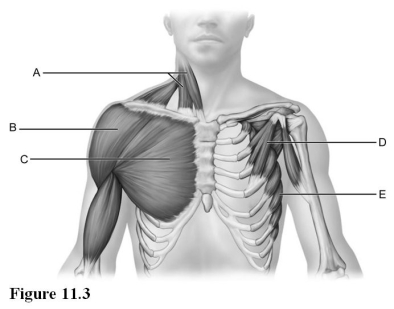 Use the diagram above to answer the following questions.
-Identify the letter that indicates the deltoid.
Use the diagram above to answer the following questions.
-Identify the letter that indicates the deltoid. (Multiple Choice)
4.8/5 (83)
(83) Intramuscular injections in adults are often given in this region to avoid the sciatic nerve.
(Multiple Choice)
4.8/5 (78)
(78) This arrangement of fascicles tends to provide the greatest range of motion (shortening distance), though not the greatest power.
(Multiple Choice)
4.8/5 (87)
(87) The extensor muscles of the upper limb lie almost exclusively in the ________ region of that limb.
(Multiple Choice)
4.8/5 (83)
(83) Shin splints result from damage to which muscle or muscle group?
(Multiple Choice)
4.8/5 (77)
(77) A prime mover for extension of the forearm at the elbow is the
(Multiple Choice)
4.9/5 (68)
(68) Use the diagram above to answer the following questions.
-Identify the letter that indicates the pectoralis minor.
Use the diagram above to answer the following questions.
-Identify the letter that indicates the pectoralis minor. (Multiple Choice)
4.9/5 (72)
(72) Visceral muscle differs in its embryonic origin from skeletal muscle because it is derived from
(Multiple Choice)
4.9/5 (88)
(88) The ________ is the longest muscle in the body, spanning two joints.
(Short Answer)
4.8/5 (82)
(82) Briefly describe the landmarks used in making a gluteal intramuscular injection.
(Essay)
4.8/5 (75)
(75) The elbow joint serves as a(n) ________ as the biceps brachii muscle flexes the forearm.
(Short Answer)
4.9/5 (94)
(94) The muscle fascicle arrangement of the orbicularis oris is best characterized as
(Multiple Choice)
4.7/5 (86)
(86) 
Filters
- Essay(0)
- Multiple Choice(0)
- Short Answer(0)
- True False(0)
- Matching(0)