



 Chat with AI
Exam 14: The Peripheral Nervous System

Exam 1: The Human Body: an Orientation110 Questions
Exam 2: Cells: the Living Units108 Questions
Exam 3: Basic Embryology112 Questions
Exam 4: Tissues110 Questions
Exam 5: The Integumentary System109 Questions
Exam 6: Bones and Skeletal Tissues108 Questions
Exam 7: Bones, Part 1: the Axial Skeleton110 Questions
Exam 8: Bones, Part 2: the Appendicular Skeleton113 Questions
Exam 9: Joints110 Questions
Exam 10: Skeletal Muscle Tissue110 Questions
Exam 11: Muscles of the Body160 Questions
Exam 12: Fundamentals of the Nervous System and Nervous Tissue112 Questions
Exam 13: The Central Nervous System109 Questions
Exam 14: The Peripheral Nervous System114 Questions
Exam 15: The Autonomic Nervous System and Visceral Sensory Neurons110 Questions
Exam 16: The Special Senses114 Questions
Exam 17: The Endocrine System115 Questions
Exam 18: Blood110 Questions
Exam 19: The Heart114 Questions
Exam 20: Blood Vessels113 Questions
Exam 21: The Lymphatic and Immune Systems115 Questions
Exam 22: The Respiratory System110 Questions
Exam 23: The Digestive System113 Questions
Exam 24: The Urinary System112 Questions
Exam 25: The Reproductive System116 Questions
Select questions type


Structures that pick up environmental changes from inside or outside of the body are called
(Multiple Choice)
4.8/5  (85)
(85) What is the only cranial nerve that has fibers that enter and leave the skull through different foramina? (Hint: It enters through the foramen magnum and leaves through the jugular foramen.)
(Multiple Choice)
4.8/5 (90)
(90) Which of these statements about intercostal nerves is true?
(Multiple Choice)
4.9/5 (83)
(83) All of the special senses, taste, smell, vision, hearing, and equilibrium, are part of the afferent division of the peripheral nervous system.
(True/False)
4.9/5 (92)
(92) An interoceptor receives information from receptors in the skin, such as temperature, pressure, and pain.
(True/False)
4.8/5 (90)
(90) The portion of the nervous system that does not include the brain and spinal cord is the ________ nervous system.
(Short Answer)
4.9/5 (76)
(76) The vagus nerve (CN X) is the only cranial nerve pair found inferior to the diaphragm.
(True/False)
4.9/5 (88)
(88) A person who cannot blink or smile could have damage to which cranial nerve?
(Multiple Choice)
4.8/5 (82)
(82) These sensory receptors are found not only on your tongue and nose, but also internally so your body can respond to changes in blood chemistry.
(Short Answer)
4.9/5 (71)
(71) Even though muscles and skin may move a long distance in development, they always keep their original nerve supply.
(True/False)
4.9/5 (88)
(88) Describe the ventral rami, the terminal branches and the pathway of the sciatic nerve.
(Essay)
4.9/5 (83)
(83) A nerve plexus is formed by interconnected dorsal and ventral rami of spinal nerves.
(True/False)
4.8/5 (100)
(100) Name the three divisions of the trigeminal nerve and the foramina through which they run.
(Essay)
4.9/5 (77)
(77) This term refers to clusters of peripheral cell bodies outside the CNS.
(Short Answer)
4.8/5 (82)
(82) Which cranial nerve pair is comprised of ventral rootlets from C1-C5?
(Multiple Choice)
4.9/5 (78)
(78) 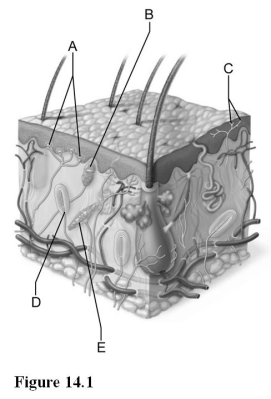 Use the diagram above to answer the following questions.
-Which letter indicates a tactile corpuscle (Meissner's corpuscle) that is responsive to light pressure?
Use the diagram above to answer the following questions.
-Which letter indicates a tactile corpuscle (Meissner's corpuscle) that is responsive to light pressure? (Multiple Choice)
4.8/5 (81)
(81) The trigeminal nerve contains which class(es) of nerve fibers?
(Multiple Choice)
4.8/5 (78)
(78) 
Filters
- Essay(0)
- Multiple Choice(0)
- Short Answer(0)
- True False(0)
- Matching(0)