



 Chat with AI
Exam 16: The Special Senses

Exam 1: The Human Body: an Orientation110 Questions
Exam 2: Cells: the Living Units108 Questions
Exam 3: Basic Embryology112 Questions
Exam 4: Tissues110 Questions
Exam 5: The Integumentary System109 Questions
Exam 6: Bones and Skeletal Tissues108 Questions
Exam 7: Bones, Part 1: the Axial Skeleton110 Questions
Exam 8: Bones, Part 2: the Appendicular Skeleton113 Questions
Exam 9: Joints110 Questions
Exam 10: Skeletal Muscle Tissue110 Questions
Exam 11: Muscles of the Body160 Questions
Exam 12: Fundamentals of the Nervous System and Nervous Tissue112 Questions
Exam 13: The Central Nervous System109 Questions
Exam 14: The Peripheral Nervous System114 Questions
Exam 15: The Autonomic Nervous System and Visceral Sensory Neurons110 Questions
Exam 16: The Special Senses114 Questions
Exam 17: The Endocrine System115 Questions
Exam 18: Blood110 Questions
Exam 19: The Heart114 Questions
Exam 20: Blood Vessels113 Questions
Exam 21: The Lymphatic and Immune Systems115 Questions
Exam 22: The Respiratory System110 Questions
Exam 23: The Digestive System113 Questions
Exam 24: The Urinary System112 Questions
Exam 25: The Reproductive System116 Questions
Select questions type


Region of the forebrain overlying the cribriform plate of the ethmoid.
(Multiple Choice)
4.8/5  (70)
(70) In Meniere's syndrome, excessive endolymph distorts the membranous labyrinth. Using your understanding of the anatomy of the inner ear, which of these would be true in Meniere's syndrome?
(Multiple Choice)
4.8/5 (100)
(100) Ordinarily, it is not possible to transplant tissues from one person to another without rejection, yet corneas can be transplanted without risk of rejection. This is because the cornea
(Multiple Choice)
4.9/5 (81)
(81) Bipolar olfactory sensory neurons undergo continual renewal and replacement.
(True/False)
4.8/5 (79)
(79) Which of the following is not part of the flow of taste sensation along the gustatory pathway to the cerebral cortex?
(Multiple Choice)
4.7/5 (78)
(78) The cone-filled region of the retina surrounding the fovea centralis is called the macula lutea.
(True/False)
4.9/5 (87)
(87) Identify the relationship between olfactory receptor cells, glomeruli, and mitral cells. Then explain how odor signals are amplified to the mitral cells.
(Essay)
4.7/5 (89)
(89) 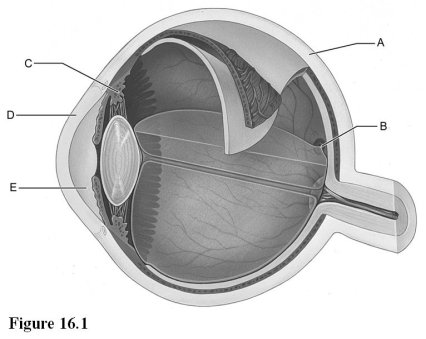 Use the diagram above to answer the following questions.
-Identify the letter that indicates the transparent portion of the fibrous layer.
Use the diagram above to answer the following questions.
-Identify the letter that indicates the transparent portion of the fibrous layer. (Multiple Choice)
4.8/5 (65)
(65) The melanin-containing layer of the eye's vascular tunic is called the
(Multiple Choice)
4.7/5 (85)
(85) Along with the saccule, this structure senses linear acceleration.
(Multiple Choice)
4.9/5 (92)
(92) 
Filters
- Essay(0)
- Multiple Choice(0)
- Short Answer(0)
- True False(0)
- Matching(0)