



 Chat with AI
Exam 25: The Reproductive System

Exam 1: The Human Body: an Orientation110 Questions
Exam 2: Cells: the Living Units108 Questions
Exam 3: Basic Embryology112 Questions
Exam 4: Tissues110 Questions
Exam 5: The Integumentary System109 Questions
Exam 6: Bones and Skeletal Tissues108 Questions
Exam 7: Bones, Part 1: the Axial Skeleton110 Questions
Exam 8: Bones, Part 2: the Appendicular Skeleton113 Questions
Exam 9: Joints110 Questions
Exam 10: Skeletal Muscle Tissue110 Questions
Exam 11: Muscles of the Body160 Questions
Exam 12: Fundamentals of the Nervous System and Nervous Tissue112 Questions
Exam 13: The Central Nervous System109 Questions
Exam 14: The Peripheral Nervous System114 Questions
Exam 15: The Autonomic Nervous System and Visceral Sensory Neurons110 Questions
Exam 16: The Special Senses114 Questions
Exam 17: The Endocrine System115 Questions
Exam 18: Blood110 Questions
Exam 19: The Heart114 Questions
Exam 20: Blood Vessels113 Questions
Exam 21: The Lymphatic and Immune Systems115 Questions
Exam 22: The Respiratory System110 Questions
Exam 23: The Digestive System113 Questions
Exam 24: The Urinary System112 Questions
Exam 25: The Reproductive System116 Questions
Select questions type


During the follicular phase of the ovarian cycle, a single primordial follicle develops, and the oocyte within it completes meiosis.
(True/False)
4.8/5  (89)
(89) All of the following are located within the spermatic cord except the
(Multiple Choice)
4.7/5 (69)
(69) This multinucleate embryonic structure invades the uterus, digesting cells and maternal blood vessels to make way for development of the placenta.
(Multiple Choice)
4.9/5 (79)
(79) The ________ is the fluid-filled cavity in a mature ovarian follicle.
(Multiple Choice)
5.0/5 (84)
(84) All of the following are functions of the sustentocytes in the seminiferous tubules except
(Multiple Choice)
4.8/5 (79)
(79) The ________ phase of the uterine cycle occurs after ovulation.
(Multiple Choice)
4.8/5 (94)
(94) At what point during fetal development are the decidua basalis and chorionic villi collectively referred to as the placenta?
(Multiple Choice)
4.8/5 (78)
(78) 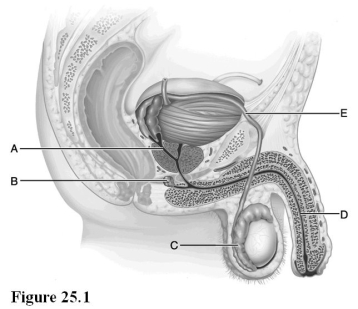 Use the diagram above to answer the following questions.
-Identify the letter indicating the site of sperm maturation and storage.
Use the diagram above to answer the following questions.
-Identify the letter indicating the site of sperm maturation and storage. (Multiple Choice)
4.9/5 (68)
(68) In which part of the uterine tube does fertilization usually occur?
(Multiple Choice)
4.9/5 (90)
(90) In addition to the remaining granulosa cells, which of the following cell types make up the corpus luteum?
(Multiple Choice)
4.9/5 (86)
(86) An ovulated oocyte swept into the oviduct via fimbriae moves from the ________ of the oviduct to the ampulla, then the isthmus, and finally into the uterus.
(Short Answer)
4.9/5 (76)
(76) Describe the structures involved in the transfer of nutrients and wastes between the fetal and maternal bloodstreams.
(Essay)
4.7/5 (88)
(88) The opening of the oviduct is surrounded by these structures.
(Multiple Choice)
4.9/5 (69)
(69) Which of the following anchors the uterus into its anteverted position in the pelvis?
(Multiple Choice)
4.9/5 (84)
(84) Sustentocytes support developing sperm and form a blood-testis barrier.
(True/False)
4.9/5 (73)
(73) The ductus deferens and uterine tube are homologous structures, each deriving from the same embryonic duct.
(True/False)
4.9/5 (81)
(81) 
Filters
- Essay(0)
- Multiple Choice(0)
- Short Answer(0)
- True False(0)
- Matching(0)