



 Chat with AI
Exam 8: Relationships Among Inflation, Interest Rates, and Exchange Rates

Exam 1: Multinational Financial Management: an Overview79 Questions
Exam 2: International Flow of Funds74 Questions
Exam 3: International Financial Markets102 Questions
Exam 4: Exchange Rate Determination68 Questions
Exam 5: Currency Derivatives160 Questions
Exam 6: Government Influence on Exchange Rates116 Questions
Exam 7: International Arbitrage and Interest Rate Parity90 Questions
Exam 8: Relationships Among Inflation, Interest Rates, and Exchange Rates59 Questions
Exam 9: Forecasting Exchange Rates83 Questions
Exam 10: Measuring Exposure to Exchange Rate Fluctuations81 Questions
Exam 11: Managing Transaction Exposure73 Questions
Exam 12: Managing Economic Exposure and Translation Exposure58 Questions
Exam 13: Direct Foreign Investment51 Questions
Exam 14: Multinational Capital Budgeting56 Questions
Exam 15: International Corporate Governance and Control56 Questions
Exam 16: Country Risk Analysis57 Questions
Exam 17: Multinational Capital Structure and Cost of Capital68 Questions
Exam 18: Long-Term Debt Financing52 Questions
Exam 19: Financing International Trade66 Questions
Exam 20: Short-Term Financing47 Questions
Exam 21: International Cash Management48 Questions
Select questions type


The following regression was conducted for the exchange rate of the British pound (BP): 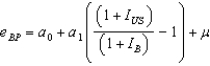 Regression results indicate that a0 = 0 and a1 = 2. Therefore:
 (Multiple Choice)
4.7/5  (71)
(71) Given a home country and a foreign country, the international Fisher effect (IFE) suggests that:
(Multiple Choice)
5.0/5 (74)
(74) Because there are a variety of factors in addition to inflation that affect exchange rates, this will:
(Multiple Choice)
4.9/5 (85)
(85) Assume that inflation in the United States is expected to be 9 percent, while inflation in Australia is expected to be 5 percent over the next year. Today you receive an offer to purchase a one-year put option for $.03 per unit on Australian dollars at a strike price of $0.72. Today the Australian dollar is quoted at $0.70. You believe that purchasing power parity holds. You should accept the offer.
(True/False)
4.8/5 (74)
(74) Purchasing power parity (PPP) focuses on the relationship between nominal interest rates and exchange rates between two countries.
(True/False)
4.8/5 (77)
(77) If purchasing power parity holds, then the Fisher effect must also hold.
(True/False)
4.9/5 (79)
(79) If interest rates on the euro are consistently below U.S. interest rates, then for the international Fisher effect (IFE) to hold:
(Multiple Choice)
4.9/5 (79)
(79) According to the international Fisher effect (IFE), the exchange rate percentage change should be approximately equal to the differential in income levels between two countries.
(True/False)
4.9/5 (90)
(90) The inflation rate in the United States is 3 percent while the inflation rate in Japan is 10 percent. The current exchange rate for the Japanese yen (¥) is $0.0075. After supply and demand for the Japanese yen have adjusted in the manner suggested by purchasing power parity, the new exchange rate for the yen will be:
(Multiple Choice)
4.9/5 (93)
(93) There is much evidence to suggest that Japanese investors invest in U.S. Treasury securities when U.S. interest rates are higher than Japanese interest rates. These investors most likely believe in the international Fisher effect.
(True/False)
4.9/5 (63)
(63) Which of the following is not true regarding IRP, PPP, and the IFE?
(Multiple Choice)
4.7/5 (89)
(89) Assume that the U.S. inflation rate is higher than the New Zealand inflation rate. This will cause U.S. consumers to ____ their imports from New Zealand and New Zealand consumers to ____ their imports from the United States. According to purchasing power parity (PPP), this will result in a(n) ____ of the New Zealand dollar (NZ$).
(Multiple Choice)
4.8/5 (85)
(85) Assume that the one-year interest rate in the United States is 7 percent and in the United Kingdom is 5 percent. According to the international Fisher effect, the British pound's spot exchange rate should ____ by about ____ over the year.
(Multiple Choice)
4.8/5 (92)
(92) If the international Fisher effect (IFE) did not hold based on historical data, this would suggest that:
(Multiple Choice)
4.9/5 (75)
(75) Given a home country and a foreign country, purchasing power parity suggests that:
(Multiple Choice)
4.9/5 (84)
(84) Research indicates that deviations from purchasing power parity (PPP) are less pronounced over the long run.
(True/False)
4.7/5 (82)
(82) Assume that the interest rate offered on pounds is 5 percent and the pound is expected to depreciate by 1.5 percent. For the international Fisher effect (IFE) to hold between the United Kingdom and the United States, the U.S. interest rate should be:
(Multiple Choice)
4.8/5 (88)
(88) Assume that the international Fisher effect (IFE) holds between the United States and the United Kingdom. The U.S. inflation is expected to be 5 percent, while British inflation is expected to be 3 percent. The interest rate offered on pounds is 7 percent, and the U.S. interest rate is 7 percent. What does this say about real interest rates expected by British investors?
(Multiple Choice)
4.8/5 (73)
(73) If nominal British interest rates are 3 percent and nominal U.S. interest rates are 6 percent, then the British pound (£) is expected to ____ by about ____percent, according to the international Fisher effect (IFE).
(Multiple Choice)
4.8/5 (66)
(66) 
Filters
- Essay(0)
- Multiple Choice(0)
- Short Answer(0)
- True False(0)
- Matching(0)