



 Chat with AI
Exam 8: Relationships Among Inflation, Interest Rates, and Exchange Rates

Exam 1: Multinational Financial Management: an Overview79 Questions
Exam 2: International Flow of Funds74 Questions
Exam 3: International Financial Markets102 Questions
Exam 4: Exchange Rate Determination68 Questions
Exam 5: Currency Derivatives160 Questions
Exam 6: Government Influence on Exchange Rates116 Questions
Exam 7: International Arbitrage and Interest Rate Parity90 Questions
Exam 8: Relationships Among Inflation, Interest Rates, and Exchange Rates59 Questions
Exam 9: Forecasting Exchange Rates83 Questions
Exam 10: Measuring Exposure to Exchange Rate Fluctuations81 Questions
Exam 11: Managing Transaction Exposure73 Questions
Exam 12: Managing Economic Exposure and Translation Exposure58 Questions
Exam 13: Direct Foreign Investment51 Questions
Exam 14: Multinational Capital Budgeting56 Questions
Exam 15: International Corporate Governance and Control56 Questions
Exam 16: Country Risk Analysis57 Questions
Exam 17: Multinational Capital Structure and Cost of Capital68 Questions
Exam 18: Long-Term Debt Financing52 Questions
Exam 19: Financing International Trade66 Questions
Exam 20: Short-Term Financing47 Questions
Exam 21: International Cash Management48 Questions
Select questions type


Given a home country and a foreign country, purchasing power parity (PPP) suggests that:

Free
(Multiple Choice)
4.8/5  (84)
(84) Correct Answer: Verified
D
Assume that the New Zealand inflation rate is higher than the U.S. inflation rate. This will cause U.S. consumers to ____ their imports from New Zealand and New Zealand consumers to ____ their imports from the United States. According to purchasing power parity (PPP), this will result in a(n) ____ of the New Zealand dollar (NZ$).
Free
(Multiple Choice)
4.8/5 (81)
(81) Correct Answer:Verified
VerifiedC
Assume U.S. and Swiss investors require a real rate of return of 3 percent. Assume the nominal U.S. interest rate is 6 percent and the nominal Swiss rate is 4 percent. According to the international Fisher effect, the Swiss franc will ____ by about ____.
Free
(Multiple Choice)
4.7/5 (65)
(65) Correct Answer:Verified
VerifiedE
Which of the following theories suggests that the percentage difference between the forward rate and the spot rate depends on the interest rate differential between two countries?
(Multiple Choice)
4.8/5 (79)
(79) Assume a two-country world: Country A and Country B. Which of the following is correct about purchasing power parity (PPP) as related to these two countries?
(Multiple Choice)
4.8/5 (76)
(76) The relative form of purchasing power parity (PPP) accounts for the possibility of market imperfections such as transportation costs, tariffs, and quotas in establishing a relationship between inflation rates and exchange rate changes.
(True/False)
4.7/5 (76)
(76) Which of the following theories suggests that the percentage change in the spot exchange rate of a currency should be equal to the inflation differential between two countries?
(Multiple Choice)
4.8/5 (81)
(81) If interest rate parity holds, then the international Fisher effect must hold.
(True/False)
4.7/5 (73)
(73) According to the IFE, when the nominal interest rate at home exceeds the nominal interest rate in the foreign country, the home currency should depreciate.
(True/False)
4.9/5 (92)
(92) The nominal interest rate can be measured as the real interest rate minus the expected inflation rate.
(True/False)
4.9/5 (79)
(79) According to the international Fisher effect, if investors in all countries require the same real rate of return, the differential in nominal interest rates between any two countries:
(Multiple Choice)
4.9/5 (73)
(73) Which of the following is not true regarding limitations of PPP and the IFE?
(Multiple Choice)
4.7/5 (65)
(65) The following regression analysis was conducted for the inflation rate information and exchange rate of the British pound: 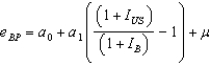 Regression results indicate that a0 = 0 and a1 = 1. Therefore:
 (Multiple Choice)
4.9/5 (80)
(80) Interest rate parity can only hold if purchasing power parity holds.
(True/False)
4.7/5 (77)
(77) If interest rate parity holds, and the international Fisher effect (IFE) holds, foreign currencies with relatively high interest rates should have forward discounts, and those currencies would be expected to depreciate.
(True/False)
4.8/5 (77)
(77) Which of the following theories can be assessed using data that exists at one specific point in time?
(Multiple Choice)
4.8/5 (87)
(87) According to purchasing power parity (PPP), if a foreign country's inflation rate is below the inflation rate at home, home country consumers will increase their imports from the foreign country, and foreign consumers will lower their demand for home country products. These market forces cause the foreign currency to appreciate.
(True/False)
4.9/5 (81)
(81) If interest rate parity holds, then the one-year forward rate of a currency will be ____ the predicted spot rate of the currency in one year according to the international Fisher effect.
(Multiple Choice)
4.8/5 (78)
(78) Which of the following is indicated by research regarding purchasing power parity (PPP)?
(Multiple Choice)
4.9/5 (77)
(77) Assume that the U.S. one-year interest rate is 5 percent and the one-year interest rate on euros is 8 percent. You have $100,000 to invest and you believe that the international Fisher effect (IFE) holds. The euro's spot exchange rate is $1.40. What will be the yield on your investment if you invest in euros?
(Multiple Choice)
4.8/5 (75)
(75) 
Filters
- Essay(0)
- Multiple Choice(0)
- Short Answer(0)
- True False(0)
- Matching(0)