



 Chat with AI
Exam 18: Clearing the Air: Respiratory Cardiovascular and Excretory Systems

Exam 1: Can Science Cure the Common Cold? Introduction to the Scientific Method74 Questions
Exam 2: Are We Alone in the Universe? Water, Biochemistry, and Cells75 Questions
Exam 3: Is It Possible to Supplement Your Way to Better Health?72 Questions
Exam 4: Fat: How Much is Right for You? Enzymes, Metabolism, and Cellular Respiration72 Questions
Exam 5: Life in the Greenhouse: Photosynthesis and Global Warming70 Questions
Exam 6: Cancer: DNA Synthesis, Mitosis, and Meiosis70 Questions
Exam 7: Are You Only as Smart as Your Genes? Mendelian and Quantitative Genetics71 Questions
Exam 8: DNA Detective: Complex Patterns of Inheritance and DNA Fingerprinting71 Questions
Exam 9: Genetically Modified Organisms: Gene Expression, Mutation, and Cloning70 Questions
Exam 10: Where Did We Come From? The Evidence for Evolution70 Questions
Exam 11: An Evolving Enemy: Natural Selection72 Questions
Exam 12: Who Am I? Species and Races66 Questions
Exam 13: Prospecting for Biological Gold: Biodiversity and Classification72 Questions
Exam 14: Is the Human Population Too Large? Population Ecology69 Questions
Exam 15: Conserving Biodiversity: Community and Ecosystem Ecology71 Questions
Exam 16: Where Do You Live? Climate and Biomes73 Questions
Exam 17: Organ Donation: Tissues Organs and Organ Systems70 Questions
Exam 18: Clearing the Air: Respiratory Cardiovascular and Excretory Systems69 Questions
Exam 19: Vaccinations: Protection and Prevention or Peril? Immune System 70 Questions
Exam 20: Sex Differences and Athleticism: Endocrine Skeletal and Muscular Systems73 Questions
Exam 21: Is There Something in the Water? Reproductive and Developmental Biology71 Questions
Exam 22: Attention Deficit Disorder: Brain Structure and Function69 Questions
Exam 23: Feeding the World: Plant Structure and Growth74 Questions
Exam 24: Growing a Green Thumb: Plant Physiology71 Questions
Select questions type


The process by which urine is released from the bladder is called
(Multiple Choice)
4.8/5  (88)
(88) The brain stem regulates breathing and will signal the diaphragm to contract in response to
(Multiple Choice)
4.9/5 (81)
(81) The emerging and scientific consensus about "secondhand smoke" supports the conclusion that, while airborne particles emitted by the lit end of cigarettes pose a health risk to those who are exposed, the gases released by a cigarette are relatively harmless.
(True/False)
4.8/5 (70)
(70) By which process is the majority of water that's filtered reabsorbed in the nephrons during urine formation?
(Multiple Choice)
4.8/5 (88)
(88) 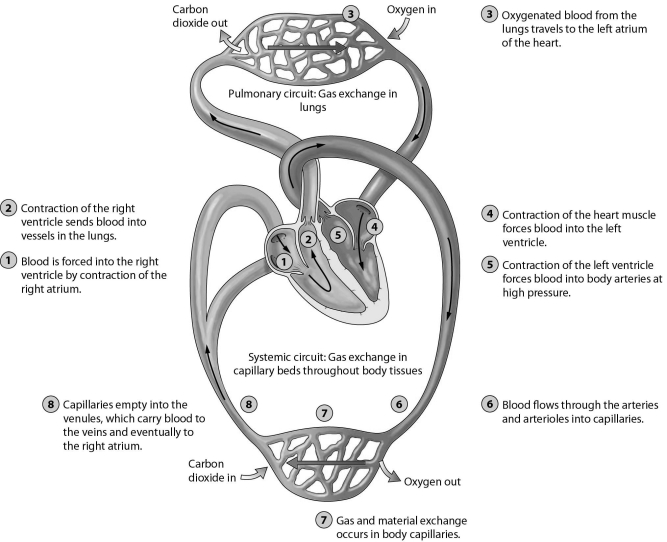 -Refer to the figure to answer the following question: In which of the labeled regions would blood pressure be the highest?
 (Multiple Choice)
4.9/5 (92)
(92) The respiratory surface where gas exchange occurs is in the
(Multiple Choice)
4.8/5 (71)
(71) A small mass of specialized muscle on the back wall of the right atrium, also known as the pacemaker, is medically known as what?
(Multiple Choice)
4.9/5 (84)
(84) What is the advantage of having grape-like clusters called alveoli as part of the respiratory system?
(Multiple Choice)
4.7/5 (77)
(77) Which chamber of the heart receives the deoxygenated blood from the systemic system first?
(Multiple Choice)
4.9/5 (84)
(84) In the alveoli and lung capillaries, carbon dioxide and oxygen are exchanged by means of
(Multiple Choice)
5.0/5 (85)
(85) Which region of the circulatory system allows passage of nutrients and other small molecules to service nearby tissues?
(Multiple Choice)
4.9/5 (69)
(69) In which of these blood vessels do the exchange of gases and other materials occur?
(Multiple Choice)
4.8/5 (69)
(69) During exhalation, when the diaphragm relaxes and the volume of the chest cavity decreases, air pressure ________ inside the lungs.
(Multiple Choice)
4.8/5 (85)
(85) Which of the following correctly traces a drop of blood through the vascular system?
(Multiple Choice)
4.9/5 (85)
(85) About how many years after quitting smoking does it take for the risk of heart disease and death to return to the levels similar to those seen in people who never smoked?
(Multiple Choice)
4.9/5 (81)
(81) ________ is the most abundant gas in environmental tobacco smoke, and the effects of exposure to elevated levels of this gas along with other health problems can lead to serious consequences.
(Short Answer)
4.9/5 (81)
(81) In the human cardiovascular system, what's the difference between the pulmonary circuit and the systemic circuit?
(Essay)
4.8/5 (70)
(70) 
Filters
- Essay(0)
- Multiple Choice(0)
- Short Answer(0)
- True False(0)
- Matching(0)