



 Chat with AI
Exam 12: Who Am I? Species and Races

Exam 1: Can Science Cure the Common Cold? Introduction to the Scientific Method74 Questions
Exam 2: Are We Alone in the Universe? Water, Biochemistry, and Cells75 Questions
Exam 3: Is It Possible to Supplement Your Way to Better Health?72 Questions
Exam 4: Fat: How Much is Right for You? Enzymes, Metabolism, and Cellular Respiration72 Questions
Exam 5: Life in the Greenhouse: Photosynthesis and Global Warming70 Questions
Exam 6: Cancer: DNA Synthesis, Mitosis, and Meiosis70 Questions
Exam 7: Are You Only as Smart as Your Genes? Mendelian and Quantitative Genetics71 Questions
Exam 8: DNA Detective: Complex Patterns of Inheritance and DNA Fingerprinting71 Questions
Exam 9: Genetically Modified Organisms: Gene Expression, Mutation, and Cloning70 Questions
Exam 10: Where Did We Come From? The Evidence for Evolution70 Questions
Exam 11: An Evolving Enemy: Natural Selection72 Questions
Exam 12: Who Am I? Species and Races66 Questions
Exam 13: Prospecting for Biological Gold: Biodiversity and Classification72 Questions
Exam 14: Is the Human Population Too Large? Population Ecology69 Questions
Exam 15: Conserving Biodiversity: Community and Ecosystem Ecology71 Questions
Exam 16: Where Do You Live? Climate and Biomes73 Questions
Exam 17: Organ Donation: Tissues Organs and Organ Systems70 Questions
Exam 18: Clearing the Air: Respiratory Cardiovascular and Excretory Systems69 Questions
Exam 19: Vaccinations: Protection and Prevention or Peril? Immune System 70 Questions
Exam 20: Sex Differences and Athleticism: Endocrine Skeletal and Muscular Systems73 Questions
Exam 21: Is There Something in the Water? Reproductive and Developmental Biology71 Questions
Exam 22: Attention Deficit Disorder: Brain Structure and Function69 Questions
Exam 23: Feeding the World: Plant Structure and Growth74 Questions
Exam 24: Growing a Green Thumb: Plant Physiology71 Questions
Select questions type


Evolution that occurs as a result of chance events is called
(Multiple Choice)
4.8/5  (80)
(80) A gene exists as two alleles in a population of freely mating individuals. If 40% of the population carries the recessive allele (a)for the gene, what percentage of the population has the homozygous recessive aa genotype?
(Multiple Choice)
4.8/5 (84)
(84) Fruit flies all look more or less alike. If you have a male and female fruit fly, how could you test the hypothesis that they're the same species?
(Multiple Choice)
4.8/5 (85)
(85) Traits like reduced body hair in many native North American and Asian populations are most likely the result of sexual selection.
(True/False)
4.7/5 (68)
(68) Which of these most accurately describes a single population?
(Multiple Choice)
4.9/5 (71)
(71) One species of plant produces flowers when nights are 10 hours long. A related species comes into flower when nights are 9 hours long. This is an example of
(Multiple Choice)
4.7/5 (96)
(96) A genealogical species definition includes fewer organisms than a biological species definition.
(True/False)
4.8/5 (75)
(75) The eggs released by sponges during reproduction have proteins on their surfaces that prevent sperm from different sponge species from binding to the eggs. This is an example of
(Multiple Choice)
4.8/5 (89)
(89) The terms "subspecies" and "race" are best described by which of the following scenarios?
(Multiple Choice)
4.9/5 (74)
(74) 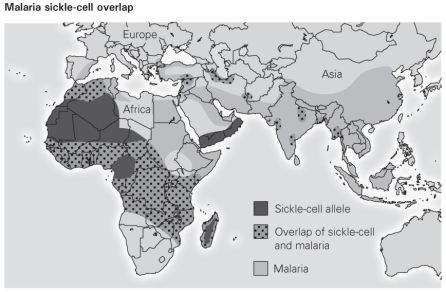 -The figure shows that sickle cell allele is not common in every region that malaria is present. Why not?
 (Multiple Choice)
4.9/5 (82)
(82) Which of the following would be considered a population genetics question that could be answered using the Hardy-Weinberg equation?
(Multiple Choice)
4.8/5 (80)
(80) In order to support the hypothesis that two groups are different races, one group should have at least some unique alleles
(Multiple Choice)
4.8/5 (83)
(83) All of the bees in an area are eliminated by disease. This could lead to reproductive isolation of which of the following species in the area?
(Multiple Choice)
4.8/5 (82)
(82) 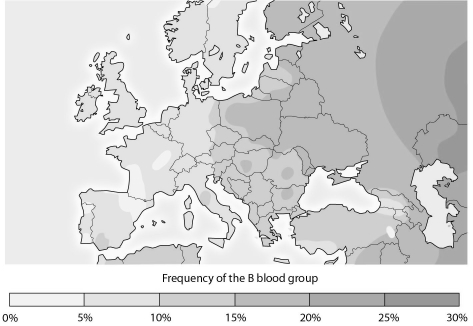 -How does the distribution shown on the map of alleles for the B blood type support the hypothesis that there are no biological races of humans?
 (Multiple Choice)
4.8/5 (80)
(80) Which of the following occurs after the creation of a new allele?
(Multiple Choice)
4.9/5 (81)
(81) When a founder population has a small gene pool, evolutionary change is more likely to be rapid than if the founder population has a large gene pool.
(True/False)
4.7/5 (75)
(75) 
Filters
- Essay(0)
- Multiple Choice(0)
- Short Answer(0)
- True False(0)
- Matching(0)