



 Chat with AI
Exam 12: Who Am I? Species and Races

Exam 1: Can Science Cure the Common Cold? Introduction to the Scientific Method74 Questions
Exam 2: Are We Alone in the Universe? Water, Biochemistry, and Cells75 Questions
Exam 3: Is It Possible to Supplement Your Way to Better Health?72 Questions
Exam 4: Fat: How Much is Right for You? Enzymes, Metabolism, and Cellular Respiration72 Questions
Exam 5: Life in the Greenhouse: Photosynthesis and Global Warming70 Questions
Exam 6: Cancer: DNA Synthesis, Mitosis, and Meiosis70 Questions
Exam 7: Are You Only as Smart as Your Genes? Mendelian and Quantitative Genetics71 Questions
Exam 8: DNA Detective: Complex Patterns of Inheritance and DNA Fingerprinting71 Questions
Exam 9: Genetically Modified Organisms: Gene Expression, Mutation, and Cloning70 Questions
Exam 10: Where Did We Come From? The Evidence for Evolution70 Questions
Exam 11: An Evolving Enemy: Natural Selection72 Questions
Exam 12: Who Am I? Species and Races66 Questions
Exam 13: Prospecting for Biological Gold: Biodiversity and Classification72 Questions
Exam 14: Is the Human Population Too Large? Population Ecology69 Questions
Exam 15: Conserving Biodiversity: Community and Ecosystem Ecology71 Questions
Exam 16: Where Do You Live? Climate and Biomes73 Questions
Exam 17: Organ Donation: Tissues Organs and Organ Systems70 Questions
Exam 18: Clearing the Air: Respiratory Cardiovascular and Excretory Systems69 Questions
Exam 19: Vaccinations: Protection and Prevention or Peril? Immune System 70 Questions
Exam 20: Sex Differences and Athleticism: Endocrine Skeletal and Muscular Systems73 Questions
Exam 21: Is There Something in the Water? Reproductive and Developmental Biology71 Questions
Exam 22: Attention Deficit Disorder: Brain Structure and Function69 Questions
Exam 23: Feeding the World: Plant Structure and Growth74 Questions
Exam 24: Growing a Green Thumb: Plant Physiology71 Questions
Select questions type


Levels of ultraviolet light influence both folate and vitamin D production in humans.
(True/False)
4.8/5  (68)
(68) In a population where most of the individuals have long, narrow noses, a child is born with a short, broad nose. What's the most likely evolutionary explanation for this variation?
(Multiple Choice)
4.8/5 (68)
(68) Fossil evidence shows that all modern human populations evolved from human ancestors in Africa.
(True/False)
4.9/5 (70)
(70) You're interested in the genetics of earlobe shape on your campus. Free (unattached)earlobes are caused by a dominant allele. The attached earlobe phenotype is caused by a recessive allele. Individuals with free earlobes have either a homozygous genotype or a heterozygous genotype. Assuming that your college campus is a stable population, how could you use one calculation to determine the percentage of students who have a heterozygous genotype for earlobe shape?
(Multiple Choice)
4.9/5 (81)
(81) 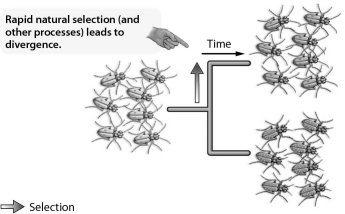 -The figure illustrates the concept of
What causes the reproductive isolation that can lead to speciation?
(Multiple Choice)
4.9/5 (72)
(72) In what type of population would evolution occur most rapidly?
(Multiple Choice)
4.9/5 (67)
(67) A small founder population of turtles has established a population on an island with a varied and good habitat that contains ample food. There is very little competition between members. What is the likely effect on evolution of this low level of competition?
(Multiple Choice)
4.8/5 (75)
(75) Many lines of evidence suggest that human populations aren't distinct races. What keeps us so similar even though adaptations to local conditions have occurred?
(Multiple Choice)
4.8/5 (82)
(82) 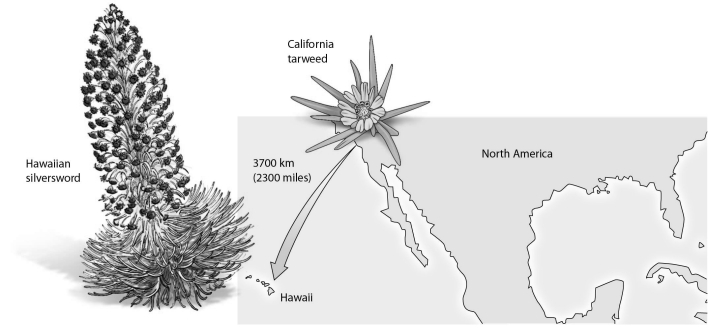 -California tarweed seeds were able to reach the Hawaiian Islands, and a new species emerged from this isolated population. This example illustrates
 (Multiple Choice)
4.8/5 (71)
(71) You're studying two species of frog. How would you know if gradualism or punctuated equilibrium played a role in the formation of the two species from their common ancestor?
(Multiple Choice)
4.7/5 (67)
(67) Scientists are most likely to use which of the following to calculate allele frequencies in a human population?
(Multiple Choice)
4.8/5 (75)
(75) Two populations that have adapted to similar environmental conditions sometimes have a similar appearance.
(True/False)
4.9/5 (86)
(86) You read that two populations of hyena are different subspecies. Which of the following would be true of the two populations?
(Multiple Choice)
4.9/5 (75)
(75) How can we explain the observation that traits such as skin color are fairly consistent within a racial group but alleles for skin color aren't consistent?
(Multiple Choice)
4.7/5 (93)
(93) In order to be acted on by sexual selection, a trait must be
(Multiple Choice)
4.9/5 (88)
(88) You wish to study interspecies mating. Which of the following would be the best mating pair to study?
(Multiple Choice)
4.8/5 (87)
(87) 
Filters
- Essay(0)
- Multiple Choice(0)
- Short Answer(0)
- True False(0)
- Matching(0)