



 Chat with AI
Exam 6: Cancer: DNA Synthesis, Mitosis, and Meiosis

Exam 1: Can Science Cure the Common Cold? Introduction to the Scientific Method74 Questions
Exam 2: Are We Alone in the Universe? Water, Biochemistry, and Cells75 Questions
Exam 3: Is It Possible to Supplement Your Way to Better Health?72 Questions
Exam 4: Fat: How Much is Right for You? Enzymes, Metabolism, and Cellular Respiration72 Questions
Exam 5: Life in the Greenhouse: Photosynthesis and Global Warming70 Questions
Exam 6: Cancer: DNA Synthesis, Mitosis, and Meiosis70 Questions
Exam 7: Are You Only as Smart as Your Genes? Mendelian and Quantitative Genetics71 Questions
Exam 8: DNA Detective: Complex Patterns of Inheritance and DNA Fingerprinting71 Questions
Exam 9: Genetically Modified Organisms: Gene Expression, Mutation, and Cloning70 Questions
Exam 10: Where Did We Come From? The Evidence for Evolution70 Questions
Exam 11: An Evolving Enemy: Natural Selection72 Questions
Exam 12: Who Am I? Species and Races66 Questions
Exam 13: Prospecting for Biological Gold: Biodiversity and Classification72 Questions
Exam 14: Is the Human Population Too Large? Population Ecology69 Questions
Exam 15: Conserving Biodiversity: Community and Ecosystem Ecology71 Questions
Exam 16: Where Do You Live? Climate and Biomes73 Questions
Exam 17: Organ Donation: Tissues Organs and Organ Systems70 Questions
Exam 18: Clearing the Air: Respiratory Cardiovascular and Excretory Systems69 Questions
Exam 19: Vaccinations: Protection and Prevention or Peril? Immune System 70 Questions
Exam 20: Sex Differences and Athleticism: Endocrine Skeletal and Muscular Systems73 Questions
Exam 21: Is There Something in the Water? Reproductive and Developmental Biology71 Questions
Exam 22: Attention Deficit Disorder: Brain Structure and Function69 Questions
Exam 23: Feeding the World: Plant Structure and Growth74 Questions
Exam 24: Growing a Green Thumb: Plant Physiology71 Questions
Select questions type


A scientist who observes cancer cells under a microscope would likely see
(Multiple Choice)
4.9/5  (79)
(79) In a certain species of animal, 33% of the bases in its DNA are A. What percent of the bases are C?
(Multiple Choice)
4.8/5 (85)
(85) ________ is the cause of about one-third of all cancer deaths.
(Multiple Choice)
5.0/5 (83)
(83) 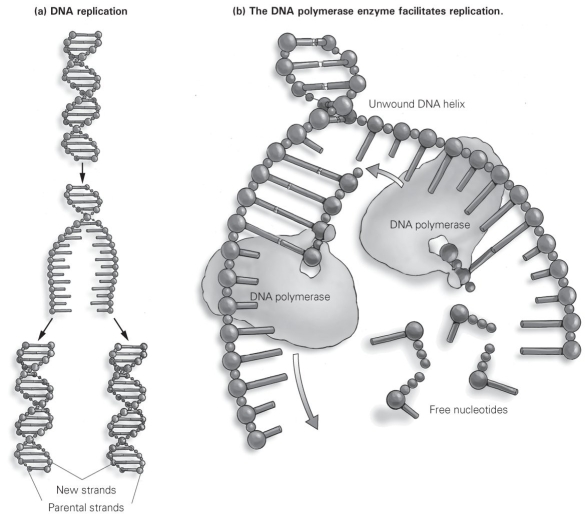 -DNA polymerase moves along the length of the unwound helix, starting at the end of one strand and finishing at the end of the other strand. As shown in this figure, what is the result of this phenomenon?
 (Multiple Choice)
4.8/5 (81)
(81) During which phase of mitosis are the replicated chromosome aligned in the middle of the cell?
(Multiple Choice)
4.8/5 (82)
(82) Which of the following is the correct order of events in mitosis?
(Multiple Choice)
4.8/5 (79)
(79) A normal human cell containing 22 autosomes and a Y chromosome is a(n)
(Multiple Choice)
4.7/5 (96)
(96) Which of these conditions is caused by nondisjunction of autosomal chromosomes?
(Multiple Choice)
4.8/5 (81)
(81) During which phase of mitosis do sister chromatids separate to opposite poles of the cell?
(Multiple Choice)
4.9/5 (78)
(78) The term "semiconservative replication" refers to the fact that
(Multiple Choice)
4.7/5 (76)
(76) ________ are places in the cell cycle where proteins survey the cell to make sure that conditions for a favorable cell division have been met.
(Short Answer)
4.9/5 (70)
(70) 
Filters
- Essay(0)
- Multiple Choice(0)
- Short Answer(0)
- True False(0)
- Matching(0)