



 Chat with AI
Exam 10: Glaciers, Deserts, and Wind

Exam 1: Introduction to Earth Science108 Questions
Exam 2: Matter and Minerals115 Questions
Exam 3: Rocks: Materials of the Solid Earth120 Questions
Exam 4: Plate Tectonics: a Scientific Revolution Unfolds89 Questions
Exam 5: Earthquakes and Earths Interior90 Questions
Exam 6: Volcanoes and Other Igneous Activity106 Questions
Exam 7: Crustal Deformation and Mountain Building97 Questions
Exam 8: Weathering, Soil, and Mass Movement124 Questions
Exam 9: Running Water and Groundwater134 Questions
Exam 10: Glaciers, Deserts, and Wind100 Questions
Exam 11: Geologic Time102 Questions
Exam 12: Earths Evolution Through Geologic Time129 Questions
Exam 13: The Ocean Floor92 Questions
Exam 14: Ocean Water and Ocean Life74 Questions
Exam 15: The Dynamic Ocean101 Questions
Exam 16: The Atmosphere: Composition, Structure, and Temperature85 Questions
Exam 17: Moisture, Clouds, and Precipitation101 Questions
Exam 18: Air Pressure and Wind97 Questions
Exam 19: Weather Patterns and Severe Storms96 Questions
Exam 20: World Climates and Global Climate Change105 Questions
Exam 21: Origins of Modern Astronomy101 Questions
Exam 22: Touring Our Solar System93 Questions
Exam 23: Light, Telescopes, and the Sun93 Questions
Exam 24: Beyond Our Solar System83 Questions
Select questions type


An ice skater's blade pushes down onto the ice very hard, creating water as a result of the pressure from the weight of the skater. How is her skate acting like a glacier?
(Multiple Choice)
4.9/5  (82)
(82) As an erosional agent, running water in arid regions is______ .
(Multiple Choice)
4.9/5 (90)
(90) Examine the words and/or phrases below and determine the relationship among the majority of words/phrases. Choose the option which does not fit the pattern.
(Multiple Choice)
4.8/5 (84)
(84) Today, glaciers cover approximately ______percent of the earth's surface.
(Multiple Choice)
4.9/5 (86)
(86) Note the picture below from a desert setting: 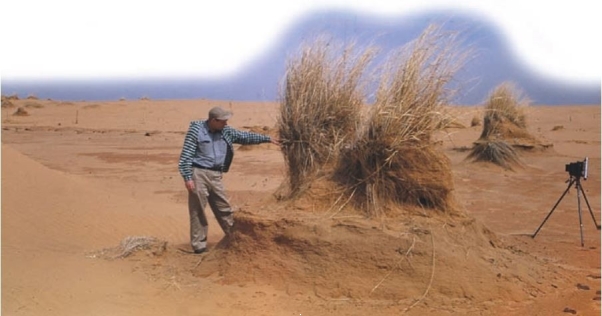 What is illustrated in the photograph?
 (Multiple Choice)
4.8/5 (79)
(79) Use the figure below to answer the following questions
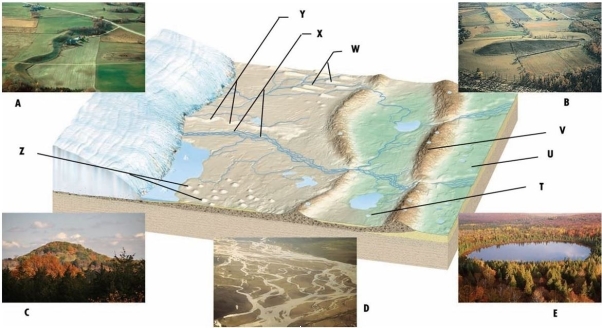 -Which feature is labeled W in the diagram and shown in photograph B?
 (Multiple Choice)
4.9/5 (93)
(93) An______ is likely to host a waterfall or steep rapids today.
(Multiple Choice)
4.8/5 (67)
(67) Why is wind less effective than moving water at picking up and moving materials?
(Multiple Choice)
4.9/5 (70)
(70) The picture below is a view of earth from the North Pole above. and one from the South Pole below.. It shows ice sheets covering Greenland and Antarctica. Why are ice sheets primarily found in these regions? 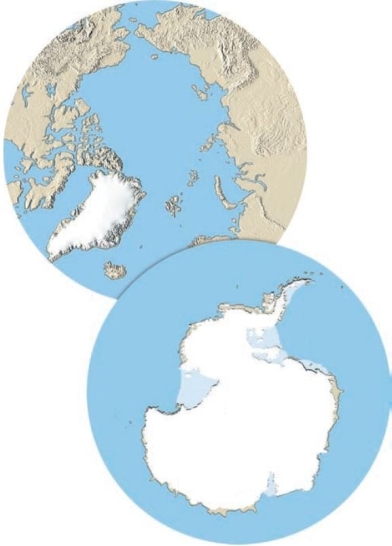
(Multiple Choice)
4.8/5 (77)
(77) Briefly explain how Plate Tectonic Theory can explain evidence that some tropical regions have experienced glaciation in the past but cannot explain the Quaternary Ice Ages.
(Essay)
4.8/5 (86)
(86) Glaciers are powerful erosional agents that alter mountain landscapes. Describe what changes glaciers make on the landscape, and some of the features that they create.
(Essay)
4.8/5 (74)
(74) Which of the following is not a typical stage in the evolution of a Basin and Range type region?
(Multiple Choice)
4.8/5 (83)
(83) The Colorado River still has water after it leaves the desert southwest region and enters the Gulf of California because______ .
(Multiple Choice)
4.8/5 (80)
(80) Which of the following statements is true of desert landscapes, like the one pictured? 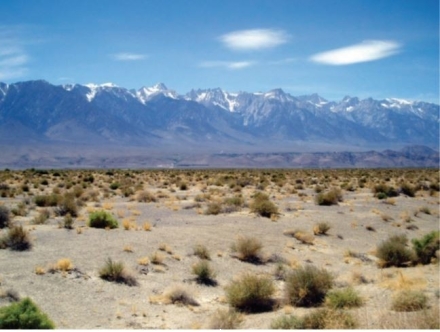
(Multiple Choice)
4.8/5 (84)
(84) Most of the deserts and steppes that occur at middle latitudes do so because of ______ .
(Multiple Choice)
4.8/5 (92)
(92) 
Filters
- Essay(0)
- Multiple Choice(0)
- Short Answer(0)
- True False(0)
- Matching(0)