



 Chat with AI
Exam 10: Glaciers, Deserts, and Wind

Exam 1: Introduction to Earth Science108 Questions
Exam 2: Matter and Minerals115 Questions
Exam 3: Rocks: Materials of the Solid Earth120 Questions
Exam 4: Plate Tectonics: a Scientific Revolution Unfolds89 Questions
Exam 5: Earthquakes and Earths Interior90 Questions
Exam 6: Volcanoes and Other Igneous Activity106 Questions
Exam 7: Crustal Deformation and Mountain Building97 Questions
Exam 8: Weathering, Soil, and Mass Movement124 Questions
Exam 9: Running Water and Groundwater134 Questions
Exam 10: Glaciers, Deserts, and Wind100 Questions
Exam 11: Geologic Time102 Questions
Exam 12: Earths Evolution Through Geologic Time129 Questions
Exam 13: The Ocean Floor92 Questions
Exam 14: Ocean Water and Ocean Life74 Questions
Exam 15: The Dynamic Ocean101 Questions
Exam 16: The Atmosphere: Composition, Structure, and Temperature85 Questions
Exam 17: Moisture, Clouds, and Precipitation101 Questions
Exam 18: Air Pressure and Wind97 Questions
Exam 19: Weather Patterns and Severe Storms96 Questions
Exam 20: World Climates and Global Climate Change105 Questions
Exam 21: Origins of Modern Astronomy101 Questions
Exam 22: Touring Our Solar System93 Questions
Exam 23: Light, Telescopes, and the Sun93 Questions
Exam 24: Beyond Our Solar System83 Questions
Select questions type


Deserts occur primarily in the Africa, Arabia, and Australia because of ______.
(Multiple Choice)
4.9/5  (82)
(82) 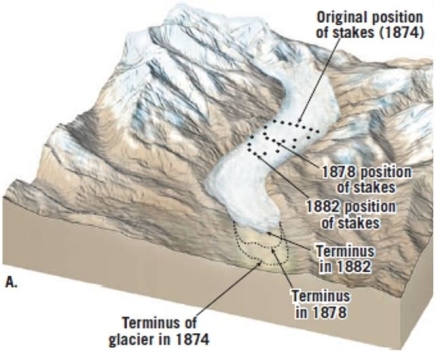 The above figure shows a classic case where Swiss geologists placed stakes into a glacier and measu outcomes a few years later. What did they conclude from the experiment?
 (Multiple Choice)
4.8/5 (71)
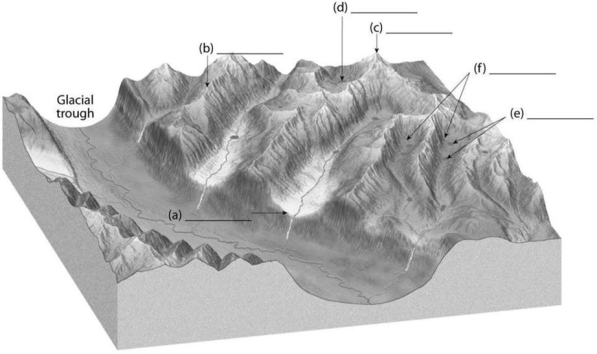
(71) 
A ______ lake forms when a block of ice is buried in drift and subsequently melts, creating a pit.
(Multiple Choice)
4.9/5 (85)
(85) Examine the words and/or phrases below and determine the relationship among the majority of words/phrases. Choose the option which does not fit the pattern.
(Multiple Choice)
4.9/5 (69)
(69) Glacial ice sheets are the largest of the types of glaciers and currently cover ______.
(Multiple Choice)
4.8/5 (76)
(76) If you fall into a crevasse, what is the maximum depth you are likely to fall?
(Multiple Choice)
4.9/5 (96)
(96) Climatologists define a "dry climate" as a climate in which______ .
(Multiple Choice)
5.0/5 (66)
(66) Antarctica's ice represents approximately 65% of the earth's fresh water supply and many populated regions need that water. Why would it be a bad idea to mine Antarctica's ice?
(Essay)
4.9/5 (82)
(82) Use the figure below to answer the following questions
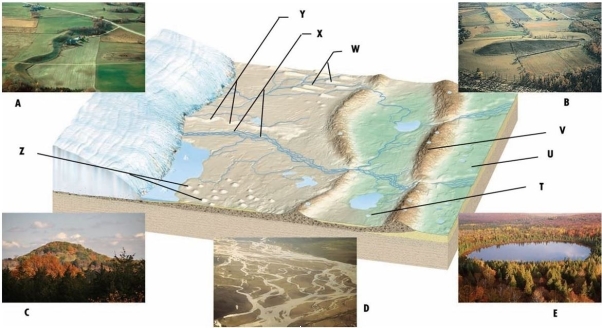 -Which feature is labeled Y in the diagram and shown in photograph A?
 (Multiple Choice)
4.8/5 (85)
(85) Our detailed knowledge of the glacial cycles and their duration is based primarily on______ .
(Multiple Choice)
4.9/5 (88)
(88) Which of the following did not exist prior to the Quaternary Ice ages?
(Multiple Choice)
4.8/5 (81)
(81) Note the two images below from the same location in Greenland in 1935 on the left. and 2013 on the right.. 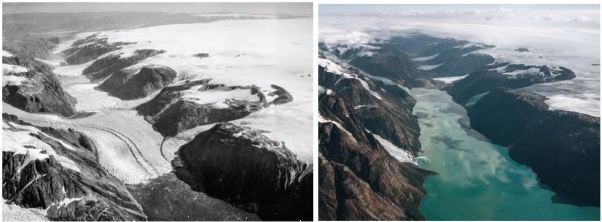 What can you conclude about how this landscape has changed during that time period?
 (Multiple Choice)
4.8/5 (82)
(82)  -In the figure above, identify the letter corresponding to a playa lake.
 (Short Answer)
4.9/5 (88)
(88) 
Filters
- Essay(0)
- Multiple Choice(0)
- Short Answer(0)
- True False(0)
- Matching(0)