



 Chat with AI
Exam 22: Touring Our Solar System

Exam 1: Introduction to Earth Science108 Questions
Exam 2: Matter and Minerals115 Questions
Exam 3: Rocks: Materials of the Solid Earth120 Questions
Exam 4: Plate Tectonics: a Scientific Revolution Unfolds89 Questions
Exam 5: Earthquakes and Earths Interior90 Questions
Exam 6: Volcanoes and Other Igneous Activity106 Questions
Exam 7: Crustal Deformation and Mountain Building97 Questions
Exam 8: Weathering, Soil, and Mass Movement124 Questions
Exam 9: Running Water and Groundwater134 Questions
Exam 10: Glaciers, Deserts, and Wind100 Questions
Exam 11: Geologic Time102 Questions
Exam 12: Earths Evolution Through Geologic Time129 Questions
Exam 13: The Ocean Floor92 Questions
Exam 14: Ocean Water and Ocean Life74 Questions
Exam 15: The Dynamic Ocean101 Questions
Exam 16: The Atmosphere: Composition, Structure, and Temperature85 Questions
Exam 17: Moisture, Clouds, and Precipitation101 Questions
Exam 18: Air Pressure and Wind97 Questions
Exam 19: Weather Patterns and Severe Storms96 Questions
Exam 20: World Climates and Global Climate Change105 Questions
Exam 21: Origins of Modern Astronomy101 Questions
Exam 22: Touring Our Solar System93 Questions
Exam 23: Light, Telescopes, and the Sun93 Questions
Exam 24: Beyond Our Solar System83 Questions
Select questions type


Large impact craters and large, domal features probably representing viscous lava flows. have been imaged on the surface of ___________.
(Multiple Choice)
4.9/5  (79)
(79) Jupiter's moon Io is thought to be the volcanically active world in our solar system. What is the inferred source of heat?
(Multiple Choice)
4.8/5 (71)
(71) Mercury reflects___________ percent of the sunlight that hits it into space.
(Multiple Choice)
4.9/5 (74)
(74) Impact craters are common on the surface of all of the terrestrial planets except___________ .
(Multiple Choice)
4.8/5 (79)
(79) Which planet has the highest recorded winds in the solar system?
(Multiple Choice)
4.9/5 (74)
(74) In 2012 scientists discovered that Mercury has an___________that is about 100 times weaker than that on Earth.
(Multiple Choice)
4.9/5 (80)
(80) ___________is the largest and most massive planet in the solar system.
(Multiple Choice)
4.8/5 (78)
(78) Why might a moon's orbit be used to evaluate if it was a primary moon, formed at the same time as the planet or a feature asteroid or comet. that was captured by the planet's gravity?
(Essay)
4.9/5 (76)
(76) The two most abundant gases in Earth's atmosphere are___________ and___________ .
(Multiple Choice)
4.9/5 (80)
(80) Venus has dense clouds and thick atmosphere, yet there is no evidence for water on the surface. Why?
(Multiple Choice)
4.8/5 (81)
(81) Carefully examine the telescopic view of the lunar surface near side. below and the features labeled A, B, and C.
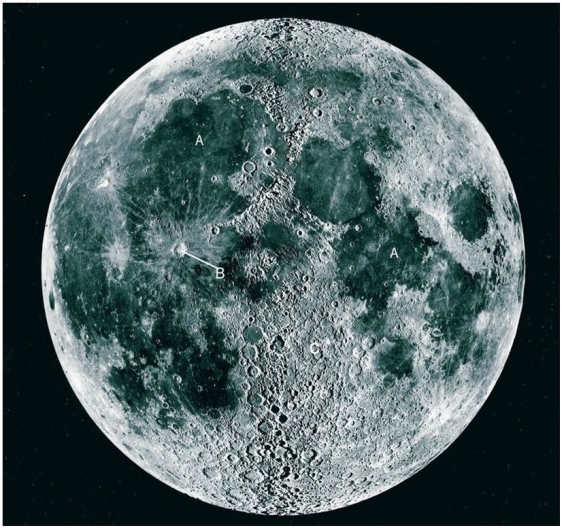 a. Give a brief description that characterizes the bright area around C.
b. Notice the features like those labeled A. What are such features called?
c. How are craters like the one labeled B different from the craters of the area labeled C?
d. In what order from first to latest. did the features form that are labeled A, B, and C?
a. Give a brief description that characterizes the bright area around C.
b. Notice the features like those labeled A. What are such features called?
c. How are craters like the one labeled B different from the craters of the area labeled C?
d. In what order from first to latest. did the features form that are labeled A, B, and C? (Essay)
4.8/5 (84)
(84) Consider the below image of a crater on the Moon.  Why would you not expect to see a similar landscape on Earth? Earth has ___________and___________ .
 (Multiple Choice)
4.9/5 (91)
(91) Jupiter contains a number of small moons that are thought to be captured comets or material ejected by collisions with larger objects. What is the evidence for this theory?
(Multiple Choice)
4.9/5 (76)
(76) A popular modern theory for the origin of the Earth- Moon system is that the early Earth collided with another planet the size of___________ .
(Multiple Choice)
4.9/5 (90)
(90) ___________are small, extraterrestrial particles that glow brightly and burn up as they travel through Earth's atmosphere.
(Multiple Choice)
4.8/5 (71)
(71) Which planet rotates the opposite direction it revolves around the Sun?
(Multiple Choice)
4.8/5 (74)
(74) The lunar maria are large impact craters filled with ___________ .
(Multiple Choice)
4.7/5 (74)
(74) Of the terrestrial planets,___________ exhibits the greatest lateral variations in surface temperatures.
(Multiple Choice)
4.9/5 (87)
(87) 
Filters
- Essay(0)
- Multiple Choice(0)
- Short Answer(0)
- True False(0)
- Matching(0)