



 Chat with AI
Exam 22: Touring Our Solar System

Exam 1: Introduction to Earth Science108 Questions
Exam 2: Matter and Minerals115 Questions
Exam 3: Rocks: Materials of the Solid Earth120 Questions
Exam 4: Plate Tectonics: a Scientific Revolution Unfolds89 Questions
Exam 5: Earthquakes and Earths Interior90 Questions
Exam 6: Volcanoes and Other Igneous Activity106 Questions
Exam 7: Crustal Deformation and Mountain Building97 Questions
Exam 8: Weathering, Soil, and Mass Movement124 Questions
Exam 9: Running Water and Groundwater134 Questions
Exam 10: Glaciers, Deserts, and Wind100 Questions
Exam 11: Geologic Time102 Questions
Exam 12: Earths Evolution Through Geologic Time129 Questions
Exam 13: The Ocean Floor92 Questions
Exam 14: Ocean Water and Ocean Life74 Questions
Exam 15: The Dynamic Ocean101 Questions
Exam 16: The Atmosphere: Composition, Structure, and Temperature85 Questions
Exam 17: Moisture, Clouds, and Precipitation101 Questions
Exam 18: Air Pressure and Wind97 Questions
Exam 19: Weather Patterns and Severe Storms96 Questions
Exam 20: World Climates and Global Climate Change105 Questions
Exam 21: Origins of Modern Astronomy101 Questions
Exam 22: Touring Our Solar System93 Questions
Exam 23: Light, Telescopes, and the Sun93 Questions
Exam 24: Beyond Our Solar System83 Questions
Select questions type


What did the Mars rover Opportunity discover on Mars that relates to questions about the existence of water on Mars?
(Multiple Choice)
4.9/5  (68)
(68) The polar caps on ___________ are thought to be mainly water ice with a thin layer of carbon dioxide in the cold season.
(Multiple Choice)
4.9/5 (86)
(86) The___________ explains how our solar system probably formed from a giant cloud of gases and dispersed solid particles.
(Multiple Choice)
4.8/5 (74)
(74) The very large, lava- covered areas of the Moon are called ___________.
(Multiple Choice)
4.8/5 (85)
(85) ___________has atmospheric pressures at its surface that are roughly comparable to those at Earth's surface.
(Multiple Choice)
4.7/5 (77)
(77) What is a popular theory for the difference in atmospheres of the Jovian planets versus terrestrial planets?
(Multiple Choice)
5.0/5 (90)
(90) Consider the following diagram of a comet's orbit: 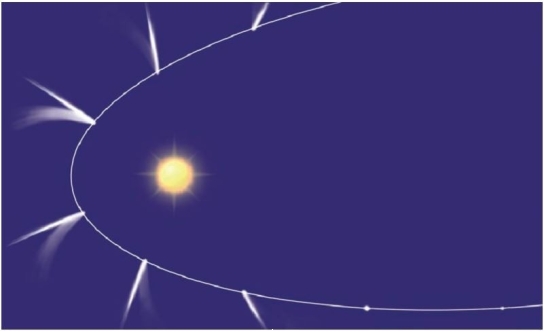 What is illustrated about comets here?
 (Multiple Choice)
5.0/5 (73)
(73) Examine the words and/or phrases below and determine the relationship among the majority of words/phrases. Choose the option that does not fit the pattern.
(Multiple Choice)
4.7/5 (97)
(97) ___________, a moon orbiting Jupiter, has an unusually smooth, uncratered, ice- covered surface.
(Multiple Choice)
4.8/5 (68)
(68) What is the most abundant element in the atmospheres of Jupiter and Saturn?
(Multiple Choice)
4.8/5 (63)
(63) Several of the moons of Saturn, Uranus and Neptune display evidence of volcanic activity. What is the most common type of volcano on these moons?
(Multiple Choice)
5.0/5 (67)
(67) Saturn is famous for its rings. Which of the following Jovian planets does not have rings?
(Multiple Choice)
4.9/5 (83)
(83) Compare Earth's surface processes to the surface processes on Saturn's moon Titan.
(Essay)
4.7/5 (80)
(80) Compared to Earth's atmosphere, the atmosphere of Mars has surface pressures that are ___________.
(Multiple Choice)
4.8/5 (75)
(75) ___________is the principal gas in the Venusian atmosphere and also a minor component of the atmospheres of Earth and Mars.
(Multiple Choice)
4.9/5 (96)
(96) ___________meteorites are thought to be analogous in composition to Earth's core.
(Multiple Choice)
4.8/5 (88)
(88) 
Filters
- Essay(0)
- Multiple Choice(0)
- Short Answer(0)
- True False(0)
- Matching(0)