



 Chat with AI
Exam 29: Controlling Manufacturing Costs: Standard Costs

Exam 1: Accounting: the Language of Business82 Questions
Exam 2: Analyzing Business Transactions93 Questions
Exam 3: Analyzing Business Transactions Using T Accounts107 Questions
Exam 4: The General Journal and the General Ledger85 Questions
Exam 5: Adjustments and the Worksheet76 Questions
Exam 6: Closing Entries and the Postclosing Trial Balance80 Questions
Exam 7: Accounting for Sales and Accounts Receivable76 Questions
Exam 8: Accounting for Purchases and Accounts Payable89 Questions
Exam 9: Cash Receipts, Cash Payments, and Banking Procedures88 Questions
Exam 10: Payroll Computations, Records, and Payment79 Questions
Exam 11: Payroll Taxes, Deposits, and Reports82 Questions
Exam 12: Accruals, Deferrals, and the Worksheet84 Questions
Exam 13: Financial Statements and Closing Procedures38 Questions
Exam 14: Accounting Principles and Reporting Standards67 Questions
Exam 15: Accounts Receivable and Uncollectible Accounts65 Questions
Exam 16: Notes Payable and Notes Receivable83 Questions
Exam 17: Merchandise Inventory91 Questions
Exam 18: Property, Plant, and Equipment118 Questions
Exam 19: Accounting for Partnerships106 Questions
Exam 20: Corporations: Formation and Capital Stock Transactions76 Questions
Exam 21: Corporate Earnings and Capital Transactions99 Questions
Exam 22: Long-Term Bonds105 Questions
Exam 23: Financial Statement Analyses107 Questions
Exam 24: The Statement of Cash Flows114 Questions
Exam 25: Departmentalized Profit and Cost Centers103 Questions
Exam 26: Accounting for Manufacturing Activities103 Questions
Exam 27: Job Order Cost Accounting102 Questions
Exam 28: Process Cost Accounting94 Questions
Exam 29: Controlling Manufacturing Costs: Standard Costs118 Questions
Exam 30: Cost-Revenue Analysis for Decision Making124 Questions
Select questions type


The purchasing department can determine the standard quantity per unit of each type of raw material required to manufacture a product.
(True/False)
4.8/5  (77)
(77) A budget performance report compares actual costs for a period with the budgeted costs for that period.
(True/False)
4.8/5 (90)
(90) Better Blankets,Inc.makes a SnuggieBlank using flannel material and trim binding.They have instituted a successful JIT system and thus no longer have to stock inventory prior to their production need.The Standard Cost Card for The SnuggieBlank model is shown. 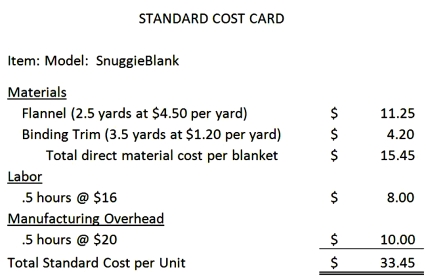 The company reported the following results concerning January results:
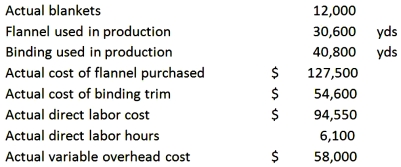 The material price variance for Flannel used in January is:
The company reported the following results concerning January results: The material price variance for Flannel used in January is: (Multiple Choice)
4.9/5 (76)
(76) Weaver Corporation has a three-year contract with a security firm that sets hourly wage rates for the firm at $10 per hour.At 7,000 units of output,factory security costs were $14,000.With an expected increase in production next year to a level of 10,000 units,the anticipated security costs are expected to remain the same.The security costs are an example of fixed factory costs.
(True/False)
4.8/5 (74)
(74) Better Blankets,Inc.makes a SnuggieBlank using flannel material and trim binding.They have instituted a successful JIT system and thus no longer have to stock inventory prior to their production need.The Standard Cost Card for The SnuggieBlank model is shown. 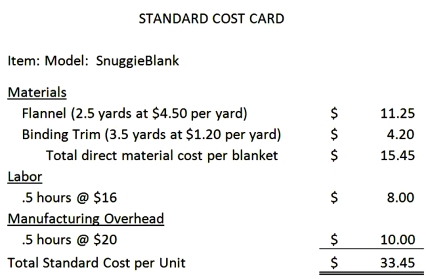 The company reported the following results concerning January results:
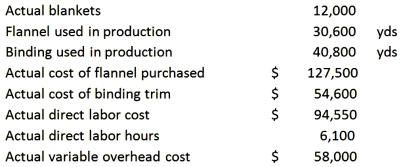 The material quantity variance for Trim used in January is:
The company reported the following results concerning January results: The material quantity variance for Trim used in January is: (Multiple Choice)
4.8/5 (67)
(67) Reelmates manufactures fishing poles.In a recent month,the company budgeted production of 2,000 poles.Actual production was 2,200.According to the standard cost card,each pole requires 3 feet of fiberglass rod at a cost of $9 per foot.Reelmates used 6,500 feet of rod at a net cost of $65,000 for the period. The material usage variance was:
(Multiple Choice)
4.8/5 (70)
(70) A price variance for an item is the difference between its actual price and its standard price multiplied by the standard quantity.
(True/False)
4.9/5 (90)
(90) The manufacturing cost budget will include both variable and fixed manufacturing costs.
(True/False)
4.9/5 (88)
(88) The cost of utilities consumed in the factory is a good example of
(Multiple Choice)
4.9/5 (78)
(78) Budgeting for manufacturing overhead is the simplest of total product costs to compute as its cost behavior is fixed.
(True/False)
4.9/5 (77)
(77) As the level of activity increases,the total fixed costs for the period
(Multiple Choice)
4.9/5 (78)
(78) The price variance for an item is the difference between its actual price and its standard price,multiplied by the ____________________ quantity.
(Essay)
4.7/5 (84)
(84) Regression analysis is a more sophisticated technique than the high-low method,and often leads to higher confidence in the projected costs.
(True/False)
4.9/5 (78)
(78) Petersen Company produces a single product with the following production and average cost data:  The best estimate of the monthly fixed cost is:
 (Multiple Choice)
4.8/5 (77)
(77) As the level of activity increases,the fixed cost per unit of activity
(Multiple Choice)
5.0/5 (68)
(68) A flexible budget that is prepared based on the actual activity level achieved in a period provides a more precise measure of efficiency and control when evaluating actual costs.
(True/False)
4.9/5 (71)
(71) Efficiency and cost control can be evaluated by comparing actual overhead costs with the budget for the actual level of operations with the
(Multiple Choice)
4.8/5 (84)
(84) 
Filters
- Essay(0)
- Multiple Choice(0)
- Short Answer(0)
- True False(0)
- Matching(0)