



 Chat with AI
Exam 30: Cost-Revenue Analysis for Decision Making

Exam 1: Accounting: the Language of Business82 Questions
Exam 2: Analyzing Business Transactions93 Questions
Exam 3: Analyzing Business Transactions Using T Accounts107 Questions
Exam 4: The General Journal and the General Ledger85 Questions
Exam 5: Adjustments and the Worksheet76 Questions
Exam 6: Closing Entries and the Postclosing Trial Balance80 Questions
Exam 7: Accounting for Sales and Accounts Receivable76 Questions
Exam 8: Accounting for Purchases and Accounts Payable89 Questions
Exam 9: Cash Receipts, Cash Payments, and Banking Procedures88 Questions
Exam 10: Payroll Computations, Records, and Payment79 Questions
Exam 11: Payroll Taxes, Deposits, and Reports82 Questions
Exam 12: Accruals, Deferrals, and the Worksheet84 Questions
Exam 13: Financial Statements and Closing Procedures38 Questions
Exam 14: Accounting Principles and Reporting Standards67 Questions
Exam 15: Accounts Receivable and Uncollectible Accounts65 Questions
Exam 16: Notes Payable and Notes Receivable83 Questions
Exam 17: Merchandise Inventory91 Questions
Exam 18: Property, Plant, and Equipment118 Questions
Exam 19: Accounting for Partnerships106 Questions
Exam 20: Corporations: Formation and Capital Stock Transactions76 Questions
Exam 21: Corporate Earnings and Capital Transactions99 Questions
Exam 22: Long-Term Bonds105 Questions
Exam 23: Financial Statement Analyses107 Questions
Exam 24: The Statement of Cash Flows114 Questions
Exam 25: Departmentalized Profit and Cost Centers103 Questions
Exam 26: Accounting for Manufacturing Activities103 Questions
Exam 27: Job Order Cost Accounting102 Questions
Exam 28: Process Cost Accounting94 Questions
Exam 29: Controlling Manufacturing Costs: Standard Costs118 Questions
Exam 30: Cost-Revenue Analysis for Decision Making124 Questions
Select questions type


Generally Accepted Accounting Principles require the use of direct costing for financial reporting purposes.

Free
(True/False)
4.9/5  (77)
(77) Correct Answer: Verified
False
The sum of unit variable and fixed costs are used as a basis for determining whether to accept or reject a special order.
Free
(True/False)
4.8/5 (81)
(81) Correct Answer:Verified
VerifiedFalse
Using the given information,determine the income under both the absorption and the direct (variable)costing methods for CRL Company this year.Explain the difference,if any. 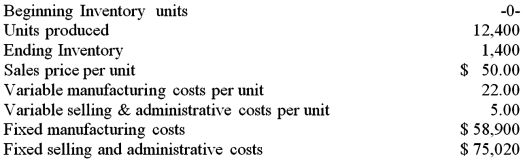
Free
(Essay)
4.9/5 (66)
(66) Correct Answer:Verified
VerifiedCRL Company income under absorption costing is $125,730 and under direct costing it is $119,080.The difference is the $4.75 per unit fixed manufacturing cost times the 1,400 units in ending inventory ($6,650)that is in ending inventory and not on the income statement under absorption costing.
The following information relates to the purchase of new machine being considered. 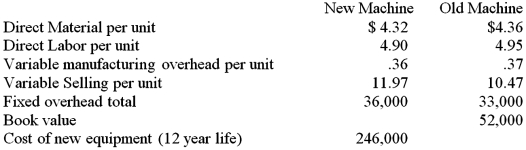 The new machine would enable the company to make 13,500 units per year.The current capacity of 12,000 is based on the maximum number of units that the old machine can produce.The company has had to turn down orders in the past few years due to this limit on capacity and estimates that it can sell as many of the product as it can produce.The sales price per unit of the product is $34.50.Determine the relevant data.Pose one addition consideration regarding this decision.
 (Essay)
4.8/5 (89)
(89) The profitability of a segment is judged by its contribution margin.
(True/False)
4.9/5 (93)
(93) 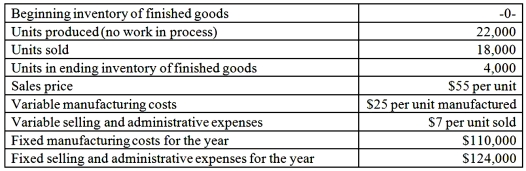 Using direct costing,the manufacturing margin is:
Green Manufacturing makes 30,000 units per year of a part used in the manufacture of its new camcorder.An outside supplier has offered to sell Green all of these parts for $48 a unit.If the parts were purchased from the supplier,all of the direct labor costs would be avoided as well as $5 of manufacturing overhead costs per unit.Product cost information for the part under review follows: 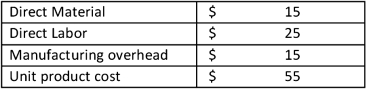 How much of the unit product cost is relevant in the decision of whether to make or buy the part?
 (Multiple Choice)
4.7/5 (81)
(81) In deciding whether to manufacture or to purchase a product,____________________ costs are generally ignored.
(Essay)
4.8/5 (76)
(76) The difference in cost between one alternative and another is called a(n)____________________ cost.
(Essay)
4.8/5 (72)
(72) If a decision must be made to replace a machine,the book value of the existing machine is a sunk cost.
(True/False)
4.9/5 (75)
(75) The difference between revenue and variable costs is referred to as the ___________________.
(Essay)
4.8/5 (75)
(75) Which of the following is not true of the direct costing procedure?
(Multiple Choice)
4.8/5 (82)
(82) If the finished goods inventory decreases during the period,the reported net income will be larger under variable costing than under absorption costing.
(True/False)
4.8/5 (76)
(76) If a segment of a business is expected to produce an annual contribution margin of $30,000 but is also expected to incur controllable fixed costs of about $40,000 annually,that segment should probably be discontinued.
(True/False)
4.8/5 (72)
(72) On an income statement prepared with a direct costing approach,the excess of sales over the cost of goods sold,based on variable costs only,is referred to as
(Multiple Choice)
4.8/5 (74)
(74) Costs that are not directly traceable to any specific department are called ____________________ costs.
(Essay)
5.0/5 (83)
(83) Under absorption costing,a portion of the fixed manufacturing overhead is deferred to future periods as part of the inventory value.
(True/False)
4.9/5 (68)
(68) Timkon Manufacturing has provided the following operating results for its recent operations: 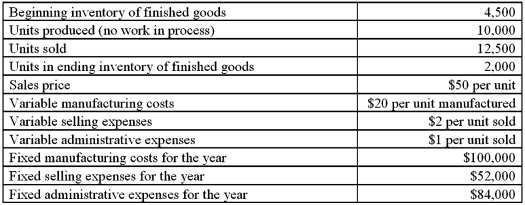 Using the direct method,cost of goods manufactured for the year is:
 (Multiple Choice)
4.8/5 (80)
(80) 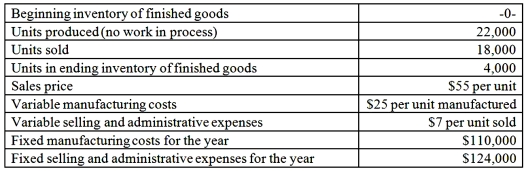 Using the absorption method,cost of goods manufactured for the year is:
 (Multiple Choice)
4.8/5 (83)
(83) 
Filters
- Essay(0)
- Multiple Choice(0)
- Short Answer(0)
- True False(0)
- Matching(0)