



 Chat with AI
Exam 30: Cost-Revenue Analysis for Decision Making

Exam 1: Accounting: the Language of Business82 Questions
Exam 2: Analyzing Business Transactions93 Questions
Exam 3: Analyzing Business Transactions Using T Accounts107 Questions
Exam 4: The General Journal and the General Ledger85 Questions
Exam 5: Adjustments and the Worksheet76 Questions
Exam 6: Closing Entries and the Postclosing Trial Balance80 Questions
Exam 7: Accounting for Sales and Accounts Receivable76 Questions
Exam 8: Accounting for Purchases and Accounts Payable89 Questions
Exam 9: Cash Receipts, Cash Payments, and Banking Procedures88 Questions
Exam 10: Payroll Computations, Records, and Payment79 Questions
Exam 11: Payroll Taxes, Deposits, and Reports82 Questions
Exam 12: Accruals, Deferrals, and the Worksheet84 Questions
Exam 13: Financial Statements and Closing Procedures38 Questions
Exam 14: Accounting Principles and Reporting Standards67 Questions
Exam 15: Accounts Receivable and Uncollectible Accounts65 Questions
Exam 16: Notes Payable and Notes Receivable83 Questions
Exam 17: Merchandise Inventory91 Questions
Exam 18: Property, Plant, and Equipment118 Questions
Exam 19: Accounting for Partnerships106 Questions
Exam 20: Corporations: Formation and Capital Stock Transactions76 Questions
Exam 21: Corporate Earnings and Capital Transactions99 Questions
Exam 22: Long-Term Bonds105 Questions
Exam 23: Financial Statement Analyses107 Questions
Exam 24: The Statement of Cash Flows114 Questions
Exam 25: Departmentalized Profit and Cost Centers103 Questions
Exam 26: Accounting for Manufacturing Activities103 Questions
Exam 27: Job Order Cost Accounting102 Questions
Exam 28: Process Cost Accounting94 Questions
Exam 29: Controlling Manufacturing Costs: Standard Costs118 Questions
Exam 30: Cost-Revenue Analysis for Decision Making124 Questions
Select questions type


Opportunity costs are calculated as the difference between two alternatives.
(True/False)
4.9/5  (71)
(71) Which of the following cost amounts can be found in a firm's accounting records?
(Multiple Choice)
4.9/5 (72)
(72) In its first year of operations,a company has sales of $150,000,ending finished goods inventory of $10,000,variable manufacturing costs of $50,000,and fixed manufacturing costs of $30,000 for the year.The company pays 10% commission to its sales force and has fixed selling and administrative expenses of $25,000 annually.The company has no other variable expenses.Assuming the company uses direct costing,the contribution margin for the year is
(Multiple Choice)
4.8/5 (80)
(80) Green Manufacturing makes 30,000 units per year of a part used in the manufacture of its new camcorder.An outside supplier has offered to sell Green all of these parts for $48 a unit.If the parts were purchased from the supplier,all of the direct labor costs would be avoided as well as $5 of manufacturing overhead costs per unit.Product cost information for the part under review follows: 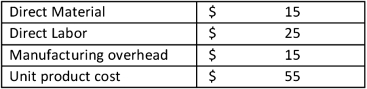 If Green has no other use for the space vacated by the decision to purchase the part from the outside supplier,what is the net total dollar advantage (disadvantage)of purchasing the part rather than making it?
 (Multiple Choice)
4.9/5 (78)
(78) When inventories decrease,the absorption costing income statement will report lower net income than reported under variable costing.
(True/False)
4.7/5 (82)
(82) In deciding whether to manufacture or to purchase a product,fixed costs are generally ignored.
(True/False)
4.9/5 (77)
(77) Tyro Manufacturing has a machine that requires frequent repairs.Production is stopped and as a result some shipment dates have not been met.The manager read in their industry's trade magazine about a new machine that has just been developed.Using the given headings,list the six steps of the decision-making process.Relate each of the first five to this specific situation using the format provided. 
(Essay)
4.9/5 (67)
(67) Using the given information,determine the income under both the absorption and the direct (variable)costing methods for the company for the year.Explain the difference,if any. 
(Essay)
4.8/5 (79)
(79) Net income under direct costing and absorption costing approaches will always equal.
(True/False)
4.8/5 (89)
(89) Which of the following is NOT a consideration regarding the purchase of new equipment when looking at the net income under each alternative?
(Multiple Choice)
4.8/5 (88)
(88) 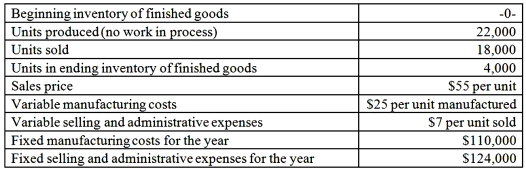 Using the absorption method,the gross profit on sales is:
It is appropriate to consider nonfinancial factors in the decision-making process.
(True/False)
4.9/5 (86)
(86) Timkon Manufacturing has provided the following operating results for its recent operations: 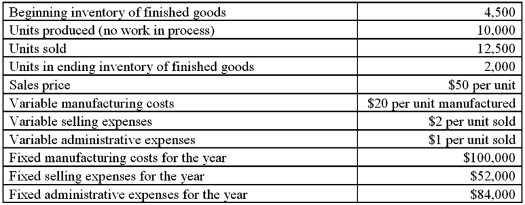 Assuming beginning inventory cost per unit is not different than ending inventory cost,the value of the ending inventory under absorption costing is:
 (Multiple Choice)
4.8/5 (83)
(83) Under the contribution margin approach,common costs are deducted from the total of all segment contributions to determine the company's profit.
(True/False)
4.8/5 (69)
(69) 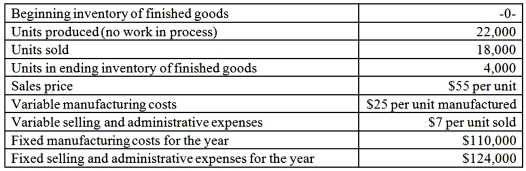 Using direct costing,the value of ending inventory of finished goods is:
 (Multiple Choice)
4.7/5 (94)
(94) Manufacturing margin less the sum of variable manufacturing overhead and variable selling and administrative expenses equals marginal income.
(True/False)
4.7/5 (87)
(87) Income statements prepared on a(n)____________________ costing basis usually provide data in a form more useful for internal decision making.
(Essay)
4.8/5 (72)
(72) 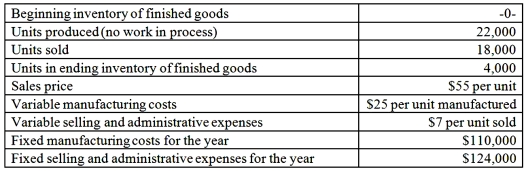 Using the absorption method,the value of ending inventory of finished goods is:
 (Multiple Choice)
4.9/5 (81)
(81) A segment of a business shows a contribution margin of $30,000 but incurs controllable fixed costs of $26,000.Eliminating that segment will result in an increase in company-wide net income.
(True/False)
5.0/5 (68)
(68) 
Filters
- Essay(0)
- Multiple Choice(0)
- Short Answer(0)
- True False(0)
- Matching(0)