



 Chat with AI
Exam 19: Decision Making

Exam 1: Defining and Collecting Data189 Questions
Exam 3: Numerical Descriptive Measures184 Questions
Exam 4: Basic Probability156 Questions
Exam 5: Discrete Probability Distributions218 Questions
Exam 6: The Normal Distribution and Other Continuous Distributions189 Questions
Exam 7: Sampling Distributions127 Questions
Exam 8: Confidence Interval Estimation196 Questions
Exam 9: Fundamentals of Hypothesis Testing: One-Sample Tests170 Questions
Exam 10: Two-Sample Tests210 Questions
Exam 11: Analysis of Variance130 Questions
Exam 12: Chi-Square Tests and Nonparametric Tests175 Questions
Exam 13: Simple Linear Regression213 Questions
Exam 14: Introduction to Multiple Regression337 Questions
Exam 15: Multiple Regression Model Building96 Questions
Exam 16: Time-Series Forecasting165 Questions
Exam 17: A Roadmap for Analyzing Data303 Questions
Exam 18: Statistical Applications in Quality Management130 Questions
Exam 19: Decision Making126 Questions
Exam 20: Index Numbers44 Questions
Exam 21: Chi-Square Tests for the Variance or Standard Deviation11 Questions
Exam 22: Mcnemar Test for the Difference Between Two Proportions Related Samples15 Questions
Exam 25: The Analysis of Means Anom2 Questions
Exam 23: The Analysis of Proportions Anop3 Questions
Exam 24: The Randomized Block Design85 Questions
Exam 26: The Power of a Test41 Questions
Exam 27: Estimation and Sample Size Determination for Finite Populations13 Questions
Exam 28: Application of Confidence Interval Estimation in Auditing13 Questions
Exam 29: Sampling From Finite Populations20 Questions
Exam 30: The Normal Approximation to the Binomial Distribution27 Questions
Exam 31: Counting Rules14 Questions
Exam 32: Lets Get Started Big Things to Learn First33 Questions
Select questions type


TABLE 19-1
The following payoff table shows profits associated with a set of 3 alternatives under 2 possible states of nature 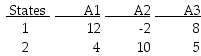
 -Blossom's Flowers purchases roses for sale for Valentine's Day.The roses are purchased for $10 a dozen and are sold for $20 a dozen.Any roses not sold on Valentine's Day can be sold for $5 per dozen.The owner will purchase 1 of 3 amounts of roses for Valentine's Day: 100,200,or 400 dozen roses.If the probability of selling 100 dozen roses is 0.2 and 200 dozen roses is 0.5,then the probability of selling 400 dozen roses is
 (Multiple Choice)
4.8/5  (81)
(81) TABLE 19-6
A student wanted to find out the optimal strategy to study for a Business Statistics exam.He constructed the following payoff table based on the mean amount of time he needed to study every week for the course and the degree of difficulty of the exam.From the information that he gathered from students who had taken the course,he concluded that there was a 40% probability that the exam would be easy.  -True or False: Referring to Table 19-6,the optimal strategy using the return-to-risk ratio criterion is to study 8 hours per week on average for the exam.
 (True/False)
4.9/5 (68)
(68) At Eastern University,60% of the students are from suburban areas,30% are from rural areas,and 10% are from urban areas.Of the students from the suburban areas,60% are nonbusiness majors.Of the students from the rural areas,70% are nonbusiness majors.Of the students from the urban areas,90% are nonbusiness majors.If a randomly selected student is not a business major,the probability that the student is from the urban area is
(Multiple Choice)
4.9/5 (70)
(70) A medical doctor is involved in a $1 million malpractice suit.He can either settle out of court for $250,000 or go to court.If he goes to court and loses,he must pay $825,000 plus $175,000 in court costs.If he wins in court the plaintiffs pay the court costs.Identify the states of nature of this decision-making problem.
(Multiple Choice)
4.9/5 (73)
(73) Look at the utility function graphed below and select the type of decision-maker that corresponds to the graph. 
(Multiple Choice)
4.8/5 (87)
(87) TABLE 19-6
A student wanted to find out the optimal strategy to study for a Business Statistics exam.He constructed the following payoff table based on the mean amount of time he needed to study every week for the course and the degree of difficulty of the exam.From the information that he gathered from students who had taken the course,he concluded that there was a 40% probability that the exam would be easy.
-True or False: Referring to Table 19-6,the optimal strategy using the maximax criterion is to study 16 hours per week on average for the exam.
-True or False: Referring to Table 19-6,the optimal strategy using the maximax criterion is to study 16 hours per week on average for the exam. (True/False)
4.7/5 (76)
(76) 
Filters
- Essay(0)
- Multiple Choice(0)
- Short Answer(0)
- True False(0)
- Matching(0)