



 Chat with AI
Exam 3: The Supply and Demand Model

Exam 1: The Central Idea156 Questions
Exam 2: Observing and Explaining the Economy143 Questions
Exam 3: The Supply and Demand Model166 Questions
Exam 4: Subtleties of the Supply and Demand Model176 Questions
Exam 5: The Demand Curve and the Behavior of Consumers176 Questions
Exam 6: The Supply Curve and the Behavior of Firms179 Questions
Exam 7: The Efficiency of Markets163 Questions
Exam 8: Costs and the Changes at Firms Over Time191 Questions
Exam 9: The Rise and Fall of Industries139 Questions
Exam 10: Monopoly184 Questions
Exam 11: Product Differentiation, Monopolistic Competition, and Oligopoly169 Questions
Exam 12: Antitrust Policy and Regulation152 Questions
Exam 13: Labor Markets179 Questions
Exam 14: Taxes, Transfers, and Income Distribution179 Questions
Exam 15: Public Goods, Externalities, and Government Behavior197 Questions
Exam 16: Capital and Financial Markets188 Questions
Exam 17: Macroeconomics: the Big Picture159 Questions
Exam 18: Measuring the Production, Income, and Spending of Nations177 Questions
Exam 19: The Spending Allocation Model166 Questions
Exam 20: Unemployment and Employment212 Questions
Exam 21: Productivity and Economic Growth162 Questions
Exam 22: Money and Inflation153 Questions
Exam 23: The Nature and Causes of Economic Fluctuations185 Questions
Exam 24: The Economic Fluctuations Model205 Questions
Exam 25: Using the Economic Fluctuations Model176 Questions
Exam 26: Fiscal Policy138 Questions
Exam 27: Monetary Policy180 Questions
Exam 28: Economic Growth Around the World157 Questions
Exam 29: International Trade242 Questions
Exam 30: International Finance125 Questions
Select questions type


The law of supply states that the quantity supplied of a good is positively related to the price of that good.
(True/False)
5.0/5  (84)
(84) Exhibit 3-2 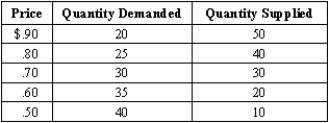 -In the market represented in Exhibit 3-2, if price rises from $.70 to $.80 as a result of government mandate, then
 (Multiple Choice)
5.0/5 (81)
(81) Which of the following will not cause the demand for ice cream to change?
(Multiple Choice)
4.9/5 (77)
(77) An increase in the minimum wage will not affect the supply of hamburgers sold by McDonald's, which hires workers mostly at the minimum wage rate.
(True/False)
4.9/5 (90)
(90) The principle that producers sell more of a good or service when the price increases, all else held equal, is called the law of
(Multiple Choice)
4.8/5 (74)
(74) When consumers expect the price of a good to go down in the future, demand will
(Multiple Choice)
4.8/5 (91)
(91) Which of the following is not held constant when constructing a supply curve for good X?
(Multiple Choice)
4.9/5 (80)
(80) If goods X and Y are substitutes, then the demand for good X increases when the price of good Y decreases.
(True/False)
4.9/5 (80)
(80) Exhibit 3-5
 -Suppose that the price of bananas has been rising while the amount sold has been falling. Which of the following is the best explanation?

-Suppose that the price of bananas has been rising while the amount sold has been falling. Which of the following is the best explanation?
(Essay)
4.9/5 (82)
(82) When supply shifts right and demand shifts left at the same time, the equilibrium market price drops.
(True/False)
4.8/5 (92)
(92) A rightward shift of a supply curve represents an increase in supply.
(True/False)
4.8/5 (93)
(93) What is the principle that explains the relationship between price and quantity demanded?
(Short Answer)
4.8/5 (69)
(69) Use the supply and demand model to explain what happens to the equilibrium price and the equilibrium quantity for pasta in the following cases:

(Essay)
4.9/5 (77)
(77) An increase in supply and demand at the same time will always result in a higher equilibrium market price.
(True/False)
4.7/5 (78)
(78) All else held equal, if the price of sirloin steak increases from $4.25 to $8.60 per pound, a greater quantity of sirloin steak will be supplied.
(True/False)
4.8/5 (72)
(72) Each supply and demand model consists of all the following three elements:
(Multiple Choice)
4.8/5 (79)
(79) 
Filters
- Essay(0)
- Multiple Choice(0)
- Short Answer(0)
- True False(0)
- Matching(0)