



 Chat with AI
Exam 3: The Supply and Demand Model

Exam 1: The Central Idea156 Questions
Exam 2: Observing and Explaining the Economy143 Questions
Exam 3: The Supply and Demand Model166 Questions
Exam 4: Subtleties of the Supply and Demand Model176 Questions
Exam 5: The Demand Curve and the Behavior of Consumers176 Questions
Exam 6: The Supply Curve and the Behavior of Firms179 Questions
Exam 7: The Efficiency of Markets163 Questions
Exam 8: Costs and the Changes at Firms Over Time191 Questions
Exam 9: The Rise and Fall of Industries139 Questions
Exam 10: Monopoly184 Questions
Exam 11: Product Differentiation, Monopolistic Competition, and Oligopoly169 Questions
Exam 12: Antitrust Policy and Regulation152 Questions
Exam 13: Labor Markets179 Questions
Exam 14: Taxes, Transfers, and Income Distribution179 Questions
Exam 15: Public Goods, Externalities, and Government Behavior197 Questions
Exam 16: Capital and Financial Markets188 Questions
Exam 17: Macroeconomics: the Big Picture159 Questions
Exam 18: Measuring the Production, Income, and Spending of Nations177 Questions
Exam 19: The Spending Allocation Model166 Questions
Exam 20: Unemployment and Employment212 Questions
Exam 21: Productivity and Economic Growth162 Questions
Exam 22: Money and Inflation153 Questions
Exam 23: The Nature and Causes of Economic Fluctuations185 Questions
Exam 24: The Economic Fluctuations Model205 Questions
Exam 25: Using the Economic Fluctuations Model176 Questions
Exam 26: Fiscal Policy138 Questions
Exam 27: Monetary Policy180 Questions
Exam 28: Economic Growth Around the World157 Questions
Exam 29: International Trade242 Questions
Exam 30: International Finance125 Questions
Select questions type


Which of the following would not affect the supply of automobiles?
(Multiple Choice)
4.8/5  (89)
(89) Exhibit 3-3  -Refer to Exhibit 3-3. The equilibrium price and quantity in the market are
 (Multiple Choice)
4.8/5 (81)
(81) Exhibit 3-2 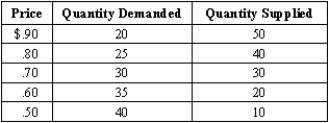 -In the market represented in Exhibit 3-2, if price is $.50,
 (Multiple Choice)
4.8/5 (89)
(89) If the government decides to pay producers of houses $5,000 for every house they build,
(Multiple Choice)
4.9/5 (76)
(76) Which of the following leads to a leftward shift of the demand curve?
(Multiple Choice)
4.9/5 (86)
(86) Exhibit 3-3
-A market is in equilibrium when a price is low enough for all consumers to afford.
-A market is in equilibrium when a price is low enough for all consumers to afford. (True/False)
4.8/5 (81)
(81) Which of the following would be a likely cause for the decreases in gasoline prices after 2014?
(Multiple Choice)
4.9/5 (84)
(84) If it is discovered that using a smartphone regularly causes brain cancer, then in the market for smartphones,
(Multiple Choice)
4.9/5 (91)
(91) The demand schedule is a table or list of the prices and corresponding quantities demanded of a particular good or service.
(True/False)
4.9/5 (90)
(90) Exhibit 3-1  -Consider the market described by the schedule in Exhibit 3-1. At a price of $5 per unit,
 (Multiple Choice)
5.0/5 (93)
(93) When a shortage exists in a market, the actual price is greater than the equilibrium price.
(True/False)
4.8/5 (91)
(91) When economists say that the demand for a product has increased, they mean that consumers are willing to buy more of the product at any given price.
(True/False)
4.9/5 (90)
(90) If the demand curve for product X shifts to the left as the price of product Y increases, then X and Y are complementary goods.
(True/False)
4.8/5 (82)
(82) 
Filters
- Essay(0)
- Multiple Choice(0)
- Short Answer(0)
- True False(0)
- Matching(0)