



 Chat with AI
Exam 8: Costs and the Changes at Firms Over Time

Exam 1: The Central Idea156 Questions
Exam 2: Observing and Explaining the Economy143 Questions
Exam 3: The Supply and Demand Model166 Questions
Exam 4: Subtleties of the Supply and Demand Model176 Questions
Exam 5: The Demand Curve and the Behavior of Consumers176 Questions
Exam 6: The Supply Curve and the Behavior of Firms179 Questions
Exam 7: The Efficiency of Markets163 Questions
Exam 8: Costs and the Changes at Firms Over Time191 Questions
Exam 9: The Rise and Fall of Industries139 Questions
Exam 10: Monopoly184 Questions
Exam 11: Product Differentiation, Monopolistic Competition, and Oligopoly169 Questions
Exam 12: Antitrust Policy and Regulation152 Questions
Exam 13: Labor Markets179 Questions
Exam 14: Taxes, Transfers, and Income Distribution179 Questions
Exam 15: Public Goods, Externalities, and Government Behavior197 Questions
Exam 16: Capital and Financial Markets188 Questions
Exam 17: Macroeconomics: the Big Picture159 Questions
Exam 18: Measuring the Production, Income, and Spending of Nations177 Questions
Exam 19: The Spending Allocation Model166 Questions
Exam 20: Unemployment and Employment212 Questions
Exam 21: Productivity and Economic Growth162 Questions
Exam 22: Money and Inflation153 Questions
Exam 23: The Nature and Causes of Economic Fluctuations185 Questions
Exam 24: The Economic Fluctuations Model205 Questions
Exam 25: Using the Economic Fluctuations Model176 Questions
Exam 26: Fiscal Policy138 Questions
Exam 27: Monetary Policy180 Questions
Exam 28: Economic Growth Around the World157 Questions
Exam 29: International Trade242 Questions
Exam 30: International Finance125 Questions
Select questions type


Draw typical average total cost, average variable cost, and marginal cost curves for a competitive firm with price at the shutdown point. Show that total revenue equals variable costs at this quantity. Also show the firm's losses at this quantity.
(Essay)
4.8/5  (90)
(90) Exhibit 8-5  -Refer to Exhibit 8-5. The curve marked I is the firm's
 (Multiple Choice)
4.8/5 (90)
(90) Long-run average cost and short-run average cost curves have their U-shapes for the same reasons.
(True/False)
4.8/5 (73)
(73) Exhibit 8-11 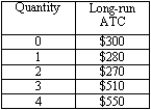 -Economies of scale can exist in both the short run and the long run.
 (True/False)
4.8/5 (79)
(79) Fixed cost does not vary with the quantity of output that a firm produces.
(True/False)
4.8/5 (83)
(83) If the average score of the first two exams is 85 and the score of the third exam is lower than 85, then the average score of all three exams must be lower than 85.
(True/False)
4.7/5 (83)
(83) Exhibit 8-3  -Both fixed cost and average fixed cost do not decline as the quantity of output increases.
 (True/False)
4.9/5 (80)
(80) Exhibit 8-5
-If average fixed cost is falling with increasing output, then
-If average fixed cost is falling with increasing output, then (Multiple Choice)
4.8/5 (92)
(92) The marginal cost curve intersects the average total cost curve at the lowest point of the average total cost curve.
(True/False)
4.7/5 (84)
(84) Capital expansion causes the average total cost to decrease at low levels of output but increase at high levels of output.
(True/False)
4.9/5 (84)
(84) Exhibit 8-2  -Refer to Exhibit 8-2. At an output quantity of 3 units, the variable cost is
 (Multiple Choice)
4.7/5 (72)
(72) Exhibit 8-5
-Refer to Exhibit 8-5. At an output level of K,
-Refer to Exhibit 8-5. At an output level of K, (Multiple Choice)
4.8/5 (74)
(74) Exhibit 8-2
-Refer to Exhibit 8-2. The marginal cost of producing the sixth unit of output is
-Refer to Exhibit 8-2. The marginal cost of producing the sixth unit of output is (Multiple Choice)
4.9/5 (74)
(74) When marginal cost is greater than average variable cost but less than average total cost,
(Multiple Choice)
4.9/5 (69)
(69) Suppose one firm buys cattle to process only the skins for leather, and another firm buys cattle to process only the meat for food. If the two firms merged, they would experience
(Multiple Choice)
4.9/5 (70)
(70) Are there economies of scale for a waiter serving customers in a restaurant? What economies of scale are realized if party sizes increase? Is there a maximum party size beyond which scale diseconomies are experienced?
(Essay)
4.9/5 (90)
(90) Consider the relationship between the average test score of a class and one student's test score. Suppose there are 10 students with an average test score of 80. Suppose the marginal score is the test score of a new student, Kelly.

(Essay)
4.9/5 (94)
(94) 
Filters
- Essay(0)
- Multiple Choice(0)
- Short Answer(0)
- True False(0)
- Matching(0)