



 Chat with AI
Exam 8: Costs and the Changes at Firms Over Time

Exam 1: The Central Idea156 Questions
Exam 2: Observing and Explaining the Economy143 Questions
Exam 3: The Supply and Demand Model166 Questions
Exam 4: Subtleties of the Supply and Demand Model176 Questions
Exam 5: The Demand Curve and the Behavior of Consumers176 Questions
Exam 6: The Supply Curve and the Behavior of Firms179 Questions
Exam 7: The Efficiency of Markets163 Questions
Exam 8: Costs and the Changes at Firms Over Time191 Questions
Exam 9: The Rise and Fall of Industries139 Questions
Exam 10: Monopoly184 Questions
Exam 11: Product Differentiation, Monopolistic Competition, and Oligopoly169 Questions
Exam 12: Antitrust Policy and Regulation152 Questions
Exam 13: Labor Markets179 Questions
Exam 14: Taxes, Transfers, and Income Distribution179 Questions
Exam 15: Public Goods, Externalities, and Government Behavior197 Questions
Exam 16: Capital and Financial Markets188 Questions
Exam 17: Macroeconomics: the Big Picture159 Questions
Exam 18: Measuring the Production, Income, and Spending of Nations177 Questions
Exam 19: The Spending Allocation Model166 Questions
Exam 20: Unemployment and Employment212 Questions
Exam 21: Productivity and Economic Growth162 Questions
Exam 22: Money and Inflation153 Questions
Exam 23: The Nature and Causes of Economic Fluctuations185 Questions
Exam 24: The Economic Fluctuations Model205 Questions
Exam 25: Using the Economic Fluctuations Model176 Questions
Exam 26: Fiscal Policy138 Questions
Exam 27: Monetary Policy180 Questions
Exam 28: Economic Growth Around the World157 Questions
Exam 29: International Trade242 Questions
Exam 30: International Finance125 Questions
Select questions type


Marginal product of labor is the change in output divided by a change in labor input.
(True/False)
4.8/5  (78)
(78) Sketch a typical isocost line and isoquant where a firm is minimizing total cost for a given quantity of output. Suppose the price of labor rises and the price of capital doesn't change. What does the firm do to maintain the original level of output? How does its input use change?
(Essay)
4.8/5 (86)
(86) Economies of scale and economies of scope are related and occur for the same reason.
(True/False)
4.8/5 (78)
(78) If a profit-maximizing firm is producing at the tangency between an isoquant and an isocost line, then a movement along the current isocost line
(Multiple Choice)
4.9/5 (78)
(78)  -Marginal cost equals
Which of the following is characteristic of short-run costs associated with increasing levels of output?
(Multiple Choice)
4.9/5 (68)
(68) Exhibit 8-6  -Refer to Exhibit 8-6. If the market price is $10, the firm's profits are
 (Multiple Choice)
4.9/5 (84)
(84) When a one-unit increase in input increases output more than the previous unit of input, we say that there are
(Multiple Choice)
4.9/5 (96)
(96) Fill in the table below for a competitive firm that can sell its product for $7 a unit. 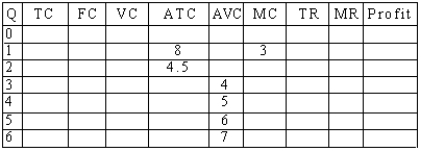

(Essay)
4.9/5 (91)
(91) Capital expansion can be shown as a shift in the average total curve.
(True/False)
5.0/5 (72)
(72) Exhibit 8-5  -Refer to Exhibit 8-5. At an output level of L, average fixed cost is
 (Multiple Choice)
4.9/5 (75)
(75) Exhibit 8-4 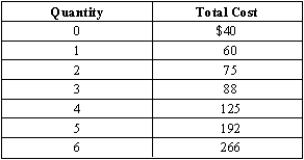 -Refer to Exhibit 8-4. Calculate the average variable cost for the fifth unit of output.
(Essay)
4.9/5 (79)
(79) Exhibit 8-5
-Refer to Exhibit 8-5. The curve marked II is the firm's
-Refer to Exhibit 8-5. The curve marked II is the firm's (Multiple Choice)
4.8/5 (88)
(88) Some competitive firms are willing to operate at a loss in the short run because their revenues are at least able to cover their fixed costs.
(True/False)
4.8/5 (74)
(74) 
Filters
- Essay(0)
- Multiple Choice(0)
- Short Answer(0)
- True False(0)
- Matching(0)