



 Chat with AI
Exam 9: The Rise and Fall of Industries

Exam 1: The Central Idea156 Questions
Exam 2: Observing and Explaining the Economy143 Questions
Exam 3: The Supply and Demand Model166 Questions
Exam 4: Subtleties of the Supply and Demand Model176 Questions
Exam 5: The Demand Curve and the Behavior of Consumers176 Questions
Exam 6: The Supply Curve and the Behavior of Firms179 Questions
Exam 7: The Efficiency of Markets163 Questions
Exam 8: Costs and the Changes at Firms Over Time191 Questions
Exam 9: The Rise and Fall of Industries139 Questions
Exam 10: Monopoly184 Questions
Exam 11: Product Differentiation, Monopolistic Competition, and Oligopoly169 Questions
Exam 12: Antitrust Policy and Regulation152 Questions
Exam 13: Labor Markets179 Questions
Exam 14: Taxes, Transfers, and Income Distribution179 Questions
Exam 15: Public Goods, Externalities, and Government Behavior197 Questions
Exam 16: Capital and Financial Markets188 Questions
Exam 17: Macroeconomics: the Big Picture159 Questions
Exam 18: Measuring the Production, Income, and Spending of Nations177 Questions
Exam 19: The Spending Allocation Model166 Questions
Exam 20: Unemployment and Employment212 Questions
Exam 21: Productivity and Economic Growth162 Questions
Exam 22: Money and Inflation153 Questions
Exam 23: The Nature and Causes of Economic Fluctuations185 Questions
Exam 24: The Economic Fluctuations Model205 Questions
Exam 25: Using the Economic Fluctuations Model176 Questions
Exam 26: Fiscal Policy138 Questions
Exam 27: Monetary Policy180 Questions
Exam 28: Economic Growth Around the World157 Questions
Exam 29: International Trade242 Questions
Exam 30: International Finance125 Questions
Select questions type


The long-run competitive equilibrium results in efficient allocation of capital.
(True/False)
4.8/5  (77)
(77) A technological breakthrough that reduces the cost of materials in a perfectly competitive industry would, in the long run,
(Multiple Choice)
4.8/5 (68)
(68) Suppose a competitive industry is in long-run equilibrium. When demand increases, market price
(Multiple Choice)
4.9/5 (99)
(99) Exhibit 9-1 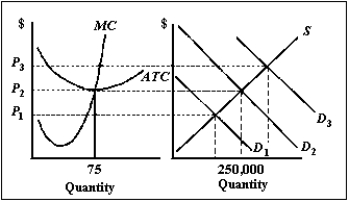 -Refer to Exhibit 9-1. If the market demand curve is D3, what happens over time?
 (Multiple Choice)
4.8/5 (84)
(84) An industry previously in long-run equilibrium might experience economic profits for any of the following reasons except when
(Multiple Choice)
4.8/5 (83)
(83) The long-run competitive equilibrium model describes what happens to an industry after
(Multiple Choice)
4.9/5 (74)
(74) External diseconomies cause the long-run industry supply curve to
(Multiple Choice)
4.7/5 (78)
(78) Explain why a sudden decrease in demand in a competitive industry causes price to fluctuate more in the short run than in the long run, compared to the original equilibrium price.
(Essay)
4.9/5 (76)
(76) Which of the following statements is false about capital in an industry?
(Multiple Choice)
4.9/5 (81)
(81) In a competitive market, capital allocation is efficient when it causes price to
(Multiple Choice)
4.8/5 (85)
(85) If, at the equilibrium level of output, a typical competitive firm's price is greater than its ATC, the firm
(Multiple Choice)
4.8/5 (63)
(63) External diseconomies of scale are caused by internal management problems when firms get very large.
(True/False)
4.8/5 (80)
(80) Explain why diseconomies of scale occur. Do you think diseconomies or economies of scale are more prevalent? Why?
(Essay)
4.9/5 (70)
(70) 
Filters
- Essay(0)
- Multiple Choice(0)
- Short Answer(0)
- True False(0)
- Matching(0)