



 Chat with AI
Exam 9: The Rise and Fall of Industries

Exam 1: The Central Idea156 Questions
Exam 2: Observing and Explaining the Economy143 Questions
Exam 3: The Supply and Demand Model166 Questions
Exam 4: Subtleties of the Supply and Demand Model176 Questions
Exam 5: The Demand Curve and the Behavior of Consumers176 Questions
Exam 6: The Supply Curve and the Behavior of Firms179 Questions
Exam 7: The Efficiency of Markets163 Questions
Exam 8: Costs and the Changes at Firms Over Time191 Questions
Exam 9: The Rise and Fall of Industries139 Questions
Exam 10: Monopoly184 Questions
Exam 11: Product Differentiation, Monopolistic Competition, and Oligopoly169 Questions
Exam 12: Antitrust Policy and Regulation152 Questions
Exam 13: Labor Markets179 Questions
Exam 14: Taxes, Transfers, and Income Distribution179 Questions
Exam 15: Public Goods, Externalities, and Government Behavior197 Questions
Exam 16: Capital and Financial Markets188 Questions
Exam 17: Macroeconomics: the Big Picture159 Questions
Exam 18: Measuring the Production, Income, and Spending of Nations177 Questions
Exam 19: The Spending Allocation Model166 Questions
Exam 20: Unemployment and Employment212 Questions
Exam 21: Productivity and Economic Growth162 Questions
Exam 22: Money and Inflation153 Questions
Exam 23: The Nature and Causes of Economic Fluctuations185 Questions
Exam 24: The Economic Fluctuations Model205 Questions
Exam 25: Using the Economic Fluctuations Model176 Questions
Exam 26: Fiscal Policy138 Questions
Exam 27: Monetary Policy180 Questions
Exam 28: Economic Growth Around the World157 Questions
Exam 29: International Trade242 Questions
Exam 30: International Finance125 Questions
Select questions type


Which of the following is a condition of long-run competitive equilibrium?
(Multiple Choice)
4.8/5  (88)
(88) How might a change in technology in one industry negatively affect another? Give an example.
(Essay)
4.9/5 (85)
(85) Suppose the government gives a subsidy to each gallon of milk sold in a competitive milk industry. Describe what happens to the price of milk in the short run and the long run when farmers are free to enter and exit. What happens to milk output and the number of farmers in the short run and the long run?
(Essay)
4.8/5 (78)
(78) Exhibit 9-1 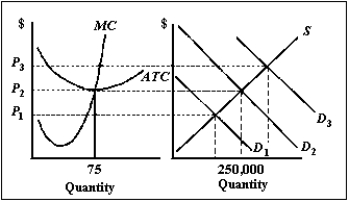 -Refer to Exhibit 9-1. When does firm entry occur?
 (Multiple Choice)
4.9/5 (77)
(77) If the computer industry exhibits external economies of scale, then its expansion is likely to result in
(Multiple Choice)
4.8/5 (75)
(75) Exhibit 9-1
-Refer to Exhibit 9-1. Which demand curve results in normal profits?
-Refer to Exhibit 9-1. Which demand curve results in normal profits? (Multiple Choice)
4.9/5 (78)
(78) Exhibit 9-1
-Refer to Exhibit 9-1. If all firms are identical, the equilibrium number of firms in the industry is
-Refer to Exhibit 9-1. If all firms are identical, the equilibrium number of firms in the industry is (Multiple Choice)
4.8/5 (89)
(89) Exhibit 9-2 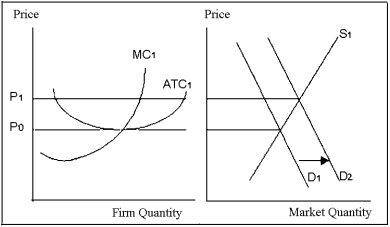 -Refer to Exhibit 9-2. If the demand curve shifts from D1 to D2, then
 (Multiple Choice)
4.8/5 (79)
(79) Explain why a long-run equilibrium can occur only when firms in the industry are at the minimum of their average total cost curves.
(Essay)
4.9/5 (88)
(88) When external diseconomies of scale occur, as compared to the original equilibrium, an increase in market demand causes
(Multiple Choice)
4.9/5 (84)
(84) When economic profits equal zero for firms in an industry, there is no entry or exit.
(True/False)
4.9/5 (73)
(73) Exhibit 9-1
-Refer to Exhibit 9-1. Which of the following describes a long-run competitive equilibrium?
-Refer to Exhibit 9-1. Which of the following describes a long-run competitive equilibrium? (Multiple Choice)
4.8/5 (80)
(80) Suppose a dentist has total revenue of $320,000, and his total costs are $250,000 for the year. Also suppose the dentist left a job paying $112,000 a year to start his own practice. What is the dentist's accounting profit?
(Multiple Choice)
4.9/5 (79)
(79) Suppose a market equilibrium occurs at a quantity of 6,500 units. Also suppose that the typical firm's constant returns to scale extend from a production level of 20 units to a production level of 50 units. Calculate the maximum and minimum number of firms that could prevail in this industry.
(Essay)
4.8/5 (85)
(85) 
Filters
- Essay(0)
- Multiple Choice(0)
- Short Answer(0)
- True False(0)
- Matching(0)