



 Chat with AI
Exam 11: Product Differentiation, Monopolistic Competition, and Oligopoly

Exam 1: The Central Idea156 Questions
Exam 2: Observing and Explaining the Economy143 Questions
Exam 3: The Supply and Demand Model166 Questions
Exam 4: Subtleties of the Supply and Demand Model176 Questions
Exam 5: The Demand Curve and the Behavior of Consumers176 Questions
Exam 6: The Supply Curve and the Behavior of Firms179 Questions
Exam 7: The Efficiency of Markets163 Questions
Exam 8: Costs and the Changes at Firms Over Time191 Questions
Exam 9: The Rise and Fall of Industries139 Questions
Exam 10: Monopoly184 Questions
Exam 11: Product Differentiation, Monopolistic Competition, and Oligopoly169 Questions
Exam 12: Antitrust Policy and Regulation152 Questions
Exam 13: Labor Markets179 Questions
Exam 14: Taxes, Transfers, and Income Distribution179 Questions
Exam 15: Public Goods, Externalities, and Government Behavior197 Questions
Exam 16: Capital and Financial Markets188 Questions
Exam 17: Macroeconomics: the Big Picture159 Questions
Exam 18: Measuring the Production, Income, and Spending of Nations177 Questions
Exam 19: The Spending Allocation Model166 Questions
Exam 20: Unemployment and Employment212 Questions
Exam 21: Productivity and Economic Growth162 Questions
Exam 22: Money and Inflation153 Questions
Exam 23: The Nature and Causes of Economic Fluctuations185 Questions
Exam 24: The Economic Fluctuations Model205 Questions
Exam 25: Using the Economic Fluctuations Model176 Questions
Exam 26: Fiscal Policy138 Questions
Exam 27: Monetary Policy180 Questions
Exam 28: Economic Growth Around the World157 Questions
Exam 29: International Trade242 Questions
Exam 30: International Finance125 Questions
Select questions type


When one firm in a cartel defects, which of the following benefits?
(Multiple Choice)
4.9/5  (80)
(80) In a repeated game, the best option for a firm is to price competitively, regardless of what action the other firm takes.
(True/False)
4.9/5 (90)
(90) Use a diagram to explain why a monopolistically competitive industry is not as efficient as a competitive industry, even though firms do not earn an economic profit when their industries are in long-run equilibrium.
(Essay)
4.9/5 (69)
(69) The chance a firm takes in defecting from a cooperative solution to a game is that
(Multiple Choice)
4.8/5 (84)
(84) Exhibit 11-1  -When firms leave a monopolistically competitive industry, remaining firms' demands increase because
 (Multiple Choice)
4.9/5 (82)
(82) Consumer information services are demanded only when product differentiation exists.
(True/False)
4.7/5 (77)
(77) In the prisoner's dilemma, each of the two prisoners will be better off if neither confesses than if they both confess.
(True/False)
4.9/5 (79)
(79) Draw a diagram of a monopolistic competitor in long-run equilibrium.
(Essay)
4.9/5 (75)
(75) A monopolistically competitive firm can increase its price without losing all its market share because of product differentiation.
(True/False)
4.9/5 (70)
(70) Exhibit 11-4  -Refer to Exhibit 11-4. If both firms price at the monopoly price,
 (Multiple Choice)
4.8/5 (80)
(80) Product differentiation is a common feature of monopolistic competition and oligopoly.
(True/False)
4.7/5 (75)
(75) To say that game theory assumes people make purposeful choices with limited resources implies that players in a game seek to
(Multiple Choice)
4.9/5 (89)
(89) In the short run, the profits for firms in monopolistic competition tend to be
(Multiple Choice)
4.8/5 (85)
(85) Exhibit 11-2 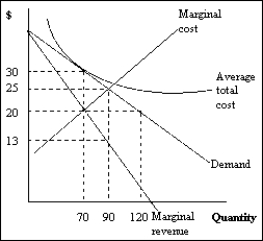 -Refer to Exhibit 11-2 for a profit-maximizing firm in a monopolistically competitive market. In the long run, the firm
 (Multiple Choice)
4.9/5 (72)
(72) The main objective of product differentiation is to increase market demand for the product.
(True/False)
4.8/5 (78)
(78) Products may be differentiated in all of the following ways except
(Multiple Choice)
4.9/5 (79)
(79) As new firms enter a monopolistically competitive industry, the demand curve facing a typical firm will most likely
(Multiple Choice)
4.9/5 (81)
(81) Compared with a monopoly, long-run equilibrium in a monopolistically competitive industry results in
(Multiple Choice)
4.7/5 (83)
(83) Suppose two small-town video stores, store A and store B, compete. The two stores collude and agree to share the market equally. If neither store cheats on the agreement, each store will make $2,500 a day in economic profits. If only one store cheats, the cheater will increase its economic profits to $4,000 and the store that abides by the agreement will incur an economic loss of $1,000. If both firms cheat, they both will earn zero economic profits. Neither store has any way of policing the actions of the other.

(Essay)
4.9/5 (67)
(67) 
Filters
- Essay(0)
- Multiple Choice(0)
- Short Answer(0)
- True False(0)
- Matching(0)