



 Chat with AI
Exam 11: Product Differentiation, Monopolistic Competition, and Oligopoly

Exam 1: The Central Idea156 Questions
Exam 2: Observing and Explaining the Economy143 Questions
Exam 3: The Supply and Demand Model166 Questions
Exam 4: Subtleties of the Supply and Demand Model176 Questions
Exam 5: The Demand Curve and the Behavior of Consumers176 Questions
Exam 6: The Supply Curve and the Behavior of Firms179 Questions
Exam 7: The Efficiency of Markets163 Questions
Exam 8: Costs and the Changes at Firms Over Time191 Questions
Exam 9: The Rise and Fall of Industries139 Questions
Exam 10: Monopoly184 Questions
Exam 11: Product Differentiation, Monopolistic Competition, and Oligopoly169 Questions
Exam 12: Antitrust Policy and Regulation152 Questions
Exam 13: Labor Markets179 Questions
Exam 14: Taxes, Transfers, and Income Distribution179 Questions
Exam 15: Public Goods, Externalities, and Government Behavior197 Questions
Exam 16: Capital and Financial Markets188 Questions
Exam 17: Macroeconomics: the Big Picture159 Questions
Exam 18: Measuring the Production, Income, and Spending of Nations177 Questions
Exam 19: The Spending Allocation Model166 Questions
Exam 20: Unemployment and Employment212 Questions
Exam 21: Productivity and Economic Growth162 Questions
Exam 22: Money and Inflation153 Questions
Exam 23: The Nature and Causes of Economic Fluctuations185 Questions
Exam 24: The Economic Fluctuations Model205 Questions
Exam 25: Using the Economic Fluctuations Model176 Questions
Exam 26: Fiscal Policy138 Questions
Exam 27: Monetary Policy180 Questions
Exam 28: Economic Growth Around the World157 Questions
Exam 29: International Trade242 Questions
Exam 30: International Finance125 Questions
Select questions type


Some economists say that advertising is wasteful because they believe that
(Multiple Choice)
5.0/5  (97)
(97) A monopolistic competitor behaves like a monopoly in the short run.
(True/False)
4.8/5 (77)
(77) The deadweight loss from monopolistic competition includes the cost consumers pay for differentiated products.
(True/False)
4.9/5 (91)
(91) Exhibit 11-6  -Refer to Exhibit 11-6. If the game is played for one period, explain why both firms will choose the competitive price.
(Essay)
5.0/5 (83)
(83) In the long run, a monopolistically competitive firm sets output so that
(Multiple Choice)
4.7/5 (91)
(91) Exhibit 11-5  -Refer to Exhibit 11-5, which illustrates the profits in a duopoly game between firm A and firm B that is played only once. When the game reaches a Nash equilibrium, the profits are
 (Multiple Choice)
4.8/5 (71)
(71) A monopolistically competitive firm can increase its price without losing all its market share because
(Multiple Choice)
4.9/5 (72)
(72)  -Refer to Exhibit 11-1. In the long run,
Product differentiation exists when producers perceive the products to be different.
(True/False)
4.8/5 (93)
(93) Exhibit 11-6
-Match the following characteristics with the appropriate model of firm behavior, and explain how efficient each firms is in the long run.
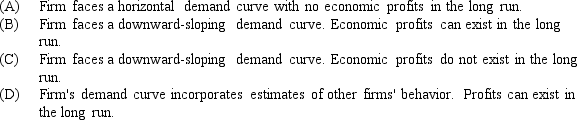
-Match the following characteristics with the appropriate model of firm behavior, and explain how efficient each firms is in the long run.
(Essay)
4.9/5 (89)
(89) The difference between explicit and tacit collusion is the degree to which
(Multiple Choice)
4.7/5 (95)
(95) Which is more important, product differentiation as perceived by firms producing the product, or product differentiation as perceived by consumers of the product? Explain.
(Essay)
4.7/5 (72)
(72) Consider a McDonald's restaurant that sells hamburgers in a small town alongside a few other fast-food restaurants.

(Essay)
4.8/5 (75)
(75) For a monopolistically competitive firm, the demand curve is more elastic in the long run than in the short run.
(True/False)
4.8/5 (75)
(75) Specialized magazines that give product reviews on such products as cameras, stereo equipment, cars, and computers exist because of
(Multiple Choice)
4.8/5 (81)
(81) 
Filters
- Essay(0)
- Multiple Choice(0)
- Short Answer(0)
- True False(0)
- Matching(0)