



 Chat with AI
Exam 17: Macroeconomics: the Big Picture

Exam 1: The Central Idea156 Questions
Exam 2: Observing and Explaining the Economy143 Questions
Exam 3: The Supply and Demand Model166 Questions
Exam 4: Subtleties of the Supply and Demand Model176 Questions
Exam 5: The Demand Curve and the Behavior of Consumers176 Questions
Exam 6: The Supply Curve and the Behavior of Firms179 Questions
Exam 7: The Efficiency of Markets163 Questions
Exam 8: Costs and the Changes at Firms Over Time191 Questions
Exam 9: The Rise and Fall of Industries139 Questions
Exam 10: Monopoly184 Questions
Exam 11: Product Differentiation, Monopolistic Competition, and Oligopoly169 Questions
Exam 12: Antitrust Policy and Regulation152 Questions
Exam 13: Labor Markets179 Questions
Exam 14: Taxes, Transfers, and Income Distribution179 Questions
Exam 15: Public Goods, Externalities, and Government Behavior197 Questions
Exam 16: Capital and Financial Markets188 Questions
Exam 17: Macroeconomics: the Big Picture159 Questions
Exam 18: Measuring the Production, Income, and Spending of Nations177 Questions
Exam 19: The Spending Allocation Model166 Questions
Exam 20: Unemployment and Employment212 Questions
Exam 21: Productivity and Economic Growth162 Questions
Exam 22: Money and Inflation153 Questions
Exam 23: The Nature and Causes of Economic Fluctuations185 Questions
Exam 24: The Economic Fluctuations Model205 Questions
Exam 25: Using the Economic Fluctuations Model176 Questions
Exam 26: Fiscal Policy138 Questions
Exam 27: Monetary Policy180 Questions
Exam 28: Economic Growth Around the World157 Questions
Exam 29: International Trade242 Questions
Exam 30: International Finance125 Questions
Select questions type


How long did the recent economic expansion last before the beginning of the Great Recession?
(Multiple Choice)
4.9/5  (72)
(72) Suppose that at a given point in time the rate of inflation in the economy is equal to 2 percent and the nominal interest rate is 5 percent. What is the real interest rate consistent with this situation?
(Multiple Choice)
4.7/5 (82)
(82) The negative correlation that occurs between inflation and economic growth can best be explained by
(Multiple Choice)
5.0/5 (90)
(90) Exhibit 17-1
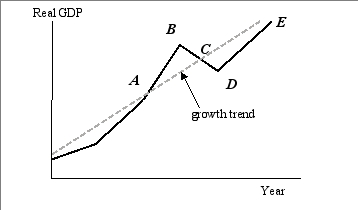 -In Exhibit 17-1, the best example of an expansion phase is
 (Multiple Choice)
4.7/5 (60)
(60) State and define as best you can the three determinants of the aggregate supply of real GDP.
(Essay)
4.8/5 (75)
(75) If real GDP and population grow at the same rate, the real GDP per capita will decrease.
(True/False)
4.9/5 (85)
(85) Between 1980 and 2000, China's GDP grew at an annual rate of 9.7 percent. China's GDP in 2006 was estimated to be $2.5 trillion. If China continues to grow at the same rate as it did between 1980 and 2000, what will its GDP be in 2026? How many years will it take for China's GDP to be twice as large as it was in 2006?
(Essay)
4.9/5 (73)
(73) The theory of economic fluctuations emphasizes fluctuations in the supply of goods and services as the reason for the ups and downs in the economy.
(True/False)
4.9/5 (66)
(66) Suppose at the beginning of 2017, I loaned out $100 and at the end of the year was paid back $108. The inflation rate during the year was 3 percent.

(Essay)
4.8/5 (91)
(91) Suppose people expect there to be a substantial increase in the rate of inflation over the next few years. Which of the following would you predict?
(Multiple Choice)
4.7/5 (78)
(78) Suppose you read in the newspaper that a large decline in business spending has occurred. Explain how this could cause real GDP to fall. Could the decline in business spending also cause potential GDP to decline? Explain.
(Essay)
4.9/5 (93)
(93) What is meant by a recession? As a rule of thumb, when is the economy considered to be in a recession?
(Essay)
5.0/5 (77)
(77) The increase in real GDP per capita over the past 50 years is closest to
(Multiple Choice)
4.9/5 (70)
(70) The theory of economic fluctuations emphasizes fluctuations in
(Multiple Choice)
4.8/5 (66)
(66) In terms of the decline in real GDP, the 2008-2009 recession was
(Multiple Choice)
4.7/5 (82)
(82) Economists generally agree on the cause of the recession that began in 1990.
(True/False)
4.9/5 (79)
(79) 
Filters
- Essay(0)
- Multiple Choice(0)
- Short Answer(0)
- True False(0)
- Matching(0)