



 Chat with AI
Exam 17: Macroeconomics: the Big Picture

Exam 1: The Central Idea156 Questions
Exam 2: Observing and Explaining the Economy143 Questions
Exam 3: The Supply and Demand Model166 Questions
Exam 4: Subtleties of the Supply and Demand Model176 Questions
Exam 5: The Demand Curve and the Behavior of Consumers176 Questions
Exam 6: The Supply Curve and the Behavior of Firms179 Questions
Exam 7: The Efficiency of Markets163 Questions
Exam 8: Costs and the Changes at Firms Over Time191 Questions
Exam 9: The Rise and Fall of Industries139 Questions
Exam 10: Monopoly184 Questions
Exam 11: Product Differentiation, Monopolistic Competition, and Oligopoly169 Questions
Exam 12: Antitrust Policy and Regulation152 Questions
Exam 13: Labor Markets179 Questions
Exam 14: Taxes, Transfers, and Income Distribution179 Questions
Exam 15: Public Goods, Externalities, and Government Behavior197 Questions
Exam 16: Capital and Financial Markets188 Questions
Exam 17: Macroeconomics: the Big Picture159 Questions
Exam 18: Measuring the Production, Income, and Spending of Nations177 Questions
Exam 19: The Spending Allocation Model166 Questions
Exam 20: Unemployment and Employment212 Questions
Exam 21: Productivity and Economic Growth162 Questions
Exam 22: Money and Inflation153 Questions
Exam 23: The Nature and Causes of Economic Fluctuations185 Questions
Exam 24: The Economic Fluctuations Model205 Questions
Exam 25: Using the Economic Fluctuations Model176 Questions
Exam 26: Fiscal Policy138 Questions
Exam 27: Monetary Policy180 Questions
Exam 28: Economic Growth Around the World157 Questions
Exam 29: International Trade242 Questions
Exam 30: International Finance125 Questions
Select questions type


Suppose you owe $1,000 on your credit card and you are charged a 2 percent monthly interest rate on the balance. How much in interest will be generated on that balance after the first month?
(Multiple Choice)
4.7/5  (90)
(90) Which of the following is not a determinant of aggregate supply capability?
(Multiple Choice)
4.8/5 (88)
(88) According to the theory of economic fluctuations, which of the following explains the relationship between aggregate demand and employment during a recession?
(Multiple Choice)
4.9/5 (79)
(79) Over the last 50 years in the United States, the unemployment rate has
(Multiple Choice)
4.8/5 (78)
(78) The highest unemployment rate recorded in the United States since World War II is
(Multiple Choice)
4.8/5 (91)
(91) Exhibit 17-2
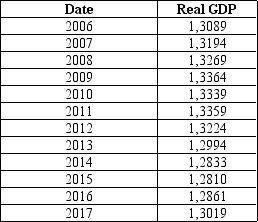 -Based on the data in Exhibit 17-2, the recession ended in which year?
 (Multiple Choice)
4.9/5 (80)
(80) What explains the uneven effect a recession has on the U.S. economy? Why would this matter?
(Essay)
4.8/5 (79)
(79) The sum of the demands from the four groups that contribute to demand in the whole economy is called
(Multiple Choice)
4.8/5 (74)
(74) Suppose the U.S. economy is currently recovering from a recession. What is the relationship between real and potential GDP? Is it likely that real GDP will stay in this position for a long period of time, say, 10 years? Briefly explain.
(Essay)
4.8/5 (60)
(60) The U.S. economy moved closer to deflation at the end of 2008; this was the first time in 40 years that deflation seemed a possibility.
(True/False)
4.8/5 (85)
(85) Exhibit 17-3
 -The data in Exhibit 17-3 shows the values of real GDP and population for two countries, X and Y, for the years 2016 and 2017. Which of these two countries experienced a faster increase in the standard of living between 2016 and 2017?
(Essay)
4.8/5 (82)
(82) The interest rate is positively correlated with the inflation rate.
(True/False)
5.0/5 (74)
(74) What is economic growth theory? What does it seek to distinguish, and why is it difficult to do this?
(Essay)
5.0/5 (77)
(77) How might the economic fluctuations theory explain the movement of the unemployment rate over the business cycle?
(Essay)
4.8/5 (72)
(72) 
Filters
- Essay(0)
- Multiple Choice(0)
- Short Answer(0)
- True False(0)
- Matching(0)