



 Chat with AI
Exam 21: Productivity and Economic Growth

Exam 1: The Central Idea156 Questions
Exam 2: Observing and Explaining the Economy143 Questions
Exam 3: The Supply and Demand Model166 Questions
Exam 4: Subtleties of the Supply and Demand Model176 Questions
Exam 5: The Demand Curve and the Behavior of Consumers176 Questions
Exam 6: The Supply Curve and the Behavior of Firms179 Questions
Exam 7: The Efficiency of Markets163 Questions
Exam 8: Costs and the Changes at Firms Over Time191 Questions
Exam 9: The Rise and Fall of Industries139 Questions
Exam 10: Monopoly184 Questions
Exam 11: Product Differentiation, Monopolistic Competition, and Oligopoly169 Questions
Exam 12: Antitrust Policy and Regulation152 Questions
Exam 13: Labor Markets179 Questions
Exam 14: Taxes, Transfers, and Income Distribution179 Questions
Exam 15: Public Goods, Externalities, and Government Behavior197 Questions
Exam 16: Capital and Financial Markets188 Questions
Exam 17: Macroeconomics: the Big Picture159 Questions
Exam 18: Measuring the Production, Income, and Spending of Nations177 Questions
Exam 19: The Spending Allocation Model166 Questions
Exam 20: Unemployment and Employment212 Questions
Exam 21: Productivity and Economic Growth162 Questions
Exam 22: Money and Inflation153 Questions
Exam 23: The Nature and Causes of Economic Fluctuations185 Questions
Exam 24: The Economic Fluctuations Model205 Questions
Exam 25: Using the Economic Fluctuations Model176 Questions
Exam 26: Fiscal Policy138 Questions
Exam 27: Monetary Policy180 Questions
Exam 28: Economic Growth Around the World157 Questions
Exam 29: International Trade242 Questions
Exam 30: International Finance125 Questions
Select questions type


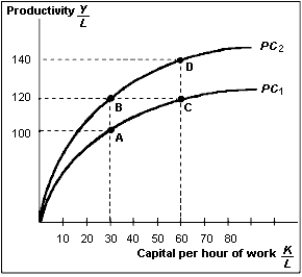
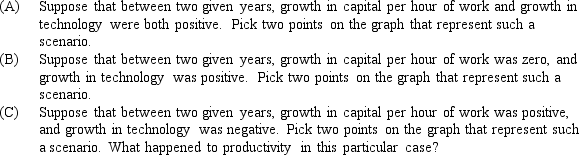

In recent years in the United States both technology and capital have contributed substantially to productivity growth, suggesting that policy should not focus solely on one determinant at the expense of the other.
(True/False)
4.9/5  (83)
(83) Renowned economists such as William Baumol, Paul Krugman, and Edward Lazear believe that productivity growth is one of the key issues for determining long-term economic growth.
(True/False)
4.8/5 (76)
(76) According to economist Daron Acemoglu, all of the following are fundamental causes of economic growth EXCEPT
(Multiple Choice)
4.7/5 (74)
(74) According to Paul Krugman, distinguished economics columnist for the New York Times, which of the following is the most important issue facing the economy today?
(Multiple Choice)
4.8/5 (81)
(81) Learning by doing represents a situation in which workers become more proficient by doing a particular task repeatedly.
(True/False)
4.7/5 (78)
(78) The growth rate of productivity due to an increase in capital income equals
(Multiple Choice)
4.7/5 (79)
(79) Suppose that in a given year there has been an increase in both technology and the amount of capital per hour worked. Draw the consequence of these changes using a productivity function.
(Essay)
4.9/5 (74)
(74)  .
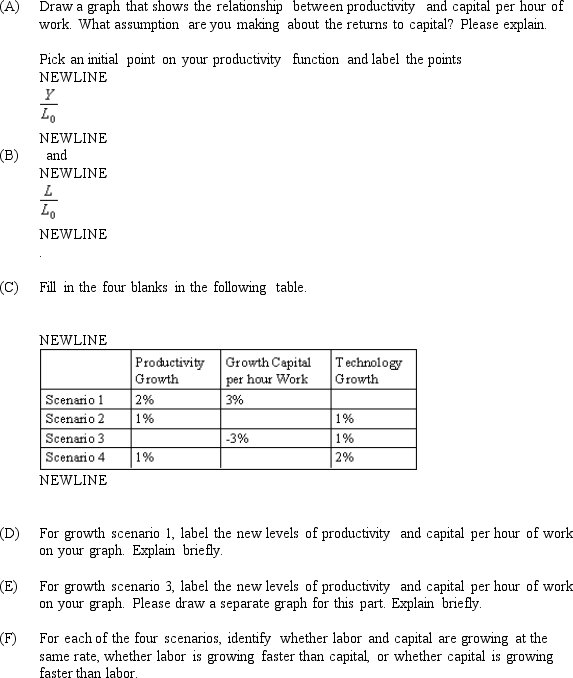
The coefficient on the growth of capital per hour of work in the growth accounting formula is
(Multiple Choice)
4.9/5 (77)
(77) The term that best describes what happens when fewer workers are needed to produce the same amount of output with the same amount of capital is
(Multiple Choice)
4.8/5 (71)
(71) Suppose that policymakers desire real GDP per hour of work to grow by 3.5 percent a year.

(Essay)
4.8/5 (76)
(76) According to economist Daron Acemoglu, causes of economic growth include of the following EXCEPT
(Multiple Choice)
4.8/5 (73)
(73) The person who figured out that it is best to keep the milk, bread, and eggs at the back of the grocery store and not at the front probably did not profit as much from this idea as the grocery industry as a whole did. This is because
(Multiple Choice)
5.0/5 (99)
(99) The government should intervene to encourage growth if the market
(Multiple Choice)
4.8/5 (75)
(75) 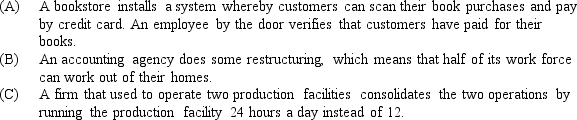
The decision to invest in human capital is influenced by considerations similar to those that motivate a firm to invest in physical capital. Therefore, if interest rates rise, fewer people will tend to invest in college education, since this is an investment that commonly involves borrowing money to afford tuition.
(True/False)
4.9/5 (68)
(68) Provide a definition of technology, and explain how it is possible to come up with an estimate of technological growth.
(Essay)
4.9/5 (70)
(70) Which of the following should be focused on to explain the growth of productivity?
(Multiple Choice)
4.9/5 (76)
(76) 
Filters
- Essay(0)
- Multiple Choice(0)
- Short Answer(0)
- True False(0)
- Matching(0)