



 Chat with AI
Exam 35: Nervous and Endocrine Control

Exam 1: Introduction81 Questions
Exam 2: The Chemistry and Energy of Life87 Questions
Exam 3: Nucleic Acids, Proteins, and Enzymes118 Questions
Exam 4: Cells: the Working Units of Life115 Questions
Exam 5: Cell Membranes and Signaling95 Questions
Exam 6: Pathways That Harvest and Store Chemical Energy130 Questions
Exam 7: The Cell Cycle and Cell Division119 Questions
Exam 8: Inheritance, Genes, and Chromosomes80 Questions
Exam 9: DNA and Its Role in Heredity94 Questions
Exam 10: From Dna to Protein: Gene Expression80 Questions
Exam 11: Regulation of Gene Expression94 Questions
Exam 12: Genomes78 Questions
Exam 13: Biotechnology83 Questions
Exam 14: Genes, Development, and Evolution94 Questions
Exam 15: Processes of Evolution83 Questions
Exam 16: Reconstructing and Using Phylogenies76 Questions
Exam 17: Speciation80 Questions
Exam 18: The History of Life on Earth82 Questions
Exam 19: Bacteria, Archaea, and Viruses100 Questions
Exam 20: The Origin and Diversification of Eukaryotes96 Questions
Exam 21: The Evolution of Plants130 Questions
Exam 22: The Evolution and Diversity of Fungi103 Questions
Exam 23: Animal Origins and Diversity136 Questions
Exam 24: The Plant Body90 Questions
Exam 25: Plant Nutrition and Transport129 Questions
Exam 26: Plant Growth and Development85 Questions
Exam 27: Reproduction of Flowering Plants85 Questions
Exam 28: Plants in the Environment85 Questions
Exam 29: Fundamentals of Animal Function86 Questions
Exam 30: Nutrition and Digestion81 Questions
Exam 31: Breathing83 Questions
Exam 32: Circulation80 Questions
Exam 33: Muscle and Movement75 Questions
Exam 34: Neurons, Sense Organs, and Nervous Systems171 Questions
Exam 35: Nervous and Endocrine Control94 Questions
Exam 36: Water and Salts: Excretion85 Questions
Exam 37: Animal Reproduction84 Questions
Exam 38: Animal Development104 Questions
Exam 39: Immunology: Animal Defense Systems91 Questions
Exam 40: Animal Behavior83 Questions
Exam 41: The Distribution of Earths Ecological Systems82 Questions
Exam 42: Populations78 Questions
Exam 43: Ecological and Evolutionary Consequences of Interactions Within and Among Species114 Questions
Exam 44: Ecological Communities121 Questions
Exam 45: The Global Ecosystem127 Questions
Select questions type


Which pair incorrectly matches a pituitary hormone with its target organ?
(Multiple Choice)
4.8/5  (70)
(70) Use the following to answer questions :
Refer to the diagram below showing the posterior pituitary. 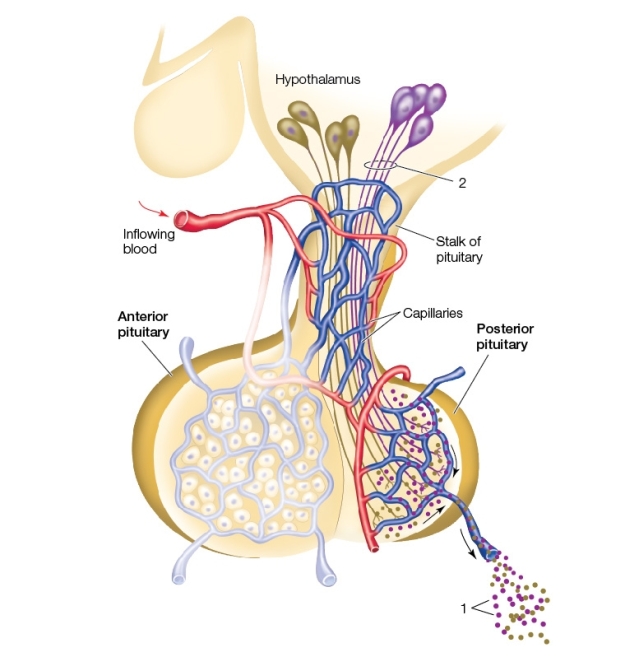 -Which statement concerning the hormones represented by the dots leaving in the bloodstream at label 1 is false?
 (Multiple Choice)
4.8/5 (79)
(79) Experiments with insects showed that the target for prothoracicotropic hormone is the
(Multiple Choice)
4.9/5 (75)
(75) Which hormone directly stimulates molting in an insect larva?
(Multiple Choice)
4.8/5 (90)
(90) Which condition does not contributes to the development of goiter?
(Multiple Choice)
4.9/5 (71)
(71) In addition to producing thyroxine,the mammalian thyroid gland produces
(Multiple Choice)
5.0/5 (85)
(85) The endocrine gland attached to the hypothalamus and located just above the back of the mouth is the _______.
(Essay)
4.9/5 (70)
(70) Malfunctioning of the thyroid gland in the human adult can result in
(Multiple Choice)
4.8/5 (73)
(73) Use the following to answer questions :
Refer to the diagram below. 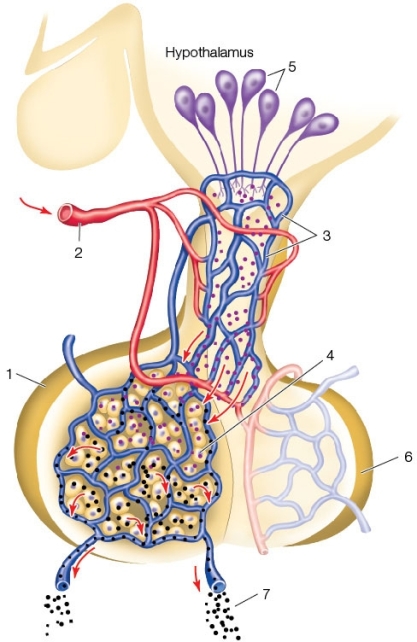 -The small black dots labeled 7 could be any of the following except for
 (Multiple Choice)
4.7/5 (82)
(82) The neurohormones vasopressin (antidiuretic hormone or ADH)and oxytocin are produced by the
(Multiple Choice)
4.8/5 (83)
(83) Which effect is caused by increased levels of antidiuretic hormone in the blood?
(Multiple Choice)
4.9/5 (86)
(86) The effects of castration prior to sexual maturation led to the discovery of _______ as the key substance that controls the development of male characteristics.
(Essay)
4.8/5 (73)
(73) 
Filters
- Essay(0)
- Multiple Choice(0)
- Short Answer(0)
- True False(0)
- Matching(0)