



 Chat with AI
Exam 37: Animal Reproduction

Exam 1: Introduction81 Questions
Exam 2: The Chemistry and Energy of Life87 Questions
Exam 3: Nucleic Acids, Proteins, and Enzymes118 Questions
Exam 4: Cells: the Working Units of Life115 Questions
Exam 5: Cell Membranes and Signaling95 Questions
Exam 6: Pathways That Harvest and Store Chemical Energy130 Questions
Exam 7: The Cell Cycle and Cell Division119 Questions
Exam 8: Inheritance, Genes, and Chromosomes80 Questions
Exam 9: DNA and Its Role in Heredity94 Questions
Exam 10: From Dna to Protein: Gene Expression80 Questions
Exam 11: Regulation of Gene Expression94 Questions
Exam 12: Genomes78 Questions
Exam 13: Biotechnology83 Questions
Exam 14: Genes, Development, and Evolution94 Questions
Exam 15: Processes of Evolution83 Questions
Exam 16: Reconstructing and Using Phylogenies76 Questions
Exam 17: Speciation80 Questions
Exam 18: The History of Life on Earth82 Questions
Exam 19: Bacteria, Archaea, and Viruses100 Questions
Exam 20: The Origin and Diversification of Eukaryotes96 Questions
Exam 21: The Evolution of Plants130 Questions
Exam 22: The Evolution and Diversity of Fungi103 Questions
Exam 23: Animal Origins and Diversity136 Questions
Exam 24: The Plant Body90 Questions
Exam 25: Plant Nutrition and Transport129 Questions
Exam 26: Plant Growth and Development85 Questions
Exam 27: Reproduction of Flowering Plants85 Questions
Exam 28: Plants in the Environment85 Questions
Exam 29: Fundamentals of Animal Function86 Questions
Exam 30: Nutrition and Digestion81 Questions
Exam 31: Breathing83 Questions
Exam 32: Circulation80 Questions
Exam 33: Muscle and Movement75 Questions
Exam 34: Neurons, Sense Organs, and Nervous Systems171 Questions
Exam 35: Nervous and Endocrine Control94 Questions
Exam 36: Water and Salts: Excretion85 Questions
Exam 37: Animal Reproduction84 Questions
Exam 38: Animal Development104 Questions
Exam 39: Immunology: Animal Defense Systems91 Questions
Exam 40: Animal Behavior83 Questions
Exam 41: The Distribution of Earths Ecological Systems82 Questions
Exam 42: Populations78 Questions
Exam 43: Ecological and Evolutionary Consequences of Interactions Within and Among Species114 Questions
Exam 44: Ecological Communities121 Questions
Exam 45: The Global Ecosystem127 Questions
Select questions type


Sexual reproduction has an evolutionary advantage over asexual reproduction because it
(Multiple Choice)
4.7/5  (84)
(84) The female common octopus (Octopus vulgaris)mates once,guards the eggs she lays,and then dies after they hatch.This is an example of
(Multiple Choice)
4.9/5 (74)
(74) In primates,follicles do not mature as long as the corpus luteum is maintained because
(Multiple Choice)
4.9/5 (82)
(82) Antarctic fur seals mate in the early summer.Fertilization also occurs at this time,but the embryos do not implant until autumn.This is an example of
(Multiple Choice)
4.8/5 (86)
(86) If a man develops a large epididymal cyst that requires removal,the surgeon will most likely make an incision in the man's _______ to remove the cyst.If the entire epididymis is removed,then the man will likely _______.
(Multiple Choice)
4.9/5 (92)
(92) The two anterior pituitary gonadotropins that coordinate human female reproductive events are _______ and _______.
(Multiple Choice)
4.9/5 (94)
(94) Suppose you incubate American alligator eggs in order to hatch out a brood of baby alligators.You carefully set the temperature of the incubator at 35°C and keep it steady throughout the incubation period.You can expect that the baby alligators that hatch will
(Multiple Choice)
4.8/5 (86)
(86) At birth,a female has about one million oocytes in each ovary.If a woman's fertile years are between the ages of 10 and 50,and she has two pregnancies during this time,about _______ of these oocytes will mature and be released at ovulation over her lifetime.
(Multiple Choice)
4.8/5 (72)
(72) While snorkeling over a coral reef in the ocean,you spot a group of anemonefish swimming among the tentacles of a single sea anemone.You can expect that in this group
(Multiple Choice)
5.0/5 (74)
(74) Which structure is a primary reproductive organ found in human males?
(Multiple Choice)
4.9/5 (88)
(88) If you caught a female blue crab and kept it by itself in an aquarium,you might be surprised to find egg masses being laid by the crab for months after you captured it.The most likely explanation for this is that this crab
(Multiple Choice)
4.8/5 (83)
(83) In primates,a corpus luteum that is secreting hormones initiates a sequence of events that prevents new follicles from developing.Which statement about this sequence is true?
(Multiple Choice)
4.8/5 (75)
(75) After spermatogenesis in humans,sperm cells are generally stored in the
(Multiple Choice)
4.8/5 (69)
(69) In the photographs below,the female(s)is/are labeled _______ and is/are distinguishable by _______. 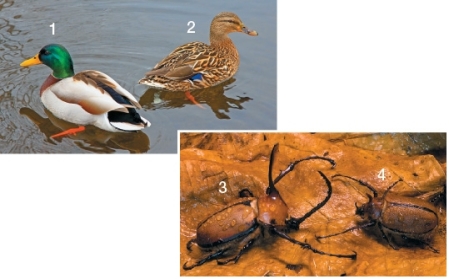
(Multiple Choice)
4.7/5 (59)
(59) In a healthy human male,semen contains a number of substances,including
(Multiple Choice)
4.7/5 (73)
(73) If a male and female rabbit are kept together in a cage,the female rabbit will ovulate
(Multiple Choice)
4.8/5 (85)
(85) Which contraceptive method has a success rate greater than 90 percent?
(Multiple Choice)
4.8/5 (84)
(84) 
Filters
- Essay(0)
- Multiple Choice(0)
- Short Answer(0)
- True False(0)
- Matching(0)