



 Chat with AI
Exam 38: Animal Development

Exam 1: Introduction81 Questions
Exam 2: The Chemistry and Energy of Life87 Questions
Exam 3: Nucleic Acids, Proteins, and Enzymes118 Questions
Exam 4: Cells: the Working Units of Life115 Questions
Exam 5: Cell Membranes and Signaling95 Questions
Exam 6: Pathways That Harvest and Store Chemical Energy130 Questions
Exam 7: The Cell Cycle and Cell Division119 Questions
Exam 8: Inheritance, Genes, and Chromosomes80 Questions
Exam 9: DNA and Its Role in Heredity94 Questions
Exam 10: From Dna to Protein: Gene Expression80 Questions
Exam 11: Regulation of Gene Expression94 Questions
Exam 12: Genomes78 Questions
Exam 13: Biotechnology83 Questions
Exam 14: Genes, Development, and Evolution94 Questions
Exam 15: Processes of Evolution83 Questions
Exam 16: Reconstructing and Using Phylogenies76 Questions
Exam 17: Speciation80 Questions
Exam 18: The History of Life on Earth82 Questions
Exam 19: Bacteria, Archaea, and Viruses100 Questions
Exam 20: The Origin and Diversification of Eukaryotes96 Questions
Exam 21: The Evolution of Plants130 Questions
Exam 22: The Evolution and Diversity of Fungi103 Questions
Exam 23: Animal Origins and Diversity136 Questions
Exam 24: The Plant Body90 Questions
Exam 25: Plant Nutrition and Transport129 Questions
Exam 26: Plant Growth and Development85 Questions
Exam 27: Reproduction of Flowering Plants85 Questions
Exam 28: Plants in the Environment85 Questions
Exam 29: Fundamentals of Animal Function86 Questions
Exam 30: Nutrition and Digestion81 Questions
Exam 31: Breathing83 Questions
Exam 32: Circulation80 Questions
Exam 33: Muscle and Movement75 Questions
Exam 34: Neurons, Sense Organs, and Nervous Systems171 Questions
Exam 35: Nervous and Endocrine Control94 Questions
Exam 36: Water and Salts: Excretion85 Questions
Exam 37: Animal Reproduction84 Questions
Exam 38: Animal Development104 Questions
Exam 39: Immunology: Animal Defense Systems91 Questions
Exam 40: Animal Behavior83 Questions
Exam 41: The Distribution of Earths Ecological Systems82 Questions
Exam 42: Populations78 Questions
Exam 43: Ecological and Evolutionary Consequences of Interactions Within and Among Species114 Questions
Exam 44: Ecological Communities121 Questions
Exam 45: The Global Ecosystem127 Questions
Select questions type


Which organisms feature a body plan with repeating segments (somites)that are modified during development into structures such as ribs and muscles?
(Multiple Choice)
4.7/5  (78)
(78) The primitive groove of bird and mammalian embryos is analogous to the _______ of amphibians and sea urchins.
(Essay)
4.8/5 (78)
(78) In organisms such as the chick,in which the egg has extensive yolk,the egg
(Multiple Choice)
4.9/5 (78)
(78) The large amount of yolk in birds' eggs results in _______ cleavage.
(Multiple Choice)
4.8/5 (86)
(86) The human embryo is able to split at the 64-cell stage to produce two viable progeny.This is an indication that human development at this stage is
(Multiple Choice)
4.9/5 (63)
(63) In a triploblastic organism,the ectoderm gives rise to the _______ and _______.
(Essay)
4.7/5 (66)
(66) If you treat unfertilized frog eggs with a poison that prevents microtubules from forming and then fertilize the eggs with sperm,the first abnormal event you would notice would most likely be
(Multiple Choice)
4.7/5 (79)
(79) In chick embryos,the extraembryonic membrane that forms around the yolk is the _______.
(Essay)
4.9/5 (91)
(91) The epiblast and hypoblast are structures found in _______ development.
(Multiple Choice)
4.9/5 (79)
(79) Cleavage in human embryos _______,whereas cleavage in frog embryos _______.
(Multiple Choice)
4.9/5 (82)
(82) If one of the blastomeres is removed from a developing mouse embryo,the remaining cells will still develop into a normal mouse.This is an example of
(Multiple Choice)
4.9/5 (78)
(78) Noggin and Chordin are signaling molecules released by the developing notochord that block BMP4,thereby allowing the formation of the _______.
(Essay)
4.7/5 (85)
(85) Using the figure of the vertebrate embryo below,list in order the structures that the arrow passes through,starting from the tail of the arrow and ending at its tip. 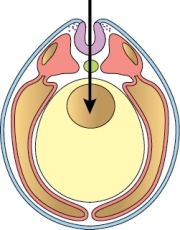
(Multiple Choice)
4.8/5 (82)
(82) If you shift the position of a fruit fly egg relative to the follicle cells as the egg is developing in the ovary,you can expect that the
(Multiple Choice)
4.8/5 (79)
(79) Of the three germ layers that develop during gastrulation,the _______ layer gives rise to the lining of the digestive tract.
(Essay)
4.9/5 (74)
(74) 
Filters
- Essay(0)
- Multiple Choice(0)
- Short Answer(0)
- True False(0)
- Matching(0)