



 Chat with AI
Exam 45: The Global Ecosystem

Exam 1: Introduction81 Questions
Exam 2: The Chemistry and Energy of Life87 Questions
Exam 3: Nucleic Acids, Proteins, and Enzymes118 Questions
Exam 4: Cells: the Working Units of Life115 Questions
Exam 5: Cell Membranes and Signaling95 Questions
Exam 6: Pathways That Harvest and Store Chemical Energy130 Questions
Exam 7: The Cell Cycle and Cell Division119 Questions
Exam 8: Inheritance, Genes, and Chromosomes80 Questions
Exam 9: DNA and Its Role in Heredity94 Questions
Exam 10: From Dna to Protein: Gene Expression80 Questions
Exam 11: Regulation of Gene Expression94 Questions
Exam 12: Genomes78 Questions
Exam 13: Biotechnology83 Questions
Exam 14: Genes, Development, and Evolution94 Questions
Exam 15: Processes of Evolution83 Questions
Exam 16: Reconstructing and Using Phylogenies76 Questions
Exam 17: Speciation80 Questions
Exam 18: The History of Life on Earth82 Questions
Exam 19: Bacteria, Archaea, and Viruses100 Questions
Exam 20: The Origin and Diversification of Eukaryotes96 Questions
Exam 21: The Evolution of Plants130 Questions
Exam 22: The Evolution and Diversity of Fungi103 Questions
Exam 23: Animal Origins and Diversity136 Questions
Exam 24: The Plant Body90 Questions
Exam 25: Plant Nutrition and Transport129 Questions
Exam 26: Plant Growth and Development85 Questions
Exam 27: Reproduction of Flowering Plants85 Questions
Exam 28: Plants in the Environment85 Questions
Exam 29: Fundamentals of Animal Function86 Questions
Exam 30: Nutrition and Digestion81 Questions
Exam 31: Breathing83 Questions
Exam 32: Circulation80 Questions
Exam 33: Muscle and Movement75 Questions
Exam 34: Neurons, Sense Organs, and Nervous Systems171 Questions
Exam 35: Nervous and Endocrine Control94 Questions
Exam 36: Water and Salts: Excretion85 Questions
Exam 37: Animal Reproduction84 Questions
Exam 38: Animal Development104 Questions
Exam 39: Immunology: Animal Defense Systems91 Questions
Exam 40: Animal Behavior83 Questions
Exam 41: The Distribution of Earths Ecological Systems82 Questions
Exam 42: Populations78 Questions
Exam 43: Ecological and Evolutionary Consequences of Interactions Within and Among Species114 Questions
Exam 44: Ecological Communities121 Questions
Exam 45: The Global Ecosystem127 Questions
Select questions type


Which sequence represents the correct size ranking of the compartments of global freshwater,from largest to smallest?
(Multiple Choice)
4.9/5  (84)
(84) Which of these regions of Earth is not part of the biosphere?
(Multiple Choice)
4.7/5 (90)
(90) Runoff of high- nitrogen substances,such as fertilizer or sewage,can lead to the process of _______ in water bodies.
(Essay)
4.8/5 (83)
(83) How are warming temperatures likely to affect species ranges?
(Multiple Choice)
4.7/5 (88)
(88) Two effects of global climate change are increases in global temperature and precipitation (with variations based on latitude and other factors)and more severe storms.Which of these two effects is likely to cause the most serious and long-term changes in species and communities,and why?
(Essay)
4.7/5 (73)
(73) Some fluxes of water through compartments of the water cycle are driven by the sun's energy,which causes water to change states,from solid to liquid to gas (vapor).Other fluxes are driven by which force?
(Multiple Choice)
4.9/5 (86)
(86) Refer to the diagram below.What is the most likely explanation for the extremely rapid increase in levels of all three greenhouse gases,beginning in the 1800s? 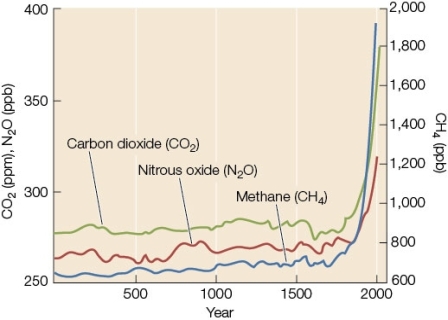
(Essay)
4.9/5 (82)
(82) Most plants lack symbiotic nitrogen-fixing microorganisms.An addition of nitrogen gas to these plants would
(Multiple Choice)
4.9/5 (79)
(79) The flux of CO2 into and out of its atmospheric compartment is not balanced;more CO2 is entering the pool than is leaving it.This means that the overall size of the CO2 pool in the atmosphere is _______.
(Essay)
4.8/5 (85)
(85) What is the fate of the greatest percentage of photons of solar energy reaching Earth?
(Multiple Choice)
4.9/5 (75)
(75) Freshwater marshes along the southeastern coast of the United States are more productive than nearby estuaries and ocean waters at the same latitude.This higher productivity is most likely due to high availability of _______.
(Essay)
4.9/5 (70)
(70) Carbon dioxide,water,methane,and nitrous oxide are all examples of _______,which absorb infrared radiation (heat)and keep it in the atmosphere.
(Essay)
4.9/5 (93)
(93) The Keeling curve has provided more than fifty years of data on changing levels of atmospheric CO2.Explain how this growing body of data has affected our understanding of climate change and describe how it has led to human cooperation in the field of climate change.
Answer Key
(Essay)
4.8/5 (88)
(88) The first time scientists hypothesized that changes in CO2 concentrations could cause climatic changes by trapping heat in the lower atmosphere was
(Multiple Choice)
5.0/5 (83)
(83) The nutrient phosphorus,which is stored in rocks,is _______ to organisms in biogeochemical cycles until it undergoes a physical or chemical process,such as weathering.
(Essay)
5.0/5 (81)
(81) How do scientists expect communities to change as global temperatures continue to increase?
(Multiple Choice)
4.8/5 (84)
(84) The pool of a phosphorus compartment is 645 units.Two fluxes enter the pool: one is 13 units per day;the other is 34 units per day.Two fluxes leave: one is 22 units per day;the other rate is unknown.If the pool of phosphorus is balanced,the size of the second outgoing flux is _______ units per day.
(Multiple Choice)
4.9/5 (80)
(80) The only group of organisms capable of obtaining carbon from the atmosphere are the _______.
(Essay)
4.8/5 (74)
(74) A large river that empties into a bay receives raw sewage (with high levels of nitrogen)from many cities and towns along its length.In some places,it also receives fertilizer runoff from surrounding farms.Explain the process that will occur in the bay if these high nitrogen inputs continue unabated.
(Essay)
5.0/5 (78)
(78) Organisms remove nitrogen from the biosphere and return it to the atmosphere through the process of _______.
(Essay)
4.9/5 (77)
(77) 
Filters
- Essay(0)
- Multiple Choice(0)
- Short Answer(0)
- True False(0)
- Matching(0)