



 Chat with AI
Exam 7: Aggregate Demand and Aggregate Supply

Exam 1: Economics: the Study of Choice149 Questions
Exam 3: Demand and Supply253 Questions
Exam 4: Applications of Demand and Supply117 Questions
Exam 5: Macroeconomics: the Big Picture146 Questions
Exam 6: Measuring Total Output and Income162 Questions
Exam 7: Aggregate Demand and Aggregate Supply166 Questions
Exam 8: Economic Growth135 Questions
Exam 9: The Nature and Creation of Money223 Questions
Exam 10: Financial Markets and the Economy175 Questions
Exam 11: Monetary Policy and the Fed176 Questions
Exam 12: Government and Fiscal Policy181 Questions
Exam 13: Consumption and the Aggregate Expenditures Model219 Questions
Exam 14: Investment and Economic Activity138 Questions
Exam 15: Net Exports and International Finance198 Questions
Exam 16: Inflation and Unemployment138 Questions
Exam 17: A Brief History of Macroeconomic Thought and Policy122 Questions
Exam 18: Inequality, Poverty, and Discrimination142 Questions
Exam 19: Economic Development112 Questions
Exam 20: Socialist Economies in Transition135 Questions
Select questions type


The rise and fall of real GDP over the course of the business cycle suggests that
(Multiple Choice)
4.9/5  (72)
(72) A change in the aggregate quantity of goods and services supplied at every price level is called a
(Multiple Choice)
4.9/5 (73)
(73) A change in the price level, all other things unchanged, causes
(Multiple Choice)
4.7/5 (67)
(67) Figure 7-6  -Refer to Figure 7-6. Suppose the economy is initially in short-run equilibrium at B. Policy makers could either pursue a stabilization policy or allow the economy to adjust on its own. What is the difference between the two policy choices, if any?
 (Multiple Choice)
4.9/5 (81)
(81) The aggregate demand curve shifts due to changes in consumption expenditures, investment expenditures, government purchases, or net exports.
(True/False)
4.8/5 (80)
(80) Figure 7-3  -Refer to Figure 7-3. Suppose that the economy is in long-run equilibrium at point A. Now suppose net exports increase. As a result of this,
 (Multiple Choice)
4.8/5 (87)
(87) Figure 7-7  -Refer to Figure 7-7. Suppose the economy is initially in short-run equilibrium at K. Which of the following stabilization policies could be used to close the gap?
 (Multiple Choice)
4.9/5 (80)
(80) What happens in the domestic economy when there is a decrease in foreign prices, all other things unchanged?
(Multiple Choice)
4.8/5 (92)
(92) Suppose the U.S. experiences a recession while foreign countries that trade with the U.S. prosper. How will this affect the U.S.?
(Multiple Choice)
4.8/5 (71)
(71) Figure 7-4  -Refer to Figure 7-4. What are the prevailing price level and the output level in the economy?
 (Multiple Choice)
4.9/5 (80)
(80) Figure 7-3
-Refer to Figure 7-3. Suppose that the economy is in long-run equilibrium at point A. Now suppose net exports increase. In the short run,
-Refer to Figure 7-3. Suppose that the economy is in long-run equilibrium at point A. Now suppose net exports increase. In the short run, (Multiple Choice)
4.8/5 (93)
(93) Figure 7-2 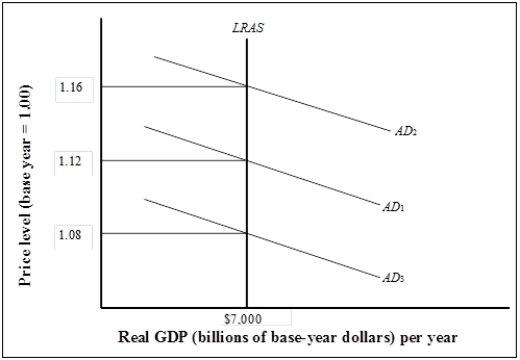 -Refer to Figure 7-2. If the real GDP is $7,000 billion and the implicit price deflator is 1.12, what is the value of nominal GDP?
 (Multiple Choice)
4.9/5 (84)
(84) Figure 7-3
-Refer to Figure 7-3. Suppose that the economy is in long-run equilibrium at point A. Now suppose the stock market crashes, significantly reducing household wealth. What happens in the long-run, all other things unchanged?
-Refer to Figure 7-3. Suppose that the economy is in long-run equilibrium at point A. Now suppose the stock market crashes, significantly reducing household wealth. What happens in the long-run, all other things unchanged? (Multiple Choice)
4.9/5 (80)
(80) As a recessionary gap is eliminated through an economy's self-correcting adjustments process,
(Multiple Choice)
4.9/5 (77)
(77) The use central bank policies to influence the level of economic activity is called
(Multiple Choice)
4.9/5 (69)
(69) During the recession of 2001, despite the decrease in aggregate demand, the price level was essentially stable. Which of the following is a reason for this?
(Multiple Choice)
4.9/5 (87)
(87) A change in the price level produces an immediate shift of the short-run aggregate supply curve.
(True/False)
4.8/5 (75)
(75) 
Filters
- Essay(0)
- Multiple Choice(0)
- Short Answer(0)
- True False(0)
- Matching(0)