



 Chat with AI
Exam 7: Aggregate Demand and Aggregate Supply

Exam 1: Economics: the Study of Choice149 Questions
Exam 3: Demand and Supply253 Questions
Exam 4: Applications of Demand and Supply117 Questions
Exam 5: Macroeconomics: the Big Picture146 Questions
Exam 6: Measuring Total Output and Income162 Questions
Exam 7: Aggregate Demand and Aggregate Supply166 Questions
Exam 8: Economic Growth135 Questions
Exam 9: The Nature and Creation of Money223 Questions
Exam 10: Financial Markets and the Economy175 Questions
Exam 11: Monetary Policy and the Fed176 Questions
Exam 12: Government and Fiscal Policy181 Questions
Exam 13: Consumption and the Aggregate Expenditures Model219 Questions
Exam 14: Investment and Economic Activity138 Questions
Exam 15: Net Exports and International Finance198 Questions
Exam 16: Inflation and Unemployment138 Questions
Exam 17: A Brief History of Macroeconomic Thought and Policy122 Questions
Exam 18: Inequality, Poverty, and Discrimination142 Questions
Exam 19: Economic Development112 Questions
Exam 20: Socialist Economies in Transition135 Questions
Select questions type


Figure 7-1 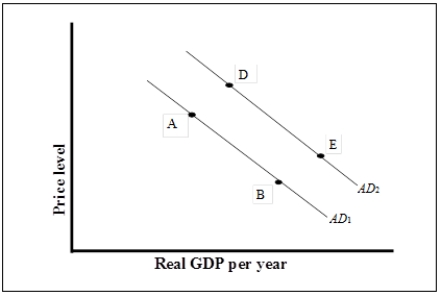 -Refer to Figure 7-1. A movement from point A to point B
 (Multiple Choice)
4.9/5  (86)
(86) A graph that depicts the relationship between the total quantity of goods and services demanded and the price level is the
(Multiple Choice)
4.9/5 (83)
(83) Suppose households become more future-oriented and decide to save more at each income level. All other things unchanged, this will
(Multiple Choice)
4.8/5 (79)
(79) When the Great Depression reached its trough in 1933, real GDP had fallen by ________ since the depression began in 1929.
(Multiple Choice)
4.9/5 (80)
(80) Figure 7-6  -Refer to Figure 7-6. Suppose the economy is initially at point A. All of the following statements are true except
 (Multiple Choice)
4.7/5 (82)
(82) As an inflationary gap is eliminated through an economy's self-correcting adjustments process,
(Multiple Choice)
4.9/5 (79)
(79) Suppose the economy is initially in long-run equilibrium. Which of the following events leads to an increase in the price level and real GDP in the short run?
(Multiple Choice)
4.8/5 (91)
(91) Figure 7-6
-Refer to Figure 7-6. Suppose the economy is initially at point A. Now suppose an increase in government purchases shifts the aggregate demand curve to AD2. What happens in the new short run?
-Refer to Figure 7-6. Suppose the economy is initially at point A. Now suppose an increase in government purchases shifts the aggregate demand curve to AD2. What happens in the new short run? (Multiple Choice)
4.9/5 (76)
(76) Using the aggregate demand-aggregate supply model, predict what happens in the short run when the consumer confidence index falls as consumers become pessimistic about their economic prospects.
(Multiple Choice)
4.7/5 (67)
(67) A movement along the short-run aggregate supply curve in response to a change in the price level is called a
(Multiple Choice)
4.9/5 (80)
(80) An increase in the prices of natural resources will lead to a decrease in short-run aggregate supply.
(True/False)
4.8/5 (80)
(80) Figure 7-7  -Refer to Figure 7-7. Suppose the economy is initially at K. Which of the following statements best explains how the economy responds to restore long-run macroeconomic equilibrium?
 (Multiple Choice)
4.8/5 (83)
(83) Public policy to eliminate a recessionary gap could involve an increase in taxes.
(True/False)
4.8/5 (89)
(89) Figure 7-2 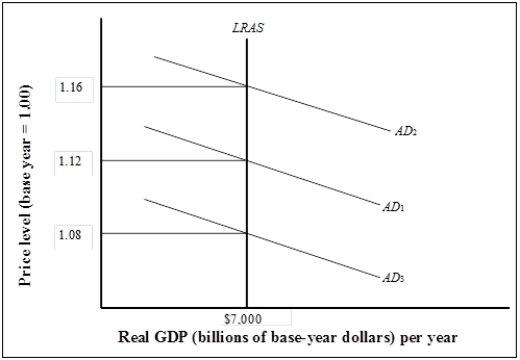 -Refer to Figure 7-2. Based on the figure, we can conclude that
 (Multiple Choice)
4.7/5 (78)
(78) If an economy is operating at its potential output level, a change in aggregate demand or short-run aggregate supply will induce an inflationary or a recessionary gap.
(True/False)
4.8/5 (82)
(82) The sticky price explanation of the short-run aggregate supply curve says that when the average price level rises,
(Multiple Choice)
4.9/5 (81)
(81) 
Filters
- Essay(0)
- Multiple Choice(0)
- Short Answer(0)
- True False(0)
- Matching(0)