



 Chat with AI
Exam 16: Inflation and Unemployment

Exam 1: Economics: the Study of Choice149 Questions
Exam 3: Demand and Supply253 Questions
Exam 4: Applications of Demand and Supply117 Questions
Exam 5: Macroeconomics: the Big Picture146 Questions
Exam 6: Measuring Total Output and Income162 Questions
Exam 7: Aggregate Demand and Aggregate Supply166 Questions
Exam 8: Economic Growth135 Questions
Exam 9: The Nature and Creation of Money223 Questions
Exam 10: Financial Markets and the Economy175 Questions
Exam 11: Monetary Policy and the Fed176 Questions
Exam 12: Government and Fiscal Policy181 Questions
Exam 13: Consumption and the Aggregate Expenditures Model219 Questions
Exam 14: Investment and Economic Activity138 Questions
Exam 15: Net Exports and International Finance198 Questions
Exam 16: Inflation and Unemployment138 Questions
Exam 17: A Brief History of Macroeconomic Thought and Policy122 Questions
Exam 18: Inequality, Poverty, and Discrimination142 Questions
Exam 19: Economic Development112 Questions
Exam 20: Socialist Economies in Transition135 Questions
Select questions type


In the early 1970s, President Nixon inherited an economy that was operating with an inflationary gap. As suggested by the Phillips curve hypothesis, policy makers instituted a combination of contractionary fiscal and monetary policies to eliminate the output gap. Which of the following occurred as a result?
(Multiple Choice)
4.7/5  (72)
(72) The theory that holds that firms may try to increase productivity by paying a wage in excess of the market-clearing wage is called the
(Multiple Choice)
4.9/5 (99)
(99) The short-run Phillips curve implies a positive relationship between inflation and unemployment.
(True/False)
4.8/5 (67)
(67) Figure 16-1 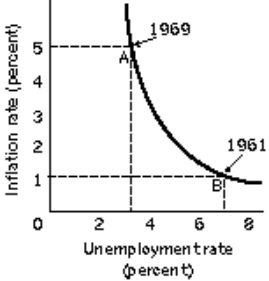 -Refer to Figure 16-1. Consider point A where inflation is relatively high and unemployment is relatively low. In order to move down the curve toward point B, what fiscal policy measures should the policymakers undertake?
 (Multiple Choice)
4.9/5 (71)
(71) Which of the following affect the values of inflation and unemployment?
I. changes in government spending
II. expectations about the price level
III. changes in nominal wages
IV. changes in money supply
(Multiple Choice)
4.8/5 (84)
(84) Which of the following economists came up with a theory regarding the tradeoff between Junemployment and inflation?
(Multiple Choice)
4.9/5 (74)
(74) The Phillips phase of the inflation-unemployment relationship emerges because
(Multiple Choice)
4.7/5 (82)
(82) Suppose an economy is operating with an inflationary gap. In this case, policymakers would Jseek to move the economy
(Multiple Choice)
4.8/5 (92)
(92) Figure 16-2 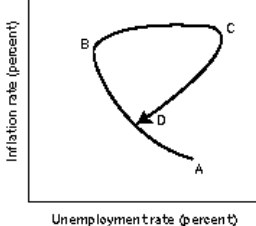 -Refer to Figure 16-2. Which of the following represents a stagflation phase?
 (Multiple Choice)
4.9/5 (88)
(88) Figure 16-8 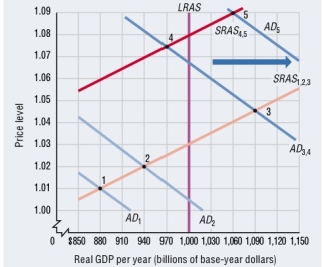 -Refer to Figure 16-8. The recessionary gap at point 4 was created
 (Multiple Choice)
4.9/5 (92)
(92) The Phillips curve hypothesis provides support for active stabilization policies. Explain in
Jwords and illustrate using a graph of aggregate-demand and aggregate supply.
(Essay)
4.9/5 (73)
(73) The Phillips phase of the inflation-unemployment relationship drives the price level
(Multiple Choice)
4.7/5 (75)
(75) Sustained inflation over many years is most likely due to increases in the money supply in
Jexcess of increases in potential output.
(True/False)
4.8/5 (81)
(81) Consider the following statement: "President Nixon expressed satisfaction with last year's economic performance. He said that with inflation and unemployment heading down, the nation 'is on the right course'. " Which of the following could have caused this phenomenon?
(Multiple Choice)
4.9/5 (78)
(78) 
Filters
- Essay(0)
- Multiple Choice(0)
- Short Answer(0)
- True False(0)
- Matching(0)