



 Chat with AI
Exam 16: Inflation and Unemployment

Exam 1: Economics: the Study of Choice149 Questions
Exam 3: Demand and Supply253 Questions
Exam 4: Applications of Demand and Supply117 Questions
Exam 5: Macroeconomics: the Big Picture146 Questions
Exam 6: Measuring Total Output and Income162 Questions
Exam 7: Aggregate Demand and Aggregate Supply166 Questions
Exam 8: Economic Growth135 Questions
Exam 9: The Nature and Creation of Money223 Questions
Exam 10: Financial Markets and the Economy175 Questions
Exam 11: Monetary Policy and the Fed176 Questions
Exam 12: Government and Fiscal Policy181 Questions
Exam 13: Consumption and the Aggregate Expenditures Model219 Questions
Exam 14: Investment and Economic Activity138 Questions
Exam 15: Net Exports and International Finance198 Questions
Exam 16: Inflation and Unemployment138 Questions
Exam 17: A Brief History of Macroeconomic Thought and Policy122 Questions
Exam 18: Inequality, Poverty, and Discrimination142 Questions
Exam 19: Economic Development112 Questions
Exam 20: Socialist Economies in Transition135 Questions
Select questions type


In a recovery phase, a falling rate of inflation means Jthat the price level is
(Multiple Choice)
4.9/5  (79)
(79) Figure 16-2 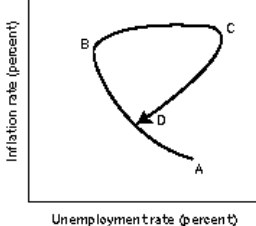 -Refer to Figure 16-2. Which of the following movements represents a Phillips phase?
 (Multiple Choice)
4.8/5 (82)
(82) What are the three phases of the inflation-unemployment cycle?
(Multiple Choice)
4.8/5 (77)
(77) 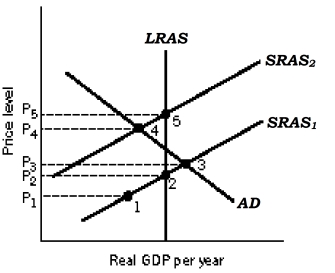 -Refer to Figure 16-7. The movement from
Figure 16-8 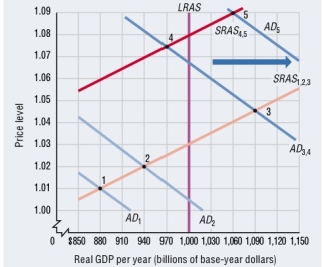 -Refer to Figure 16-8. The movement from point 4 to point 5 is consistent with which inflation-unemployment phase J?
 (Multiple Choice)
4.8/5 (79)
(79) In a stagflation phase, a decrease in short-run aggregate supply will generate
(Multiple Choice)
4.9/5 (71)
(71) In the long run, the major cause of inflation is excessive government spending.
(True/False)
4.9/5 (73)
(73) Which of the following statements is true? Economists generally agree that
(Multiple Choice)
4.8/5 (69)
(69) The lowest wage that a worker would accept if offered a job is called the subsistence wage.
(True/False)
4.7/5 (76)
(76) Which of the following predictions can be made using the growth rates associated with the equation of exchange, given that velocity is stable and that the economy moves to its potential output (YP) in the long run?
(Multiple Choice)
4.7/5 (73)
(73) Suppose the full-employment level of real GDP is increasing at a rate of 3% per period and the money supply is growing at a 3% rate. Using the equation of exchange, what is the value of the long-run inflation rate, assuming constant velocity?
(Multiple Choice)
4.9/5 (78)
(78) Which of the following is a cost of unemployment?
I. output foregone
II. unemployment compensation that must be paid
III. rising inflation that erodes the value of money
(Multiple Choice)
4.8/5 (77)
(77) Figure 16-2
-Refer to Figure 16-2. Consider the following statement: "The nation's inflation rate rose to a record high last month, the government reported yesterday. The consumer price index jumped 0.3% in January. Coupled with the announcement earlier this month that unemployment had risen by 0.5 percentage points, the reports suggested that the first month of President Nixon's second term had gotten off to a rocky start." Which of the following movements represents the statement?
-Refer to Figure 16-2. Consider the following statement: "The nation's inflation rate rose to a record high last month, the government reported yesterday. The consumer price index jumped 0.3% in January. Coupled with the announcement earlier this month that unemployment had risen by 0.5 percentage points, the reports suggested that the first month of President Nixon's second term had gotten off to a rocky start." Which of the following movements represents the statement? (Multiple Choice)
4.9/5 (71)
(71) Which of the following determines the rate of inflation in the long run?
I. the rate of money growth
II. changes in expectations about the price level
III. the rate of economic growth
IV. changes in government spending
(Multiple Choice)
5.0/5 (82)
(82) The relationship between inflation and unemployment suggested by the experience of the
J1960s was supported by the results in the U.S. economy from 1970 to 2010.
(True/False)
4.9/5 (65)
(65) In a recovery phase, a falling inflation rate means that the price level is rising by smaller and smaller percentages.
(True/False)
4.8/5 (85)
(85) A Phillips phase emerges because wages are
Jflexible and adjust more quickly than anticipated.
(True/False)
4.8/5 (80)
(80) 
Filters
- Essay(0)
- Multiple Choice(0)
- Short Answer(0)
- True False(0)
- Matching(0)