



 Chat with AI
Exam 14: Monopolistic Competition

Exam 1: What Is Economics479 Questions
Exam 2: The Economic Problem439 Questions
Exam 3: Demand and Supply515 Questions
Exam 4: Elasticity533 Questions
Exam 5: Efficiency and Equity449 Questions
Exam 6: Government Actions in Markets410 Questions
Exam 7: Global Markets in Action200 Questions
Exam 8: Utility and Demand364 Questions
Exam 9: Possibilities, Preferences, and Choices464 Questions
Exam 10: Organizing Production385 Questions
Exam 11: Output and Costs494 Questions
Exam 12: Perfect Competition487 Questions
Exam 13: Monopoly606 Questions
Exam 14: Monopolistic Competition320 Questions
Exam 15: Oligopoly280 Questions
Exam 16: Public Choices and Public Goods356 Questions
Exam 17: Externalities and the Environment284 Questions
Exam 18: Markets for Factors of Production382 Questions
Exam 19: Economic Inequality354 Questions
Exam 20: Uncertainty and Information233 Questions
Exam 21: Extension A: Review11 Questions
Exam 22: Extension B: Review25 Questions
Exam 23: Extension C: Review14 Questions
Exam 24: Extension D: Review38 Questions
Exam 25: Extension E: Review11 Questions
Exam 26: Extension F: Review18 Questions
Select questions type


 The figure shows the demand curve for Nike shoes (D), and Nike's marginal revenue curve (MR), marginal cost curve (MC), and average total cost curve (ATC).
-In the figure above, Nike's economic profit is ________.
The figure shows the demand curve for Nike shoes (D), and Nike's marginal revenue curve (MR), marginal cost curve (MC), and average total cost curve (ATC).
-In the figure above, Nike's economic profit is ________. (Multiple Choice)
4.8/5  (83)
(83) Monopolistic competition is a market in which ________ firms produce ________ goods and services.
(Multiple Choice)
4.8/5 (86)
(86) In the long run, a monopolistically competitive firm ________ make an economic profit and a monopoly ________ make an economic profit.
(Multiple Choice)
4.8/5 (81)
(81) The key feature of monopolistic competition that distinguishes it from perfect competition is
(Multiple Choice)
4.9/5 (86)
(86) In the long run, a firm in monopolistic competition has its price equal to ________ and also has its price ________.
(Multiple Choice)
4.8/5 (78)
(78) 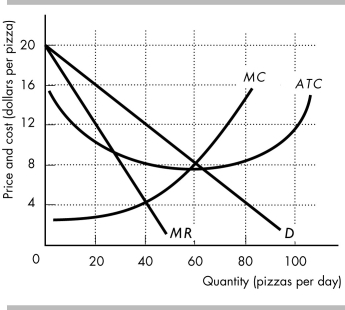 -The above figure represents Tony's Pizza Parlor, a firm in monopolistic competition.
a) What quantity will be produced?
b) What price will be charged?
c) What is Tony's total cost?
d) What is Tony's total revenue?
e) What is Tony's economic profit or loss?
f) Is this a long-run equilibrium? Why or why not?
-The above figure represents Tony's Pizza Parlor, a firm in monopolistic competition.
a) What quantity will be produced?
b) What price will be charged?
c) What is Tony's total cost?
d) What is Tony's total revenue?
e) What is Tony's economic profit or loss?
f) Is this a long-run equilibrium? Why or why not? (Essay)
4.8/5 (67)
(67) In monopolistic competition, firms sell a differentiated product. In perfect competition, firms sell an identical product. How do these markets differ as a result?
(Essay)
4.9/5 (75)
(75) Shower Power, Inc., a firm in monopolistic competition, produces shower radios. The company's economists know that it if it does not advertise, it can sell no radios at $80, and for each $10 cut in price, the quantity of radios it can sell increases by 50 a day. This relationship continues to hold until the price falls to $20. The firm's total fixed cost is $3,000 a day. Its marginal cost is constant at $20 per radio. Shower Power's economists have determined that if the firm spends $3,500 a day on advertising, it can double the quantity of radios sold at each price.
a) Draw the new demand curve faced by the firm and its new marginal revenue curve. Also draw Shower Power's marginal cost and average total cost curves.
b) If Shower Power does not advertise, what quantity of radios sold maximizes its profit? What is the profit-maximizing price? What is the firm's economic profit?
c) If Shower Power does advertise, what quantity of radios sold maximizes its profit? What is the profit-maximizing price? What is the maximum economic profit that the firm can make on its shower radios? Draw a diagram to show the effects of advertising.
d) Will Shower Power advertise? Why or why not?
(Essay)
4.8/5 (78)
(78) Which of the following firms are in a monopolistically competitive market?
(Multiple Choice)
4.8/5 (88)
(88) Firms in monopolistic competition maximize their profit by setting their price equal to their marginal revenue.
(True/False)
4.8/5 (83)
(83) In monopolistic competition in the long run, firms ________.
(Multiple Choice)
4.9/5 (87)
(87) Which characteristic is associated with monopolistic competition?
(Multiple Choice)
4.9/5 (79)
(79) Firms in monopolistic competition can make an economic profit in the long run.
(True/False)
4.8/5 (93)
(93) In the long run, monopolistically competitive firms produce where
(Multiple Choice)
4.7/5 (75)
(75) Which of the following is part of the market structure for monopolistic competition?
(Multiple Choice)
4.9/5 (74)
(74) A textbook publisher is in monopolistic competition. If the firm spends nothing on advertising, it can sell no books at $100 a book, but for each $10 cut in price, the quantity of books it can sell increases by 20 books a day. The firm's total fixed cost is $2,400 a day. Its average variable cost and marginal cost is a constant $20 per book. If the firm spends $1,200 a day on advertising, it can increase the quantity of books sold at each price by 50 percent. If the firm advertises, its maximum economic profit is
(Multiple Choice)
4.8/5 (78)
(78) Suppose that at one of the Talbot's shops, marginal cost of a coat is constant at $150, and total fixed cost is $3,000 a day. The shop maximizes its profit by selling 15 coats a day at $500 per coat. Then the shops nearby increase their advertising. The Talbot shop responds by spending $1,500 a day more on advertising its coats. As a result, its profit-maximizing number of coats sold increases to 25 a day at $400 per coat.
-In the scenario above, as a result of increased advertising, Talbot's markup:
(Multiple Choice)
4.8/5 (81)
(81) One important difference between monopoly and monopolistic competition is the
(Multiple Choice)
4.9/5 (88)
(88) 
Filters
- Essay(0)
- Multiple Choice(0)
- Short Answer(0)
- True False(0)
- Matching(0)