



 Chat with AI
Exam 14: Monopolistic Competition

Exam 1: What Is Economics479 Questions
Exam 2: The Economic Problem439 Questions
Exam 3: Demand and Supply515 Questions
Exam 4: Elasticity533 Questions
Exam 5: Efficiency and Equity449 Questions
Exam 6: Government Actions in Markets410 Questions
Exam 7: Global Markets in Action200 Questions
Exam 8: Utility and Demand364 Questions
Exam 9: Possibilities, Preferences, and Choices464 Questions
Exam 10: Organizing Production385 Questions
Exam 11: Output and Costs494 Questions
Exam 12: Perfect Competition487 Questions
Exam 13: Monopoly606 Questions
Exam 14: Monopolistic Competition320 Questions
Exam 15: Oligopoly280 Questions
Exam 16: Public Choices and Public Goods356 Questions
Exam 17: Externalities and the Environment284 Questions
Exam 18: Markets for Factors of Production382 Questions
Exam 19: Economic Inequality354 Questions
Exam 20: Uncertainty and Information233 Questions
Exam 21: Extension A: Review11 Questions
Exam 22: Extension B: Review25 Questions
Exam 23: Extension C: Review14 Questions
Exam 24: Extension D: Review38 Questions
Exam 25: Extension E: Review11 Questions
Exam 26: Extension F: Review18 Questions
Select questions type


Monopolistically competitive firms constantly develop new products in an effort to
(Multiple Choice)
4.9/5  (86)
(86) 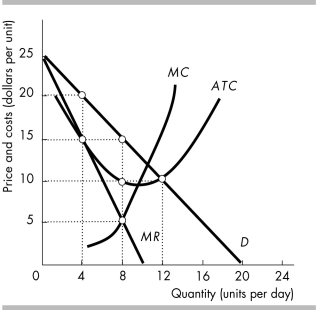 -In a monopolistically competitive industry, the firms are currently making an economic profit. When this market moves to its long-run equilibrium, the firms' demand curves will have ________ and their economic profit will have ________.
 (Multiple Choice)
4.9/5 (96)
(96) Which of the following is always true regarding a profit maximizing monopolistically competitive firm in short-run equilibrium?
(Multiple Choice)
4.8/5 (82)
(82) If in monopolistic competition in the short run, firms make ________ profits, then in the long run, new firms will enter the market. The ________ each individual firm's product will ________. In the new long-run equilibrium firms will make ________ profit.
(Multiple Choice)
4.8/5 (78)
(78) In the long run, firms in monopolistic competition have excess capacity.
(True/False)
4.8/5 (81)
(81) A textbook publisher is in monopolistic competition. If the firm spends nothing on advertising, it can sell no books at $100 a book, but for each $10 cut in price, the quantity of books it can sell increases by 20 books a day. The firm's total fixed cost is $2,400 a day. Its average variable cost and marginal cost is a constant $20 per book. If the firm spends $1,200 a day on advertising, it can increase the quantity of books sold at each price by 50 percent. If the publisher advertises, its profit maximizing price is
(Multiple Choice)
4.9/5 (81)
(81) In long-run equilibrium, a firm in monopolistic competition makes
(Multiple Choice)
4.8/5 (72)
(72) 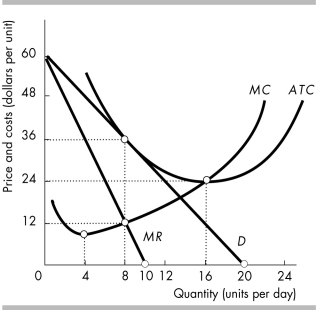 -The above figure shows a firm in monopolistic competition. At the profit maximizing level of output, excess capacity for the firm is equal to
 (Multiple Choice)
4.9/5 (76)
(76) 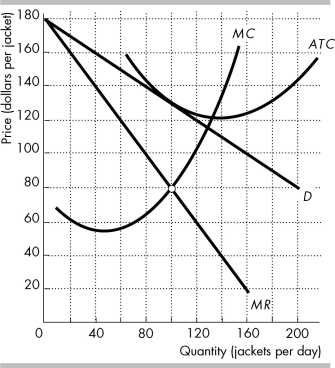 The figure shows the demand curve for Gap jackets (D), and Gap's marginal revenue curve (MR), marginal cost curve (MC), and average total cost curve (ATC).
-In the figure above, what is Gap's markup?
The figure shows the demand curve for Gap jackets (D), and Gap's marginal revenue curve (MR), marginal cost curve (MC), and average total cost curve (ATC).
-In the figure above, what is Gap's markup? (Multiple Choice)
4.8/5 (73)
(73) Define the efficient scale of production. For the situation of a firm in monopolistic competition, discuss its excess capacity.
(Essay)
4.8/5 (77)
(77) When firms in monopolistic competition incur an economic loss, some firms will
(Multiple Choice)
4.8/5 (68)
(68) In monopolistic competition, each firm's marginal revenue curve has a ________ and its demand curve has a ________.
(Multiple Choice)
4.7/5 (66)
(66) A textbook publisher is in monopolistic competition. The firm can sell no books at $100 a book, but for each $10 cut in price, the quantity of books it can sell increases by 20 books a day. The firm's average variable cost and marginal cost is a constant $20 per book. What is the publisher's profit-maximizing level of output?
(Multiple Choice)
4.8/5 (71)
(71) In monopolistic competition, firms compete on product quality, price and marketing.
(True/False)
4.7/5 (78)
(78) Advertising costs affect a firm in a monopolistic competition by increasing the firm's
(Multiple Choice)
5.0/5 (75)
(75) In the long run, firms in monopolistic competition become price takers.
(True/False)
4.9/5 (93)
(93) 
Filters
- Essay(0)
- Multiple Choice(0)
- Short Answer(0)
- True False(0)
- Matching(0)