



 Chat with AI
Exam 10: Energy

Exam 1: Concepts of Motion52 Questions
Exam 2: Kinematics in One Dimension59 Questions
Exam 3: Vectors and Coordinate Systems33 Questions
Exam 4: Kinematics in Two Dimensions50 Questions
Exam 5: Force and Motion31 Questions
Exam 6: Dynamics I: Motion Along a Line46 Questions
Exam 7: Newtons Third Law43 Questions
Exam 8: Dynamics Ii: Motion in a Plane20 Questions
Exam 9: Impulse and Momentum20 Questions
Exam 10: Energy43 Questions
Exam 11: Work100 Questions
Exam 12: Rotation of a Rigid Body113 Questions
Exam 13: Newtons Theory of Gravity50 Questions
Exam 14: Oscillations49 Questions
Exam 15: Fluids and Elasticity72 Questions
Exam 16: A Macroscopic Description of Matter29 Questions
Exam 17: Work, Heat, and the First Law of Thermodynamics98 Questions
Exam 18: The Micromacro Connection39 Questions
Exam 19: Heat Engines and Refrigerators50 Questions
Exam 20: Traveling Waves49 Questions
Exam 21: Superpositions64 Questions
Exam 22: Wave Optics51 Questions
Exam 23: Ray Optics63 Questions
Exam 24: Optical Instruments49 Questions
Exam 25: Electric Charges and Forces26 Questions
Exam 26: The Electric Field32 Questions
Exam 27: Gausss Law41 Questions
Exam 28: The Electric Potential40 Questions
Exam 29: Potential and Field57 Questions
Exam 30: Current and Resistance32 Questions
Exam 31: Fundamentals of Circuits68 Questions
Exam 32: The Magnetic Field87 Questions
Exam 33: Electromagnetic Induction66 Questions
Exam 34: Electromagnetic Fields and Waves52 Questions
Exam 35: Ac Circuits46 Questions
Exam 36: Relativity49 Questions
Exam 37: The Foundations of Modern Physics8 Questions
Exam 38: Quantization54 Questions
Exam 39: Wave Functions and Uncertainty18 Questions
Exam 40: One-Dimensional Quantum Mechanics32 Questions
Exam 41: Atomic Physics39 Questions
Exam 42: Nuclear Physics65 Questions
Select questions type


In the figure, two identical springs have unstretched lengths of 0.25 m and spring constants of 300 N/m. The springs are attached to a small cube and stretched to a length L of 0.36 m as in Figure A. An external force P pulls the cube a distance D = 0.020 m to the right and holds it there. (See Figure B.) The work done by the external force P in pulling the cube 0.020 m is closest to 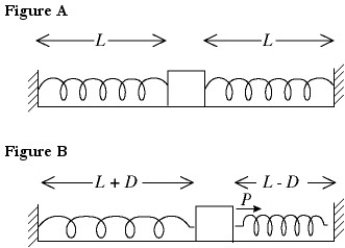
(Multiple Choice)
4.8/5  (82)
(82) In the figure, determine the character of the collision. The masses of the blocks, and the velocities before and after are given, and no other unbalanced forces act on these blocks. The collision is 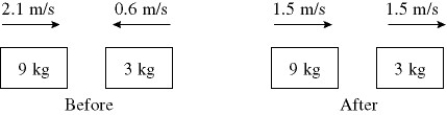
(Multiple Choice)
4.9/5 (77)
(77) An athlete stretches a spring an extra 40.0 cm beyond its initial length. How much energy has he transferred to the spring, if the spring constant is 52.9 N/cm?
(Multiple Choice)
4.8/5 (88)
(88) An 8.0-kg block is released from rest, with v1 = 0.00 m/s, on a rough incline, as shown in the figure. The block moves a distance of 1.6-m down the incline, in a time interval of 0.80 s, and acquires a velocity of v2 = 4.0 m/s. How much work does gravity do on the block during this process? 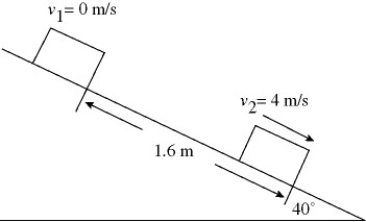
(Multiple Choice)
4.9/5 (80)
(80) A 1000.0 kg car is moving at 15 km/h. If a 2000.0 kg truck has 18 times the kinetic energy of the car, how fast is the truck moving?
(Multiple Choice)
4.9/5 (77)
(77) An object attached to an ideal massless spring is pulled across a frictionless surface. If the spring constant is 45 N/m and the spring is stretched by 0.88 m when the object is accelerating at 2.0 m/s2, what is the mass of the object?
(Multiple Choice)
4.9/5 (80)
(80) A 0.500-kg ball traveling horizontally on a frictionless surface approaches a very massive stone at 20.0 m/s perpendicular to wall and rebounds with 70.0% of its initial kinetic energy. What is the magnitude of the change in momentum of the stone?
(Multiple Choice)
4.8/5 (64)
(64) A 1.0-kg block and a 2.0-kg block are pressed together on a horizontal frictionless surface with a compressed very light spring between them. They are not attached to the spring. After they are released and have both moved free of the spring
(Multiple Choice)
4.8/5 (86)
(86) A person pushes horizontally on a heavy box and slides it across the level floor at constant velocity. The person pushes with a 60.0 N force for the first 6.88 m, at which time he begins to tire. The force he exerts then starts to decrease linearly from 60.0 N to 0.00 N across the remaining 6.88 m. How much total work did the person do on the box?
(Multiple Choice)
4.9/5 (72)
(72) A 2.00-kg object traveling east at 20.0 m/s collides with a 3.00-kg object traveling west at 10.0 m/s. After the collision, the 2.00-kg object has a velocity 5.00 m/s to the west. How much kinetic energy was lost during the collision?
(Multiple Choice)
4.7/5 (55)
(55) In the figure, two identical ideal massless springs have unstretched lengths of 0.25 m and spring constants of 700 N/m. The springs are attached to a small cube and stretched to a length L of 0.30 m as in Figure A. An external force P pulls the cube a distance D = 0.020 m to the right and holds it there. (See Figure B.) The external force P, that holds the cube in place in Figure B, is closest to 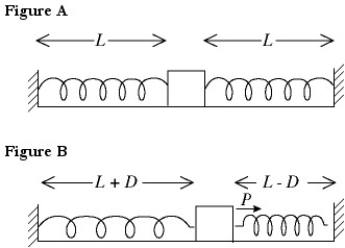
(Multiple Choice)
4.9/5 (81)
(81) A block of mass m = 8.40 kg, moving on a horizontal frictionless surface with a speed 4.20 m/s, makes a perfectly elastic collision with a block of mass M at rest. After the collision, the 8.40 block recoils with a speed of 0.400 m/s. In the figure, the blocks are in contact for 0.200 s. The magnitude of the average force on the 8.40-kg block, while the two blocks are in contact, is closest to 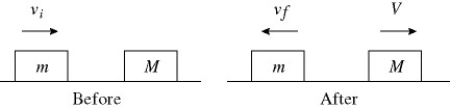
(Multiple Choice)
4.9/5 (88)
(88) Block A (0.40 kg) and block B (0.30 kg) are on a frictionless table (see figure). Spring 1 connects block A to a frictionless peg at 0 and spring 2 connects block A and block B. When the blocks are in uniform circular motion about 0, the springs have lengths of 0.60 m and 0.40 m, as shown. The springs are ideal and massless, and the linear speed of block B is 2.0 m/s. If the distance that spring 2 stretches is 0.060 m, the spring constant of spring 2 is closest to 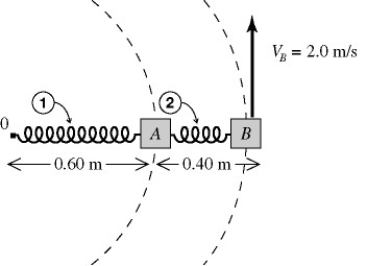
(Multiple Choice)
4.8/5 (85)
(85) A 10.0-kg shell is traveling horizontally to the right at 25.0 m/s relative to the ground when it explodes into two fragments, one of mass 3.00 kg and the other of mass 7.00 kg. The lighter fragment goes directly forward, and the explosion releases 1.50 × 10³ J of mechanical energy to the fragments. Find the magnitude and direction of the velocity of the heavier fragment relative to the ground just after the explosion. Ignore the effect of any ejected gases.
(Short Answer)
4.7/5 (73)
(73) A pool player is attempting a fancy shot. He hits the cue ball giving it a speed of 5.57 m/s and directs its center on a path tangent to the surface of the target ball having the same mass as the cue ball. After the collision (on a frictionless table) the initially-stationary ball moves with a speed of 4.82 m/s. After the collision, the new speed of the cue ball and the relative direction of the balls are closest to
(Multiple Choice)
4.9/5 (76)
(76) A 15-g bullet is shot vertically into an 2-kg block. The block lifts upward 8.0 mm (see the figure). The bullet penetrates the block and comes to rest in it in a time interval of 0.0010 s. Assume the force on the bullet is constant during penetration and that air resistance is negligible. The initial kinetic energy of the bullet is closest to 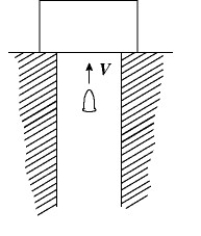
(Multiple Choice)
4.7/5 (90)
(90) Consider a plot of the displacement (x) as a function of the applied force (F) for an ideal elastic spring. The slope of the curve would be
(Multiple Choice)
4.8/5 (73)
(73) In the figure, determine the character of the collision. The masses of the blocks, and the velocities before and after are given. The collision is 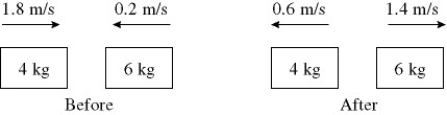
(Multiple Choice)
4.8/5 (65)
(65) A tennis ball bounces on the floor three times. If each time it loses 22.0% of its energy due to heating, how high does it rise after the third bounce, provided we released it 2.3 m from the floor?
(Multiple Choice)
4.8/5 (75)
(75) Block A (0.40 kg) and block B (0.30 kg) are on a frictionless table (see figure). Spring 1 connects block A to a frictionless peg at 0 and spring 2 connects block A and block B. When the blocks are in uniform circular motion about 0, the springs have lengths of 0.60 m and 0.40 m, as shown. The springs are ideal and massless, and the linear speed of block B is 2.0 m/s. If the spring constant of spring 1 is equal to 30 N/m, the unstretched length of spring 1 is closest to 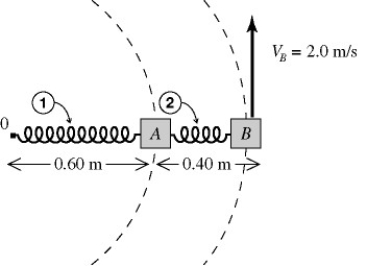
(Multiple Choice)
4.8/5 (78)
(78) 
Filters
- Essay(0)
- Multiple Choice(0)
- Short Answer(0)
- True False(0)
- Matching(0)