



 Chat with AI
Exam 12: Rotation of a Rigid Body

Exam 1: Concepts of Motion52 Questions
Exam 2: Kinematics in One Dimension59 Questions
Exam 3: Vectors and Coordinate Systems33 Questions
Exam 4: Kinematics in Two Dimensions50 Questions
Exam 5: Force and Motion31 Questions
Exam 6: Dynamics I: Motion Along a Line46 Questions
Exam 7: Newtons Third Law43 Questions
Exam 8: Dynamics Ii: Motion in a Plane20 Questions
Exam 9: Impulse and Momentum20 Questions
Exam 10: Energy43 Questions
Exam 11: Work100 Questions
Exam 12: Rotation of a Rigid Body113 Questions
Exam 13: Newtons Theory of Gravity50 Questions
Exam 14: Oscillations49 Questions
Exam 15: Fluids and Elasticity72 Questions
Exam 16: A Macroscopic Description of Matter29 Questions
Exam 17: Work, Heat, and the First Law of Thermodynamics98 Questions
Exam 18: The Micromacro Connection39 Questions
Exam 19: Heat Engines and Refrigerators50 Questions
Exam 20: Traveling Waves49 Questions
Exam 21: Superpositions64 Questions
Exam 22: Wave Optics51 Questions
Exam 23: Ray Optics63 Questions
Exam 24: Optical Instruments49 Questions
Exam 25: Electric Charges and Forces26 Questions
Exam 26: The Electric Field32 Questions
Exam 27: Gausss Law41 Questions
Exam 28: The Electric Potential40 Questions
Exam 29: Potential and Field57 Questions
Exam 30: Current and Resistance32 Questions
Exam 31: Fundamentals of Circuits68 Questions
Exam 32: The Magnetic Field87 Questions
Exam 33: Electromagnetic Induction66 Questions
Exam 34: Electromagnetic Fields and Waves52 Questions
Exam 35: Ac Circuits46 Questions
Exam 36: Relativity49 Questions
Exam 37: The Foundations of Modern Physics8 Questions
Exam 38: Quantization54 Questions
Exam 39: Wave Functions and Uncertainty18 Questions
Exam 40: One-Dimensional Quantum Mechanics32 Questions
Exam 41: Atomic Physics39 Questions
Exam 42: Nuclear Physics65 Questions
Select questions type


An extremely light rod 1.00 m long has a 2.00-kg mass attached to one end and a 3.00-kg mass attached to the other. The system rotates at a constant angular speed about a fixed axis perpendicular to the rod that passes through the rod 30.0 cm from the end with the 3.00-kg mass attached. The kinetic energy of the system is measured to be 100.0 J.
(a) What is the moment of inertia of this system about the fixed axis?
(b) What is the angular speed (in revolutions per second) of this system?
(Essay)
4.8/5  (85)
(85) When a rigid body rotates about a fixed axis, all the points in the body have the same
(Multiple Choice)
4.9/5 (89)
(89) When you ride a bicycle, in what direction is the angular velocity of the wheels?
(Multiple Choice)
5.0/5 (69)
(69) A very thin horizontal, 2.00-m long, 5.00-kg uniform beam that lies along the east-west direction is acted on by two forces. At the east end of the beam, a 200-N force pushes downward. At the west end of the beam, a 200-N force pushes upward. What is the angular acceleration of the beam?
(Multiple Choice)
4.8/5 (81)
(81) A uniform solid disk of radius 1.60 m and mass 2.30 kg rolls without slipping to the bottom of an inclined plane. If the angular velocity of the disk is 5.35 rad/s at the bottom, what is the height of the inclined plane?
(Multiple Choice)
4.9/5 (91)
(91) If two vectors point in opposite directions, their cross product must be zero.
(True/False)
4.9/5 (76)
(76) A futuristic design for a car is to have a large solid disk-shaped flywheel within the car storing kinetic energy. The uniform flywheel has mass 370 kg with a radius of 0.500 m and can rotate up to 230 rev/s. Assuming all of this stored kinetic energy could be transferred to the linear velocity of the 1600-kg\ car, find the maximum attainable speed of the car.
(Short Answer)
4.9/5 (78)
(78) For the apparatus shown in the figure, there is no slipping between the cord and the surface of the pulley. The blocks have mass of 3.0 kg and 5.7 kg, and the pulley has a radius of 0.12 m and a mass of 10.3 kg. At the instant the 5.7 kg mass has fallen 1.5 m starting from rest, find the speed of each block. (Assume the pulley is in the shape of a uniform solid disk and has no friction in its axle.) 
(Short Answer)
4.9/5 (93)
(93) Two identical ladders are 3.0 m long and weigh 600 N each. They are connected by a hinge at the top and are held together by a horizontal rope, 1.0 m above the smooth floor forming a symmetric "A" arrangement. The angle between the ladders is 60° and both ladders have their center of gravity at their midpoint. What is the tension in the rope?
(Multiple Choice)
4.8/5 (77)
(77) If two vectors are perpendicular to each other, their cross product must be zero.
(True/False)
4.9/5 (78)
(78) A uniform sign is supported against a wall at point P as shown in the figure. If the sign is a square 0.40 m on a side and its mass is 4.0 kg, what is the magnitude of the horizontal force that the wall at P experiences? 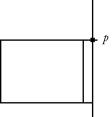
(Multiple Choice)
4.7/5 (67)
(67) A 2.00-m rod of negligible mass connects two very small objects at its ends. The mass of one object is 1.00 kg and the mass of the other is unknown. The center of mass of this system is on the rod a distance 1.60 m from the 1.00-kg mass object. What is the mass of the other object?
(Multiple Choice)
4.8/5 (81)
(81) A figure skater rotating at 5.00 rad/s with arms extended has a moment of inertia of 2.25 kg∙m2. If the arms are pulled in so the moment of inertia decreases to 1.80 kg∙m2, what is the final angular speed?
(Multiple Choice)
4.8/5 (72)
(72) When a 2.75-kg fan, having blades 18.5 cm long, is turned off, its angular speed decreases uniformly from 10.0 rad/s to 6.30 rad/s in 5.00 s.
(a) What is the magnitude of the angular acceleration of the fan?
(b) Through what angle (in degrees) does it turn while it is slowing down during the 5.00 s?
(c) If its angular acceleration does not change, how long after it is turned off does it take the fan to stop.
(Essay)
4.8/5 (85)
(85) In the figure, a uniform ladder 12 meters long rests against a vertical frictionless wall. The ladder weighs 400 N and makes an angle θ of 79° with the floor. A man weighing 790 N climbs slowly up the ladder When he has climbed to a point that is 7.8 m from the base of the ladder, the ladder starts to slip. What is the coefficient of static friction between the floor and the ladder? 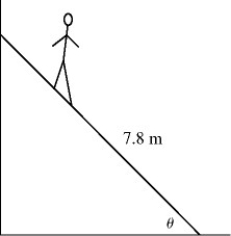
(Short Answer)
4.8/5 (78)
(78) A 72.0-kg person pushes on a small doorknob with a force of 5.00 N perpendicular to the surface of the door. The doorknob is located 0.800 m from axis of the frictionless hinges of the door. The door begins to rotate with an angular acceleration of 2.00 rad/s2. What is the moment of inertia of the door about the hinges?
(Multiple Choice)
4.9/5 (81)
(81) A 1.15-kg grinding wheel 22.0 cm in diameter is spinning counterclockwise at a rate of 20.0 revolutions per second. When the power to the grinder is turned off, the grinding wheel slows with constant angular acceleration and takes 80.0 s to come to a rest.
(a) What was the angular acceleration (in rad/s2) of the grinding wheel as it came to rest if we take a counterclockwise rotation as positive?
(b) How many revolutions did the wheel make during the time it was coming to rest?
(Essay)
4.8/5 (83)
(83) A ball is released from rest on a no-slip surface, as shown in the figure. After reaching its lowest point, the ball begins to rise again, this time on a frictionless surface as shown in the figure. When the ball reaches its maximum height on the frictionless surface, it is 
(Multiple Choice)
4.9/5 (75)
(75) A uniform solid sphere of mass M and radius R rotates with an angular speed ω about an axis through its center. A uniform solid cylinder of mass M, radius R, and length 2R rotates through an axis running through the central axis of the cylinder. What must be the angular speed of the cylinder so it will have the same rotational kinetic energy as the sphere?
(Multiple Choice)
4.8/5 (93)
(93) 
Filters
- Essay(0)
- Multiple Choice(0)
- Short Answer(0)
- True False(0)
- Matching(0)