



 Chat with AI
Exam 22: Wave Optics

Exam 1: Concepts of Motion52 Questions
Exam 2: Kinematics in One Dimension59 Questions
Exam 3: Vectors and Coordinate Systems33 Questions
Exam 4: Kinematics in Two Dimensions50 Questions
Exam 5: Force and Motion31 Questions
Exam 6: Dynamics I: Motion Along a Line46 Questions
Exam 7: Newtons Third Law43 Questions
Exam 8: Dynamics Ii: Motion in a Plane20 Questions
Exam 9: Impulse and Momentum20 Questions
Exam 10: Energy43 Questions
Exam 11: Work100 Questions
Exam 12: Rotation of a Rigid Body113 Questions
Exam 13: Newtons Theory of Gravity50 Questions
Exam 14: Oscillations49 Questions
Exam 15: Fluids and Elasticity72 Questions
Exam 16: A Macroscopic Description of Matter29 Questions
Exam 17: Work, Heat, and the First Law of Thermodynamics98 Questions
Exam 18: The Micromacro Connection39 Questions
Exam 19: Heat Engines and Refrigerators50 Questions
Exam 20: Traveling Waves49 Questions
Exam 21: Superpositions64 Questions
Exam 22: Wave Optics51 Questions
Exam 23: Ray Optics63 Questions
Exam 24: Optical Instruments49 Questions
Exam 25: Electric Charges and Forces26 Questions
Exam 26: The Electric Field32 Questions
Exam 27: Gausss Law41 Questions
Exam 28: The Electric Potential40 Questions
Exam 29: Potential and Field57 Questions
Exam 30: Current and Resistance32 Questions
Exam 31: Fundamentals of Circuits68 Questions
Exam 32: The Magnetic Field87 Questions
Exam 33: Electromagnetic Induction66 Questions
Exam 34: Electromagnetic Fields and Waves52 Questions
Exam 35: Ac Circuits46 Questions
Exam 36: Relativity49 Questions
Exam 37: The Foundations of Modern Physics8 Questions
Exam 38: Quantization54 Questions
Exam 39: Wave Functions and Uncertainty18 Questions
Exam 40: One-Dimensional Quantum Mechanics32 Questions
Exam 41: Atomic Physics39 Questions
Exam 42: Nuclear Physics65 Questions
Select questions type


In a double slit experiment, the slit separation is constructed to be exactly 4 times the wavelength of the light passing through the slits. At what angles from the center of the pattern will the third bright fringes on both sides of the central fringe occur?
(Multiple Choice)
4.8/5  (88)
(88) Two small forward-facing speakers are 2.50 m apart. They are both emitting, in phase with each other, a sound of frequency 1100 Hz in a room where the speed of sound is 344 m/s. A woman is standing opposite the midpoint between the speakers and is initially 35.0 m from the midpoint. As she slowly walks parallel to the line connecting the speakers, at what angle θ (relative to the centerline coming outward from the midpoint between the speakers) will she first hear no sound?
(Multiple Choice)
4.7/5 (88)
(88) A thin beam of laser light of wavelength 514 nm passes through a diffraction grating having 3952 lines/cm. The resulting pattern is viewed on a distant curved screen that can show all bright fringes up to and including ±90.0° from the central spot. What is the TOTAL number of bright fringes that will show up on the screen?
(Multiple Choice)
4.9/5 (93)
(93) In the two-slit experiment, monochromatic light of frequency 5.00 × 10¹⁴ Hz passes through a pair of slits separated by 2.20 × 10⁻⁵ m. (c = 3.00 × 10⁸ m/s)
(a) At what angle away from the central bright spot does the third bright fringe past the central bright spot occur?
(b) At what angle does the second dark fringe occur?
(Essay)
4.9/5 (67)
(67) A diffraction grating has 300 lines per mm. If light of wavelength 630 nm is sent through this grating, what is the highest order maximum that will appear?
(Multiple Choice)
4.7/5 (87)
(87) A slit of width 0.010 mm has light of frequency 5.0 × 10¹⁴ Hz passing through it onto a screen 60 cm away. How wide is the central maximum? (c = 3.00 × 10⁸ m/s)
(Multiple Choice)
4.8/5 (82)
(82) A light beam shines through a thin slit and illuminates a distant screen. The central bright fringe on the screen is 1.00 cm wide, as measured between the dark fringes that border it on either side. Which of the following actions would decrease the width of the central bright fringe? (There may be more than one correct choice.)
(Multiple Choice)
4.9/5 (79)
(79) A single slit, which is 0.050 mm wide, is illuminated by light of 550 nm wavelength. What is the angular separation between the first two minima on either side of the central maximum?
(Multiple Choice)
4.7/5 (76)
(76) Coherent monochromatic light of wavelength 632.8 nm passes through a pair of thin parallel slits. The figure shows the central portion of the pattern of bright fringes viewed on a screen 1.40 m beyond the slits. What is the distance between the two slits? 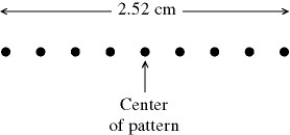
(Multiple Choice)
4.8/5 (79)
(79) An 18-mm wide diffraction grating has rulings of 880 lines per mm. Monochromatic light of 590 nm wavelength is incident normally on the grating. What is the largest angle, measured from the central bright spot, at which an intensity maximum is formed?
(Multiple Choice)
4.9/5 (77)
(77) What is the angular separation of the two second-order spectral lines having wavelengths 417 nm and 388 nm using a diffraction grating having 456 lines/mm?
(Multiple Choice)
4.8/5 (81)
(81) A single-slit diffraction pattern is formed on a distant screen. Assuming the angles involved are small, by what factor will the width of the central bright spot on the screen change if the slit width is doubled?
(Multiple Choice)
5.0/5 (89)
(89) Monochromatic laser light of frequency 5.20 × 10¹⁴ Hz is shown on a pair of thin parallel slits, and the pattern is viewed on a screen 1.20 m away. The fifth bright fringes (not counting the central fringe) occur at ±2.12 cm on either side of the central bright fringe. The entire apparatus is now immersed in a transparent liquid. When the experiment is repeated, the fifth bright fringes now occur at ±1.43 cm from the central bright fringe. (c = 3.00 × 10⁸ m/s)
(a) How far apart are the slits?
(b) What is the index of refraction of the liquid?
(Essay)
4.9/5 (78)
(78) A laser beam passes through a thin slit. When the pattern is viewed on a screen 1.25 m past the slit, you observe that the fifth-order dark fringes occur at ±2.41 cm from the central bright fringe. The entire experiment is now performed within a liquid, and you observe that each of the fifth-order dark fringes is 0.790 cm closer to the central fringe than it was in air. What is the index of refraction of this liquid?
(Multiple Choice)
4.9/5 (65)
(65) In a two-slit experiment, the slit separation is 3.00 × 10⁻⁵ m. The interference pattern is recorded on a flat screen-like detector that is 2.00 m away from the slits. If the seventh bright fringe on the detector is 10.0 cm away from the central fringe, what is the wavelength of the light passing through the slits?
(Multiple Choice)
4.8/5 (65)
(65) A single slit illuminated with a 500 nm light gives a diffraction pattern on a far screen. The 5th minimum occurs at 7.00° away from the central maximum. At what angle does the 18th minimum occur?
(Multiple Choice)
4.8/5 (81)
(81) Monochromatic light of wavelength 500 nm is incident normally on a diffraction grating. If the third-order maximum of the diffraction pattern is observed at 32.0° from the central spot, how many TOTAL number of maxima can be seen?
(Multiple Choice)
5.0/5 (72)
(72) In the figure, a slit 0.30 mm wide is illuminated by light of wavelength 426 nm. A diffraction pattern is seen on a screen 2.8 m from the slit. What is the linear distance on the screen between the first diffraction minima on either side of the central diffraction maximum? 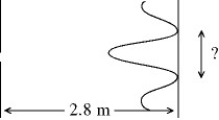
(Short Answer)
4.8/5 (82)
(82) A He-Ne laser, which produces light of wavelength 632.8 nm, is used to calibrate a diffraction grating. If the first-order maximum occurs at 20.5° from the central spot, what is the distance between the slits of the grating?
(Multiple Choice)
5.0/5 (79)
(79) A pair of narrow slits, separated by 1.8 mm, is illuminated by a monochromatic light source. Light waves arrive at the two slits in phase, and a fringe pattern is observed on a screen 4.8 m from the slits. If there are 5.0 complete bright fringes per centimeter on the screen near the center of the pattern, what is the wavelength of the monochromatic light?
(Multiple Choice)
4.9/5 (89)
(89) 
Filters
- Essay(0)
- Multiple Choice(0)
- Short Answer(0)
- True False(0)
- Matching(0)