



 Chat with AI
Exam 28: The Electric Potential

Exam 1: Concepts of Motion52 Questions
Exam 2: Kinematics in One Dimension59 Questions
Exam 3: Vectors and Coordinate Systems33 Questions
Exam 4: Kinematics in Two Dimensions50 Questions
Exam 5: Force and Motion31 Questions
Exam 6: Dynamics I: Motion Along a Line46 Questions
Exam 7: Newtons Third Law43 Questions
Exam 8: Dynamics Ii: Motion in a Plane20 Questions
Exam 9: Impulse and Momentum20 Questions
Exam 10: Energy43 Questions
Exam 11: Work100 Questions
Exam 12: Rotation of a Rigid Body113 Questions
Exam 13: Newtons Theory of Gravity50 Questions
Exam 14: Oscillations49 Questions
Exam 15: Fluids and Elasticity72 Questions
Exam 16: A Macroscopic Description of Matter29 Questions
Exam 17: Work, Heat, and the First Law of Thermodynamics98 Questions
Exam 18: The Micromacro Connection39 Questions
Exam 19: Heat Engines and Refrigerators50 Questions
Exam 20: Traveling Waves49 Questions
Exam 21: Superpositions64 Questions
Exam 22: Wave Optics51 Questions
Exam 23: Ray Optics63 Questions
Exam 24: Optical Instruments49 Questions
Exam 25: Electric Charges and Forces26 Questions
Exam 26: The Electric Field32 Questions
Exam 27: Gausss Law41 Questions
Exam 28: The Electric Potential40 Questions
Exam 29: Potential and Field57 Questions
Exam 30: Current and Resistance32 Questions
Exam 31: Fundamentals of Circuits68 Questions
Exam 32: The Magnetic Field87 Questions
Exam 33: Electromagnetic Induction66 Questions
Exam 34: Electromagnetic Fields and Waves52 Questions
Exam 35: Ac Circuits46 Questions
Exam 36: Relativity49 Questions
Exam 37: The Foundations of Modern Physics8 Questions
Exam 38: Quantization54 Questions
Exam 39: Wave Functions and Uncertainty18 Questions
Exam 40: One-Dimensional Quantum Mechanics32 Questions
Exam 41: Atomic Physics39 Questions
Exam 42: Nuclear Physics65 Questions
Select questions type


A negative charge is moved from point A to point B along an equipotential surface. Which of the following statements must be true for this case?
(Multiple Choice)
4.9/5  (75)
(75) Two large conducting parallel plates A and B are separated by 2.4 m. A uniform field of 1500 V/m, in the positive x-direction, is produced by charges on the plates. The center plane at x = 0.00 m is an equipotential surface on which V = 0. An electron is projected from x = 0.00 m, with an initial velocity of 1.0 × 10⁷ m/s perpendicular to the plates in the positive x-direction, as shown in the figure. What is the kinetic energy of the electron as it reaches plate A? (e = 1.60 × 10⁻¹⁹ C, mel = 9.11 x 10⁻³¹ kg) 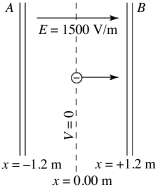
(Multiple Choice)
4.9/5 (75)
(75) Four point charges of magnitude 6.00 μC and of varying signs are placed at the corners of a square 2.00 m on each side, as shown in the figure. (k = 1/4πε0 = 8.99 × 10⁹ N ∙ m2/C2)
(a) What is the electric potential (relative to infinity) at the center of this square due to these charges?
(b) What is the magnitude of the electric field due to these charges at the center of the square? 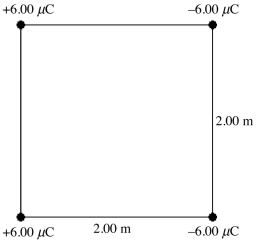
(Essay)
4.9/5 (78)
(78) An electron is released from rest at a distance of 9.00 cm from a proton. If the proton is held in place, how fast will the electron be moving when it is 3.00 cm from the proton? (mel = 9.11 x 10⁻³¹ kg, e = 1.60 × 10⁻¹⁹ C, k = 1/4πε0 = 8.99 × 10⁹ N ∙ m2/C2)
(Multiple Choice)
4.9/5 (79)
(79) If the electric field is zero everywhere inside a region of space, the potential must also be zero in that region.
(True/False)
4.9/5 (76)
(76) Four equal +6.00-μC point charges are placed at the corners of a square 2.00 m on each side. (k = 1/4πε0 = 8.99 × 10⁹ N ∙ m2/C2)
(a) What is the electric potential (relative to infinity) due to these charges at the center of this square?
(b) What is the magnitude of the electric field due to these charges at the center of the square?
(Essay)
4.8/5 (73)
(73) A -7.0-μC point charge has a positively charged object in an elliptical orbit around it. If the mass of the positively charged object is 1.0 kg and the distance varies from 5.0 mm to 20.0 mm between the charges, what is the maximum electric potential difference through which the positive object moves?
(k = 1/4πε0 = 8.99 × 10⁹ N ∙ m2/C2)
(Multiple Choice)
4.8/5 (72)
(72) Which statements are true for an electron moving in the direction of an electric field? (There may be more than one correct choice.)
(Multiple Choice)
4.9/5 (79)
(79) A charge Q = -820 nC is uniformly distributed on a ring of 2.4 m radius. A point charge q = +530 nC is fixed at the center of the ring. Points A and B are located on the axis of the ring, as shown in the figure. What is the minimum work that an external force must do to transport an electron from B to A?
(e = 1.60 × 10⁻¹⁹ C, k = 1/4πε0 = 8.99 × 10⁹ N ∙ m2/C2) 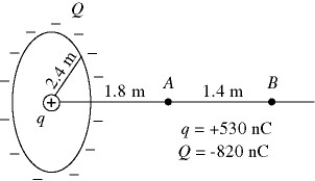
(Multiple Choice)
4.7/5 (91)
(91) Three point charges of -2.00 μC, +4.00 μC, and +6.00 μC are placed along the x-axis as shown in the figure. What is the electrical potential at point P (relative to infinity) due to these charges? (k = 1/4πε0 = 8.99 × 10⁹ N ∙ m2/C2) 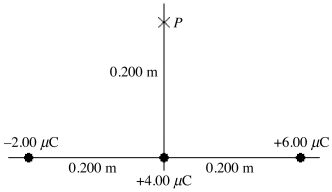
(Multiple Choice)
5.0/5 (68)
(68) If the electric potential at a point in space is zero, then the electric field at that point must also be zero.
(True/False)
4.8/5 (95)
(95) A tiny object carrying a charge of +3.00 μC and a second tiny charged object are initially very far apart. If it takes 29.0 J of work to bring them to a final configuration in which the +3.0.0-μC object i is at x = 1.00 mm, y = 1.00 mm, and the other charged object is at x = 1.00 mm, y = 3.00 mm, find the magnitude of the charge on the second object. (k = 1/4πε0 = 8.99 × 10⁹ N ∙ m2/C2)
(Multiple Choice)
4.9/5 (75)
(75) Two parallel conducting plates are separated by 1.0 mm and carry equal but opposite surface charge densities. If the potential difference between them is 2.0 V, what is the magnitude of the surface charge density on each plate? (ε0 = 8.85 × 10⁻¹² C2/N ∙ m2)
(Multiple Choice)
4.8/5 (68)
(68) When the electric field is zero at a point, the potential must also be zero there.
(True/False)
4.9/5 (73)
(73) Two point charges of +1.0 μC and -2.0 μC are located 0.50 m apart. What is the minimum amount of work needed to move the charges apart to double the distance between them? (k = 1/4πε0 = 8.99 × 10⁹ N ∙ m2/C2)
(Multiple Choice)
4.9/5 (84)
(84) An alpha particle is a nucleus of helium. It has twice the charge and four times the mass of the proton. When they were very far away from each other, but headed toward directly each other, a proton and an alpha particle each had an initial speed of 0.0030c, where c is the speed of light. What is their distance of closest approach? Hint: There are two conserved quantities. Make use of both of them.
(c = 3.00 × 10⁸ m/s, k = 1/4πε0 = 8.99 × 10⁹ N ∙ m2/C2, e = 1.60 × 10⁻¹⁹ C, mproton = 1.67 x 10⁻²⁷ kg)
(Multiple Choice)
4.8/5 (83)
(83) Two positive point charges +4.00 μC and +2.00 μC are placed at the opposite corners of a rectangle as shown in the figure. (k = 1/4πε0 = 8.99 × 10⁹ N ∙ m2/C2) 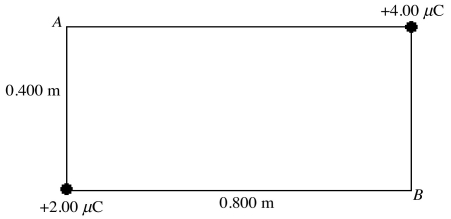 (a) What is the potential at point A (relative to infinity) due to these charges?
(b) What is the potential at point B (relative to infinity) due to these charges?
(a) What is the potential at point A (relative to infinity) due to these charges?
(b) What is the potential at point B (relative to infinity) due to these charges? (Essay)
4.9/5 (73)
(73) A charge Q = -610 nC is uniformly distributed on a ring of 2.4-m radius. A point charge q = +480 nC is fixed at the center of the ring, as shown in the figure. An electron is projected from infinity toward the ring along the axis of the ring. This electron comes to a momentary halt at a point on the axis that is 5.0 m from the center of the ring. What is the initial speed of the electron at infinity? (e = 1.60 × 10⁻¹⁹ C, k = 1/4πε0 = 8.99 × 10⁹ N ∙ m2/C2, mel = 9.11 x 10⁻³¹ kg) 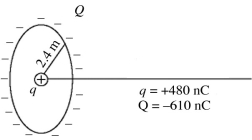
(Multiple Choice)
4.7/5 (78)
(78) The figure shows two arcs of a circle on which charges +Q and -Q have been spread uniformly. What is the value of the electric potential at the center of the circle? 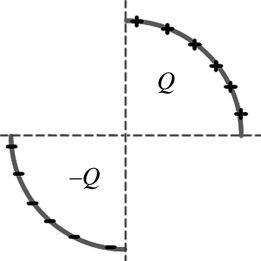
(Short Answer)
4.8/5 (83)
(83) 
Filters
- Essay(0)
- Multiple Choice(0)
- Short Answer(0)
- True False(0)
- Matching(0)