



 Chat with AI
Exam 29: Potential and Field

Exam 1: Concepts of Motion52 Questions
Exam 2: Kinematics in One Dimension59 Questions
Exam 3: Vectors and Coordinate Systems33 Questions
Exam 4: Kinematics in Two Dimensions50 Questions
Exam 5: Force and Motion31 Questions
Exam 6: Dynamics I: Motion Along a Line46 Questions
Exam 7: Newtons Third Law43 Questions
Exam 8: Dynamics Ii: Motion in a Plane20 Questions
Exam 9: Impulse and Momentum20 Questions
Exam 10: Energy43 Questions
Exam 11: Work100 Questions
Exam 12: Rotation of a Rigid Body113 Questions
Exam 13: Newtons Theory of Gravity50 Questions
Exam 14: Oscillations49 Questions
Exam 15: Fluids and Elasticity72 Questions
Exam 16: A Macroscopic Description of Matter29 Questions
Exam 17: Work, Heat, and the First Law of Thermodynamics98 Questions
Exam 18: The Micromacro Connection39 Questions
Exam 19: Heat Engines and Refrigerators50 Questions
Exam 20: Traveling Waves49 Questions
Exam 21: Superpositions64 Questions
Exam 22: Wave Optics51 Questions
Exam 23: Ray Optics63 Questions
Exam 24: Optical Instruments49 Questions
Exam 25: Electric Charges and Forces26 Questions
Exam 26: The Electric Field32 Questions
Exam 27: Gausss Law41 Questions
Exam 28: The Electric Potential40 Questions
Exam 29: Potential and Field57 Questions
Exam 30: Current and Resistance32 Questions
Exam 31: Fundamentals of Circuits68 Questions
Exam 32: The Magnetic Field87 Questions
Exam 33: Electromagnetic Induction66 Questions
Exam 34: Electromagnetic Fields and Waves52 Questions
Exam 35: Ac Circuits46 Questions
Exam 36: Relativity49 Questions
Exam 37: The Foundations of Modern Physics8 Questions
Exam 38: Quantization54 Questions
Exam 39: Wave Functions and Uncertainty18 Questions
Exam 40: One-Dimensional Quantum Mechanics32 Questions
Exam 41: Atomic Physics39 Questions
Exam 42: Nuclear Physics65 Questions
Select questions type


An air-filled capacitor stores a potential energy of 6.00 mJ due to its charge. It is accidentally filled with water in such a way as not to discharge its plates. How much energy does it continue to store after it is filled? (The dielectric constant for water is 78 and for air it is 1.0006.)
(Multiple Choice)
4.7/5  (85)
(85) Three capacitors are connected as shown in the figure. What is the equivalent capacitance between points a and b? 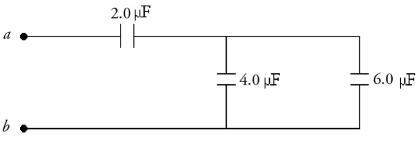
(Multiple Choice)
4.8/5 (70)
(70) An ideal air-filled parallel-plate capacitor has round plates and carries a fixed amount of equal but opposite charge on its plates. All the geometric parameters of the capacitor (plate diameter and plate separation) are now DOUBLED. If the original capacitance was C0, what is the new capacitance?
(Multiple Choice)
4.8/5 (78)
(78) Two capacitors of capacitance 6.00 μF and 8.00 μF are connected in parallel. The combination is then connected in series with a 12.0-V voltage source and a 14.0-μF capacitor, as shown in the figure. 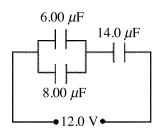 (a) What is the equivalent capacitance of this combination?
(b) What is the charge on the 6.00-μF capacitor?
(c) What is the potential difference across the 6.00-μF capacitor?
(a) What is the equivalent capacitance of this combination?
(b) What is the charge on the 6.00-μF capacitor?
(c) What is the potential difference across the 6.00-μF capacitor? (Essay)
5.0/5 (79)
(79) Three capacitors, with capacitances C1 = 4.0 μF, C2 = 3.0 μF, and C3 = 2.0 μF, are connected to a 12 -V voltage source, as shown in the figure. What is the charge on capacitor C2? 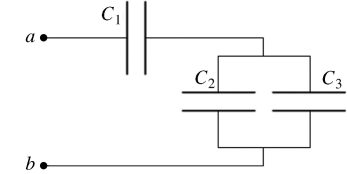
(Multiple Choice)
4.9/5 (65)
(65) Equal but opposite charges Q are placed on the square plates of an air-filled parallel-plate capacitor. The plates are then pulled apart to twice their original separation, which is small compared to the dimensions of the plates. Which of the following statements about this capacitor are true? (There may be more than one correct choice.)
(Multiple Choice)
4.7/5 (90)
(90) The capacitive network shown in the figure is assembled with initially uncharged capacitors. A potential difference, Vab = +100V, is applied across the network. The switch S in the network is kept open. Assume that all the capacitances shown are accurate to two significant figures. What is the total energy stored in the seven capacitors? 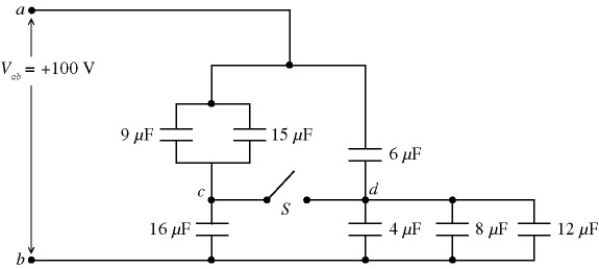
(Multiple Choice)
4.9/5 (96)
(96) A 6.0-μF air-filled capacitor is connected across a 100-V voltage source. After the source fully charges the capacitor, the capacitor is immersed in transformer oil (of dielectric constant 4.5). How much ADDITIONAL charge flows from the voltage source, which remained connected during the process?
(Multiple Choice)
4.8/5 (86)
(86) The graph in the figure shows the variation of the electric potential V(x) (in arbitrary units) as a function of the position x (also in arbitrary units). Which of the choices below correctly describes the orientation of the x-component of the electric field along the x-axis? 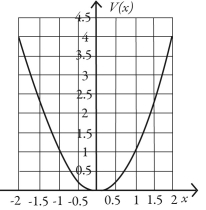
(Multiple Choice)
4.8/5 (75)
(75) In the circuit shown in the figure, all the capacitors are air-filled. With the switch S open, the 40.0-µF capacitor has an initial charge of 5.00 µC while the other three capacitors are uncharged. The switch is then closed and left closed for a long time. Calculate the initial and final values of the total electrical energy stored in these four capacitors. 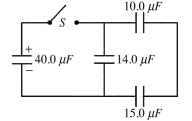
(Essay)
4.9/5 (83)
(83) If the potential in a region is given by V(x,y,z) = xy - 3z-2, then the y component of the electric field in that region is
(Multiple Choice)
4.9/5 (69)
(69) A charge of 2.00 μC flows onto the plates of a capacitor when it is connected to a 12.0-V potential source. What is the minimum amount of work that must be done in charging this capacitor?
(Multiple Choice)
4.9/5 (80)
(80) Five capacitors are connected across a potential difference Vab as shown in the figure. Because of the dielectrics used, each capacitor will break down if the potential across it exceeds 30.0 V. The largest that Vab can be without damaging any of the capacitors is closest to 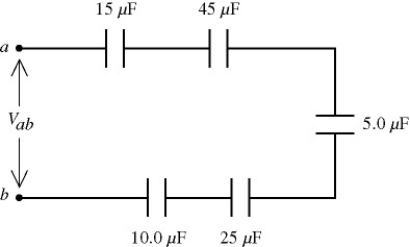
(Multiple Choice)
4.8/5 (76)
(76) A nonconducting sphere contains positive charge distributed uniformly throughout its volume. Which statements about the potential due to this sphere are true? All potentials are measured relative to infinity. (There may be more than one correct choice.)
(Multiple Choice)
4.7/5 (87)
(87) The potential as a function of position x is shown in the graph in the figure. Which statement about the electric field is true? 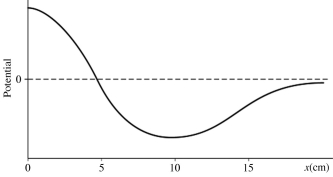
(Multiple Choice)
4.8/5 (89)
(89) Each plate of an air-filled parallel-plate air capacitor has an area of 0.0040 m2, and the separation of the plates is 0.080 mm. An electric field of 5.3 × 10⁶ V/m is present between the plates. What is the energy density between the plates? (ε0 = 8.85 × 10⁻¹² C2/N ∙ m2)
(Multiple Choice)
4.7/5 (77)
(77) Four capacitors are connected across a 90-V voltage source as shown in the figure. 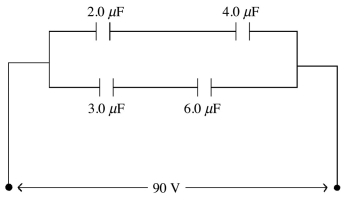 (a) What is the charge on the 4.0-μF capacitor?
(b) What is the charge on a 2.0-μF capacitor?
(c) What is the charge on the 3.0-μF capacitor?
(d) What is the potential difference across the 6.0-μF capacitor?
(a) What is the charge on the 4.0-μF capacitor?
(b) What is the charge on a 2.0-μF capacitor?
(c) What is the charge on the 3.0-μF capacitor?
(d) What is the potential difference across the 6.0-μF capacitor? (Essay)
4.8/5 (82)
(82) 
Filters
- Essay(0)
- Multiple Choice(0)
- Short Answer(0)
- True False(0)
- Matching(0)