



 Chat with AI
Exam 3: Vectors and Coordinate Systems

Exam 1: Concepts of Motion52 Questions
Exam 2: Kinematics in One Dimension59 Questions
Exam 3: Vectors and Coordinate Systems33 Questions
Exam 4: Kinematics in Two Dimensions50 Questions
Exam 5: Force and Motion31 Questions
Exam 6: Dynamics I: Motion Along a Line46 Questions
Exam 7: Newtons Third Law43 Questions
Exam 8: Dynamics Ii: Motion in a Plane20 Questions
Exam 9: Impulse and Momentum20 Questions
Exam 10: Energy43 Questions
Exam 11: Work100 Questions
Exam 12: Rotation of a Rigid Body113 Questions
Exam 13: Newtons Theory of Gravity50 Questions
Exam 14: Oscillations49 Questions
Exam 15: Fluids and Elasticity72 Questions
Exam 16: A Macroscopic Description of Matter29 Questions
Exam 17: Work, Heat, and the First Law of Thermodynamics98 Questions
Exam 18: The Micromacro Connection39 Questions
Exam 19: Heat Engines and Refrigerators50 Questions
Exam 20: Traveling Waves49 Questions
Exam 21: Superpositions64 Questions
Exam 22: Wave Optics51 Questions
Exam 23: Ray Optics63 Questions
Exam 24: Optical Instruments49 Questions
Exam 25: Electric Charges and Forces26 Questions
Exam 26: The Electric Field32 Questions
Exam 27: Gausss Law41 Questions
Exam 28: The Electric Potential40 Questions
Exam 29: Potential and Field57 Questions
Exam 30: Current and Resistance32 Questions
Exam 31: Fundamentals of Circuits68 Questions
Exam 32: The Magnetic Field87 Questions
Exam 33: Electromagnetic Induction66 Questions
Exam 34: Electromagnetic Fields and Waves52 Questions
Exam 35: Ac Circuits46 Questions
Exam 36: Relativity49 Questions
Exam 37: The Foundations of Modern Physics8 Questions
Exam 38: Quantization54 Questions
Exam 39: Wave Functions and Uncertainty18 Questions
Exam 40: One-Dimensional Quantum Mechanics32 Questions
Exam 41: Atomic Physics39 Questions
Exam 42: Nuclear Physics65 Questions
Select questions type


You walk 55 m to the north, then turn 60° to your right and walk another 45 m. How far are you from where you originally started?
(Multiple Choice)
4.8/5  (71)
(71) For the vectors shown in the figure, express vector  in terms of vectors
 and
 .
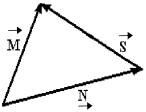
in terms of vectors
and
. (Essay)
4.9/5 (75)
(75) A teacher sends her students on a treasure hunt. She gives the following instructions:
1. Walk 300 m north
2. Walk 400 m northwest
3. Walk 700 m east-southeast and the treasure is buried there.
As all the other students walk off following the instructions, Jane physics student quickly adds the displacements and walks in a straight line to find the treasure. How far and in what direction does Jane need to walk?
(Multiple Choice)
4.8/5 (93)
(93) If the eastward component of vector  is equal to the westward component of vector
 And their northward components are equal. Which one of the following statements about these two vectors is correct?
is equal to the westward component of vector
And their northward components are equal. Which one of the following statements about these two vectors is correct? (Multiple Choice)
4.8/5 (77)
(77) An airplane undergoes the following displacements: First, it flies 66 km in a direction 30° east of north. Next, it flies 49 km due south. Finally, it flies 100 km 30° north of west. Using vector components, determine how far the airplane ends up from its starting point.
(Multiple Choice)
4.8/5 (65)
(65) An apple falls from an apple tree growing on a 20° slope. The apple hits the ground with an impact velocity of 16.2 m/s straight downward. What is the component of the apple's impact velocity parallel to the surface of the slope?
(Multiple Choice)
4.9/5 (87)
(87) A helicopter is flying horizontally with a speed of 444 m/s over a hill that slopes upward with a 2% grade (that is, the "rise" is 2% of the "run"). What is the component of the helicopter's velocity perpendicular to the sloping surface of the hill?
(Multiple Choice)
4.9/5 (74)
(74) If  = +4
 - 2
 - 3
 And
 = -4
 -2
 - 3
 , which of the following numbers is closest to the magnitude of
 -
 ?
= +4
- 2
- 3
And
= -4
-2
- 3
, which of the following numbers is closest to the magnitude of
-
? (Multiple Choice)
4.9/5 (84)
(84)  -
 | = A + B?
As shown in the figure, three force vectors act on an object. The magnitudes of the forces as shown in the figure are  = 80.0 N,
 = 60.0 N, and
 = 40.0 N, where N is the standard SI unit of force. The resultant force acting on the object is given by
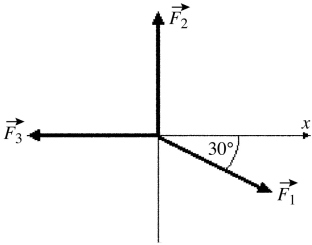
= 80.0 N,
= 60.0 N, and
= 40.0 N, where N is the standard SI unit of force. The resultant force acting on the object is given by (Multiple Choice)
4.7/5 (84)
(84) If all the components of a vector are equal to 1, then that vector is a unit vector.
(True/False)
4.9/5 (87)
(87) Vector  has a magnitude of 75.0 cm and points at 30° above the positive x-axis. Vector
 has a magnitude of 25.0 cm and points along the negative x-axis. Vector
 has a magnitude of 40.0 cm and points at 45° below the negative x-axis.
(a) Determine the x and y components of Vector
 .
(b) Determine the x and y components of Vector
 .
(c) Determine the x and y components of Vector
 .
(d) Determine x and y components of the sum of these three vectors.
(e) Determine the magnitude and direction of the sum of these three vectors.
has a magnitude of 75.0 cm and points at 30° above the positive x-axis. Vector
has a magnitude of 25.0 cm and points along the negative x-axis. Vector
has a magnitude of 40.0 cm and points at 45° below the negative x-axis.
(a) Determine the x and y components of Vector
.
(b) Determine the x and y components of Vector
.
(c) Determine the x and y components of Vector
.
(d) Determine x and y components of the sum of these three vectors.
(e) Determine the magnitude and direction of the sum of these three vectors. (Essay)
5.0/5 (79)
(79) 
Filters
- Essay(0)
- Multiple Choice(0)
- Short Answer(0)
- True False(0)
- Matching(0)