



 Chat with AI
Exam 30: Current and Resistance

Exam 1: Concepts of Motion52 Questions
Exam 2: Kinematics in One Dimension59 Questions
Exam 3: Vectors and Coordinate Systems33 Questions
Exam 4: Kinematics in Two Dimensions50 Questions
Exam 5: Force and Motion31 Questions
Exam 6: Dynamics I: Motion Along a Line46 Questions
Exam 7: Newtons Third Law43 Questions
Exam 8: Dynamics Ii: Motion in a Plane20 Questions
Exam 9: Impulse and Momentum20 Questions
Exam 10: Energy43 Questions
Exam 11: Work100 Questions
Exam 12: Rotation of a Rigid Body113 Questions
Exam 13: Newtons Theory of Gravity50 Questions
Exam 14: Oscillations49 Questions
Exam 15: Fluids and Elasticity72 Questions
Exam 16: A Macroscopic Description of Matter29 Questions
Exam 17: Work, Heat, and the First Law of Thermodynamics98 Questions
Exam 18: The Micromacro Connection39 Questions
Exam 19: Heat Engines and Refrigerators50 Questions
Exam 20: Traveling Waves49 Questions
Exam 21: Superpositions64 Questions
Exam 22: Wave Optics51 Questions
Exam 23: Ray Optics63 Questions
Exam 24: Optical Instruments49 Questions
Exam 25: Electric Charges and Forces26 Questions
Exam 26: The Electric Field32 Questions
Exam 27: Gausss Law41 Questions
Exam 28: The Electric Potential40 Questions
Exam 29: Potential and Field57 Questions
Exam 30: Current and Resistance32 Questions
Exam 31: Fundamentals of Circuits68 Questions
Exam 32: The Magnetic Field87 Questions
Exam 33: Electromagnetic Induction66 Questions
Exam 34: Electromagnetic Fields and Waves52 Questions
Exam 35: Ac Circuits46 Questions
Exam 36: Relativity49 Questions
Exam 37: The Foundations of Modern Physics8 Questions
Exam 38: Quantization54 Questions
Exam 39: Wave Functions and Uncertainty18 Questions
Exam 40: One-Dimensional Quantum Mechanics32 Questions
Exam 41: Atomic Physics39 Questions
Exam 42: Nuclear Physics65 Questions
Select questions type


When a potential difference of 10 V is placed across a certain solid cylindrical resistor, the current through it is 2 A. If the diameter of this resistor is now tripled, the current will be
(Multiple Choice)
4.9/5  (89)
(89) The diameter of a 12-gauge copper wire is 0.081 in. The maximum safe current it can carry (in order to prevent fire danger in building construction) is 20 A. At this current, what is the drift velocity of the electrons? The number of electron carriers in 1.0 cm3 of copper is 8.5 × 10²² and e = 1.60 × 10⁻¹⁹ C.
(Multiple Choice)
4.8/5 (76)
(76) A certain fuse "blows" if the current in it exceeds 1.0 A, at which instant the fuse melts with a current density of 620 A/cm2. What is the diameter of the wire in the fuse?
(Multiple Choice)
4.9/5 (73)
(73) In an electroplating process, copper (ionic charge +2e, atomic weight 63.6 g/mol) is deposited using a current of 10.0 A. What mass of copper is deposited in 10.0 minutes? Avogadro's number is 6.022 × 10²³ molecules/mol and e = 1.60 × 10⁻¹⁹ C.
(Multiple Choice)
4.8/5 (90)
(90) The figure shows a 2.0-cm diameter roller that turns at 90 rpm. A 4.0-cm wide plastic film is being wrapped onto the roller, and this plastic carries an excess electric charge having a uniform surface charge density of 5.0 nC/cm2. What is the current of the moving film? 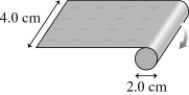
(Multiple Choice)
4.9/5 (81)
(81) Nichrome wire, often used for heating elements, has resistivity of 1.0 × 10⁻⁶ Ω ∙ m at room temperature. What length of No. 30 wire (of diameter 0.250 mm) is needed to wind a resistor that has 50 ohms at room temperature?
(Multiple Choice)
5.0/5 (74)
(74) When a voltage difference is applied to a piece of metal wire, a 5.0-mA current flows through it. If this metal wire is now replaced with a silver wire having twice the diameter of the original wire, how much current will flow through the silver wire? The lengths of both wires are the same, and the voltage difference remains unchanged. (The resistivity of the original metal is 1.68 × 10⁻⁸ Ω ∙ m, and the resistivity of silver is 1.59 × 10⁻⁸ Ω ∙ m.)
(Multiple Choice)
4.8/5 (82)
(82) A wire has a cross-sectional area of 0.10 mm2. If there are 4.0 × 1028 atoms per cubic meter in this wire, and if each atom contributes 2 free electrons, what is the drift velocity of the electrons when the current in the wire is 6.0 A? (e = 1.60 × 10⁻¹⁹ C)
(Multiple Choice)
4.8/5 (79)
(79) If the current density in a wire or radius R is given by J = kr, 0 < r < R, what is the current in the wire?
(Multiple Choice)
4.8/5 (71)
(71) Calculate the current through a 10.0-m long 22 gauge (having radius 0.321 mm) nichrome wire if it is connected to a 12.0-V battery. The resistivity of nichrome is 100 × 10-8 Ω ∙ m.
(Multiple Choice)
4.8/5 (87)
(87) Building codes usually limit the current carried by a No. 14 copper wire to 15 A. Many household circuits are wired with this size wire. What is the drift velocity of the electrons in this case? The diameter of this wire is 1.6 mm. Assume one conduction electron per atom in copper. The atomic weight of copper is 63.3 g/mol and its density is 8900 kg/m3. Avogadro's number is 6.022 × 10²³ molecules/mol and e = 1.60 × 10⁻¹⁹ C.
(Multiple Choice)
4.7/5 (84)
(84) A silver wire with resistivity 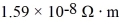 carries a current density of 4.0 mm2. What is the magnitude of the electric field inside the wire?
 (Multiple Choice)
4.9/5 (76)
(76) 
Filters
- Essay(0)
- Multiple Choice(0)
- Short Answer(0)
- True False(0)
- Matching(0)